What can artefacts tell us about groups of people in Scotland’s past?
It’s a question posed to archaeologists early in their studies. Do pots equal people? Or more specifically, do objects (or groups of objects) reflect groups of people (whether cultural, political or ethnic groups)? Can objects help us track where different groups of people lived in the past?
The answer may seem simple enough but take Roman pottery found in Scotland as an example; did Roman people use it, was it used by locals wanting to be Roman, or was it traded to, stolen by or found by other people? And what do we even mean when we say ‘Roman’?
The more archaeologists look at artefacts from the past, the more complicated the picture becomes!
Early Medieval Identities
We often think about identities in the past as fixed and unchanging: people were Vikings or Northumbrians, Romans or Picts. But people, communities and societies were as complex as those today, and cultural identity could be just as fluid.
Archaeologists understand identity as an active process where your identity is created by what you do and what you display. Physical objects can play an active role in building identity. By using and making objects associated with a certain group, people can build up an understanding of themselves as part of that group. And through using and displaying different kinds of objects, people can associate themselves with different groups over their lifetime.
We can also see people use these identity markers in different ways, sometimes forming new group identities. Just as the modern goth subculture pulled together elements (like clothing, jewellery and hair) from the existing punk and glam movements and combined them with elements from gothic literature, new identities can be formed by mixing the styles of existing groups.
So how can we use physical objects to understand identity in the early medieval period? Rather than broad groups like ‘Northumbrians’ and ‘Vikings’, it might be more helpful to think about identities in the past as a package of traits which you could choose to take up at different points in your life. Historical documents might suggest people belonged to different cultural groups, but there are layers of complexity to these identities that the documents might miss which can be explored through artefacts.
Identities of the Galloway Hoard
A good example of a group of artefacts which demonstrate the complicated identities of people in the past is the Galloway Hoard, which was buried at Balmaghie in Southwest Scotland around the year AD 900 (some 1,100 years ago).
At this time, Galloway was at the edge of multiple different territories, where different groups of people interacted with each other. We can see this interaction through the languages preserved in the place-names of Galloway. These place-names tell us that in Galloway people were speaking Old English (and probably came from the Northumbrian kingdom, which much of Galloway was a part of in the 9th century). But they were also speaking Old Norse (from Scandinavia), Gaelic (originally from Ireland) and Northern Brittonic, which had been spoken in Galloway for hundreds of years before any of these other languages. Some place-names even include elements from multiple languages! We can see some of these different groups represented within the hoard itself.
At the time the hoard was buried, big political and societal changes were happening in Galloway. It’s very difficult to understand exactly what was going on, as very few written records from this time still exist. We can, however, turn to artefacts to try to find out more about this period and the early medieval people living here.

The Galloway Hoard pectoral cross, with Trewhiddle style gold and niello decoration (© National Museums Scotland)
Northumbrian Connections
We can start by looking at different decorative styles which were created by particular groups of people. For example, one style which can be seen on many silver objects in the Galloway Hoard is Trewhiddle style. This type of decoration is named after a hoard found in Cornwall, at the southern end of Britain, and is found on metal artefacts from the 9th and early 10th centuries in the kingdoms which would eventually become England. One of these kingdoms is Northumbria which also included most of Galloway in the 8th century.
A beautiful example of the Trewhiddle style can be found on the pectoral cross in the Galloway Hoard, which would’ve been worn on a chain and sat on the wearer’s chest. It was made from silver and decorated with gold and niello, a mixture of metal and sulphur which creates clean black lines.
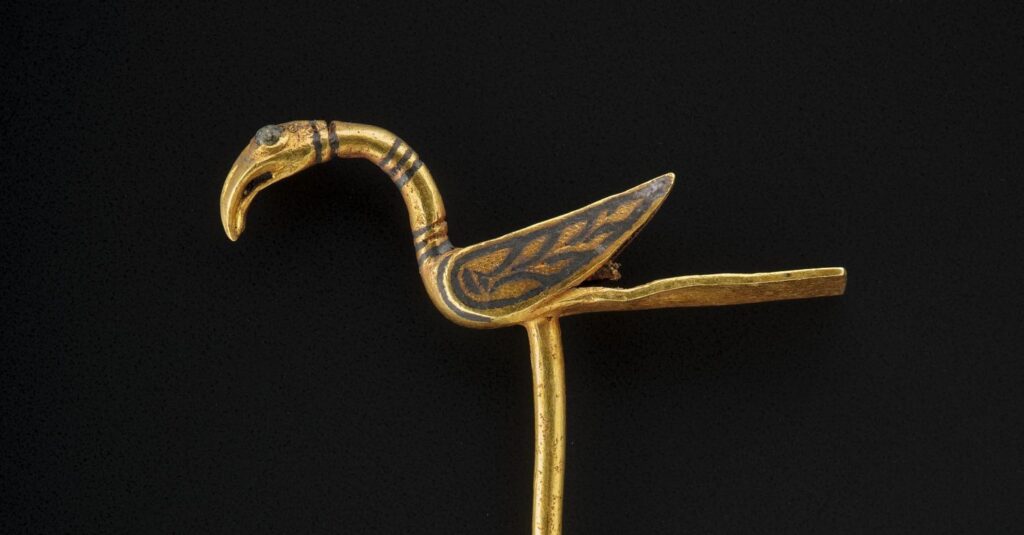
The decoration here shows representations of the Four Evangelists from Christian tradition (Matthew, Mark, Luke, and John). This cross, along with seven silver brooches, a gold bird pin and a pair of hinged straps were also ornamented in Trewhiddle style. These objects may have been used by the Northumbrian – as in, the Old English-speaking – inhabitants of Galloway.
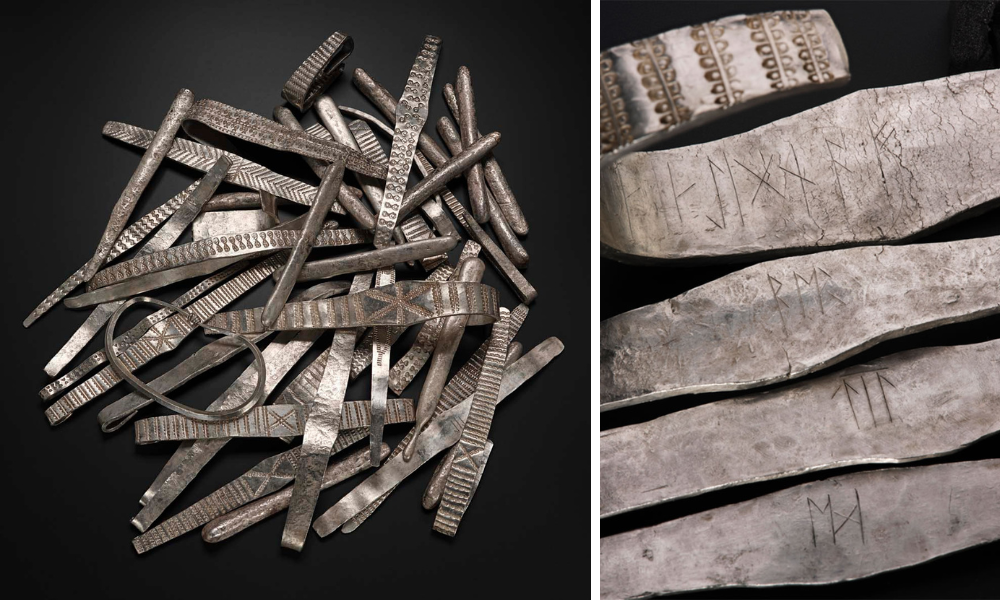
Silver from the lower part of the Galloway Hoard, including 30 Hiberno-Scandinavian arm rings (© National Museums Scotland)
Viking Galloway
The Hiberno-Scandinavian arm rings in the hoard represent another group of people who were living in Galloway at this time. These bands of silver were made in areas of Ireland which were under Viking (Scandinavian) control between c.AD 880 and AD 930.
Archaeologists have found these objects in places around the Irish Sea – mostly in Ireland and northwest England – which indicates the presence of Viking traders. There are more than 40 of these arm rings in the Galloway Hoard, which shows that there was likely a strong Scandinavian presence in Galloway at the time.
You may have already spotted an issue with using these objects to track the movements of particular groups of people in the past: there’s more than one cultural group represented in this hoard.
Plus, the Galloway Hoard has another layer of complexity: some of the Hiberno-Scandinavian arm rings have Old English runes carved into them. This language would’ve been used by Northumbrians, not Vikings. Using artefact types to track groups of people may not be as easy as we had thought!
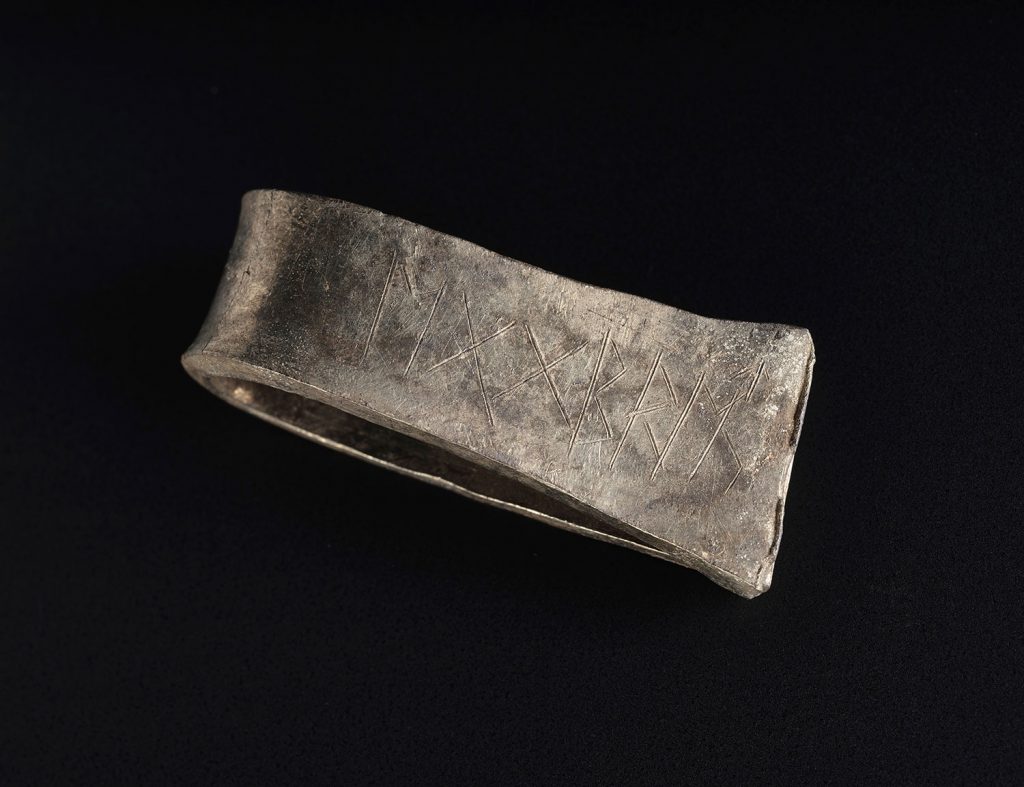
A Hiberno-Scandinavian arm ring from Balmaghie, inscribed with the name Egbert in Old English runes (© National Museums Scotland)
The People of Galloway
The presence of these different types of artefacts and decorative styles in Galloway doesn’t necessarily mean that big groups of people were moving in and throwing out the people who had lived there before. When new groups like the Vikings arrived in Galloway, it may have been a small number of important and powerful people who took over estates as landowners.
This means that most of the existing people in Galloway would’ve remained but paid tributes to new lords. The new groups of important people would’ve also introduced new types of objects, new connections and new languages. The different cultural styles that we can see in the artefacts probably show these few powerful people influencing the types of objects being produced.
With all of these different cultural groups now present, the people of Galloway could mix and match different identities and, as a result, represented these identities in their art, such as the Old English runic inscriptions on the ‘Viking’ arm-rings.
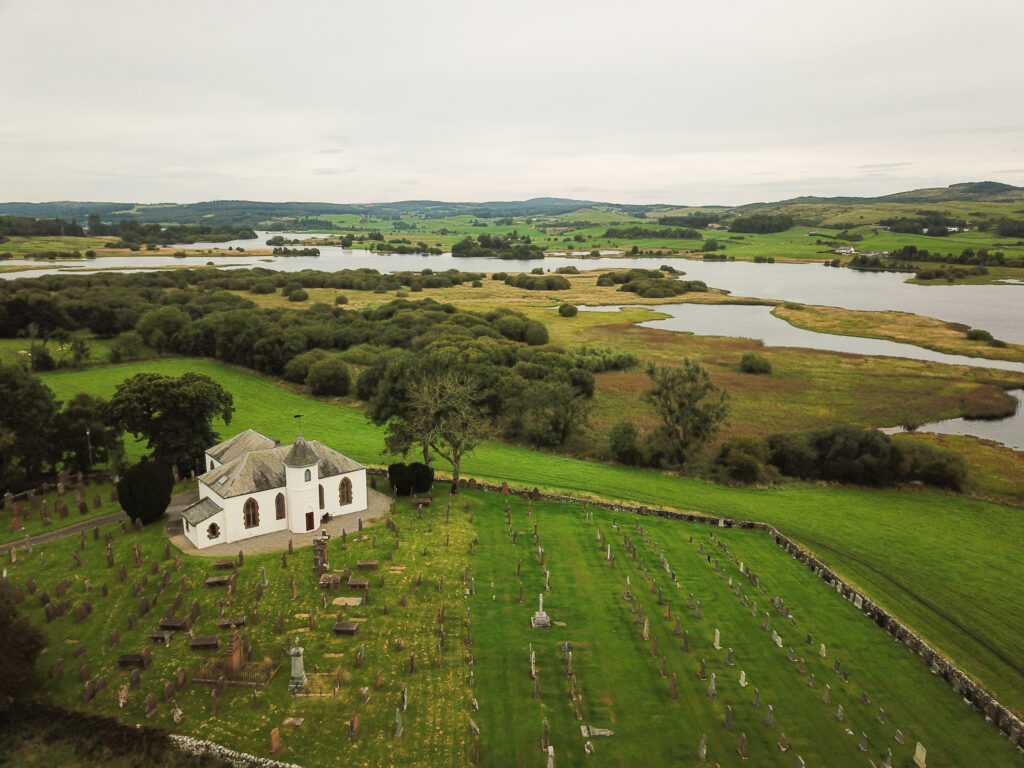
Balmaghie Parish Church, where the Galloway Hoard was found in 2014 (Credit: Orla Craig FSAScot)
Creating the Galloway Hoard
When we look at the objects in the Galloway Hoard, we can see signs of this mix of different cultures and identities, as well as connections to the wider world. Creating and bringing these objects together would’ve both reflected and helped to create the unique cultural identity of the people who buried it. It may be that Balmaghie’s place in the middle of the cultural stramash of early medieval Galloway is what allowed these particular objects to be brought together in this way, creating “one of the most important UK archaeological finds of the century”.
The Galloway Hoard shows us that we can use artefacts to learn about groups of people in the past, but identity isn’t as clear cut as archaeologists once thought. Groups of artefacts like the hoard show us that identities were formed and expressed in different ways, and that creating and bringing together these different “cultural styles” played a part in building and displaying those identities.
People in the past were just as complex as people are now, and the mixing and overlapping cultural identities that takes place in the 21st century are sure to fascinate archaeologists 1,000 years from now, just as the Galloway Hoard fascinates us today.
Want to dig deeper into the Galloway Hoard? Get closer to the textile remains of the hoard with Dr Susanna Harris FSAScot.
By Orla Craig FSAScot. Orla recently finished a PhD researching ‘The Archaeological, Landscape and Historical Context of the Galloway Hoard’ at the University of Glasgow, and is now dealing with all things Ancient Monuments at Historic Environment Scotland. Keep up with her research on X at @orlacraig.
Tweet
Header Image © National Museums Scotland
