What Can Artefacts Tell Us About the Past?
As a medieval archaeologist I have always been fascinated by objects which tell a story, artefacts which can be interrogated and analysed to show how or by whom they were used.
A good example of this are seals – piece of wax, lead, or other material with an individual design pressed into it which was attached to a document as a guarantee of authenticity. They were designed to impart messages about their owners, their status in life, their interests and affiliations, and although they don’t often survive, the popularity of metal detecting in recent times has led to the recovery of numbers of matrices, the metal moulds used to create them.
A seal with a story
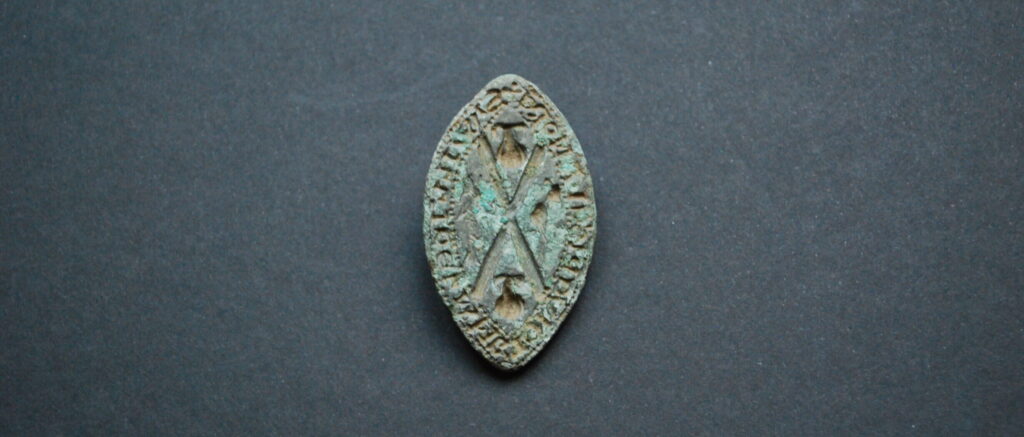
One particularly impressive seal matrix was found in 2015 by a young metal detectorist named Abbey Moffat at Boarhills in Fife and reported to the Treasure Trove Unit. It was duly claimed by the Crown and is now on display in Kirkcaldy Galleries. It is oval in shape, just 45mm by 26mm, with a suspension loop on its back, showing that it may have been worn around the neck.
Its design tells us a lot about the history of the seal matrix. It consists of a saltire cross with a scallop shell at top and bottom, a bird to the left and a fish to the right. The text around the edge reads “S’ WILLI DE LAMB’TON EPIS’CI ANDRE”, which is Latin for “the seal of William of Lamberton, bishop of St Andrew”. The saltire is the symbol of St Andrew and the scallops are from the Lamberton coat of arms.
A bishop’s loss
William Lamberton was a distinguished churchman and patriot. The Lamberton name derives from a place in Berwickshire in the Scottish Borders. He held several prominent positions before being elected as bishop of St Andrews in 1297, less than a month after the Scottish victory over the English at Stirling Bridge on 11 September.
He was later appointed a guardian of the realm and remained an influential figure in national affairs until his death in 1328, supporting Robert Bruce’s bid for kingship and undertaking diplomatic activities abroad.

St Andrews Cathedral (Image Credit: Jeremiah Mercurio via Flickr at http://bit.ly/2KPUg9H, CC BY-NC 2.0)
What makes this seal particularly interesting is that we know of no seals made by this matrix from Boarhills. It should have been defaced or destroyed when it fell out of use, either through the death of Lamberton or its replacement by a seal with a different design.
Its discovery at Boarhills is presumably the result of accidental loss; Boarhills is a village near the coast, about 7km south-eastwards from St Andrews, so we can imagine an official of St Andrews diocese travelling on business in early 14th-century Fife and the matrix dropping out of his bag and being lost until it was found 700 years later.
A medieval advertisement?
The discovery of the Boarhills matrix has also revealed important features of other seals belonging to William Lamberton, which until now have attracted little attention from seal experts.
The first feature is the inscriptions which describe Lamberton as bishop of St Andrew. Previous bishops in St Andrews had called themselves bishops of the Scots, They had not at that time, however, achieved the status of archbishops or automatic governance of the Church in Scotland.

The bird and fish symbols on the Boarhills seal relate to the legendary life of St Kentigern or Mungo, Glasgow’s patron saint. The bird is the robin, the pet of St Serf, brought back to life by Kentigern, and the fish is the salmon taken from the River Clyde, found to have swallowed the queen’s missing ring (Glasgow Cathedral by Phyllis Buchanan via Flickr at http://bit.ly/3iesVyh, CC BY-SA 2.0)
The second feature is the designs of a fish and a bird, as the second most important Scottish diocese was Glasgow, and throughout the Medieval Period it is clear that there was often considerable rivalry between the churchmen of Glasgow and others in St Andrews. The bird and fish (on other seals with a ring in its mouth) then, which appear on Lamberton’s seals, are especially interesting because at the time these were symbols of Glasgow.
The use of such designs was not accidental, these symbols, along with the bishop’s change of title, must have had some political meaning. Perhaps they indicate a shift in how the bishop wanted his position to be seen and the control he wanted to exert over the diocese of Glasgow. There is definitely an intriguing story to be teased out here, perhaps by someone reading this piece.
The Boarhills matrix is a great example of how archaeology and history work hand in hand to reveal stories from the past. It is finds like this that can make the study of Scotland’s material culture so interesting and rewarding, and there is still plenty more to do.
Discover more of Scotland’s most famous artefacts and the part they’ve played in the creation of the Scottish nation below.
By David H. Caldwell. David worked as a curator in the National Museum of Scotland for 38 years until his retirement in 2012 and was President of the Society of Antiquaries of Scotland from 2016 to 2020.
Header Image: The Boarhills seal matrix courtesy of Fife Cultural Trust
