What is Post-Excavation Processing?
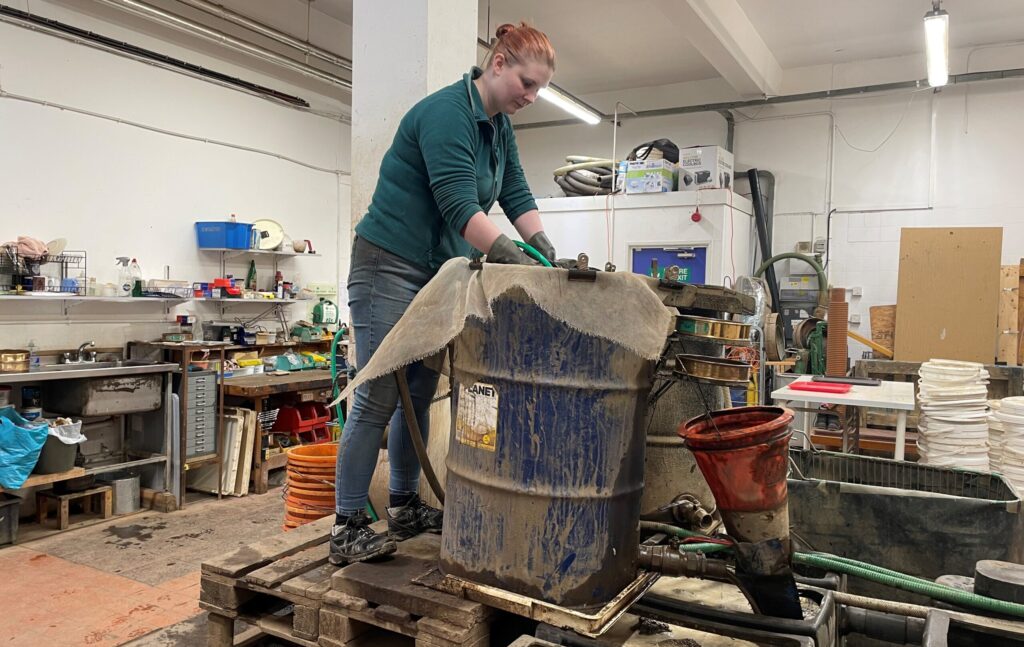
Archaeologists don’t just dig in the soil. We also take lots of soil back to our finds labs, as samples of the soil we recover during an excavation (what is known as the “contexts”) often contain artefacts waiting to be found.
Processing soil samples is another way of recovering archaeological evidence, especially the kind of evidence it’s difficult to extract in the field.
How do archaeologists know which soil samples to investigate?
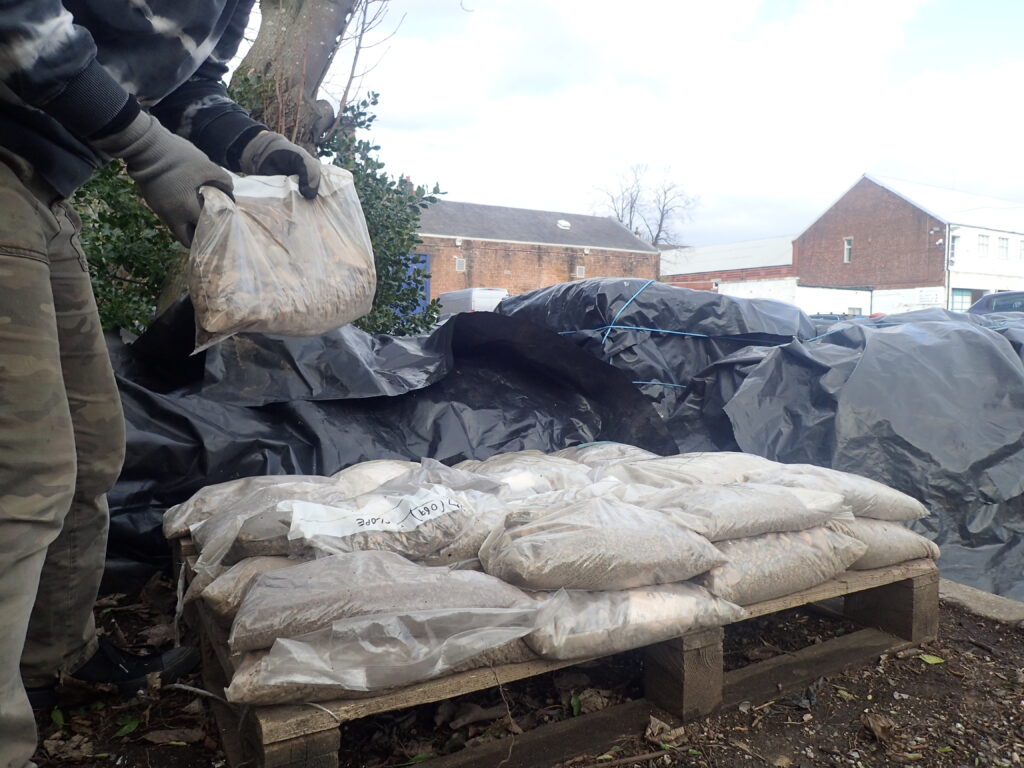
Soil samples awaiting processing (© GUARD Archaeology Ltd)
Soil samples are taken from sites we are excavating; each feature we encounter and explore will have soil comprising of what we call a fill, this soil is bagged and collected. The samples can range in size, from tiny bags taken from smaller features such as stake holes (usually just a few spoonfuls), to a more normal feature such as a pit which may fill our standard 10 litre bag, to slots cut through moats or hill forts that could fill around eight 10 litre bags.
Soil samples collected on site and returned to our base are stored ready for post-excavation processing. Not all samples are created equal, however. Each feature that a soil sample was taken from is evaluated to determine its relevance to understanding the site and the potential for material that can be carbon dated, or if it still has artefacts within it, or has environmental remains that need to be extracted. The list is honed down to the chosen samples – those that we think contain the greatest potential for holding archaeological evidence.
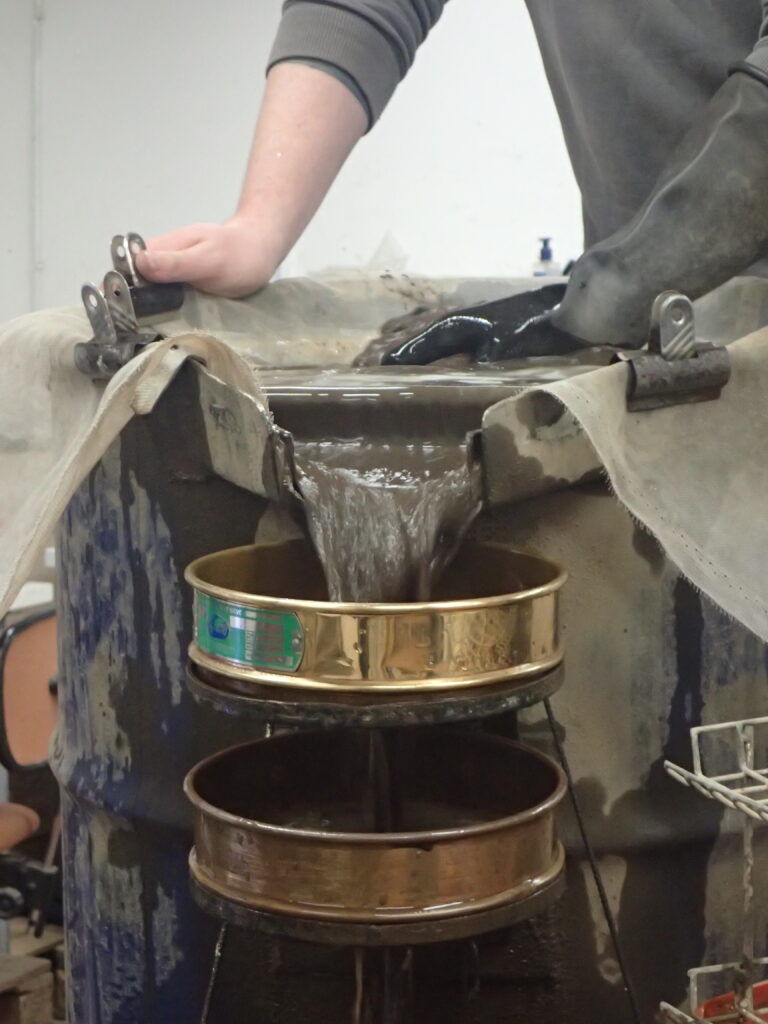
(insert GUARD PX 3 image: GUARD Archaeology’s siraf tanks (© GUARD Archaeology Ltd)
Why do archaeologists wash soil?
We begin the process with flotation. This is where we ‘wash’ the chosen samples in specialised tanks (called ‘Siraf’ tanks), where the mud and silt drop to the bottom of the tank leaving our now gleaming clean residues – which are mostly stones.
Any botanics (plant materials) float their way out of the tank and into the awaiting sieves for collection (all except oak, which is just too heavy).
Some soil samples give us very little botanics, while others provide so much that it creates mayhem as we dash to keep up with changing sieves during the floatation process.
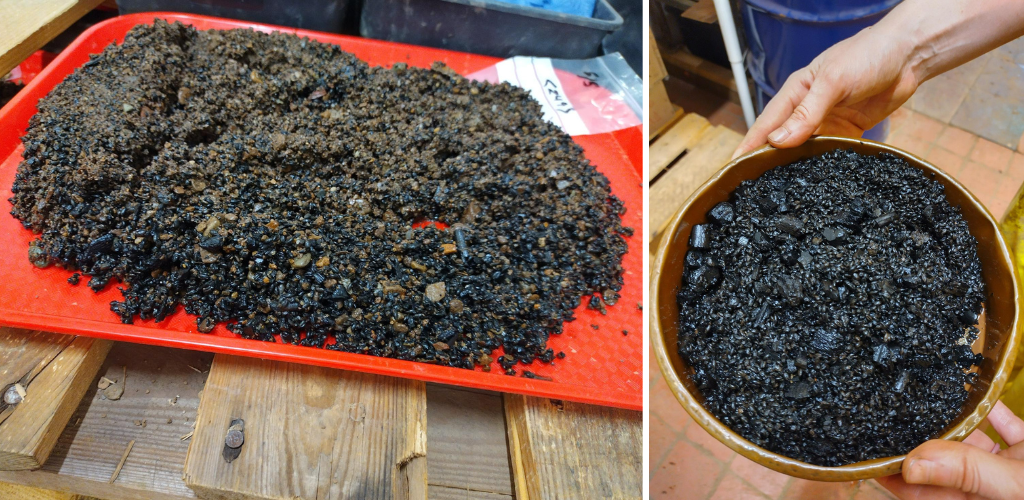
Left; Wet residue on tray after flotation and right; a sieve full of botanics (© GUARD Archaeology Ltd)
The greatest thing we could find is carbonised vegetation (also known as “C.V.”, burnt wood, or charcoal). These are messy black lumps which are the best candidates for radiocarbon dating and so provide valuable evidence for when the site was in use.
These three key botanicals – burnt wood, cereals and nutshell – are what we send to our archaeobotanical specialists, who are able to tell us exactly what they are. They can also tell us which pieces can be radiocarbon dated so we gain an understanding of when our site was occupied, as well as what natural resources were being used for food, buildings and fuel.
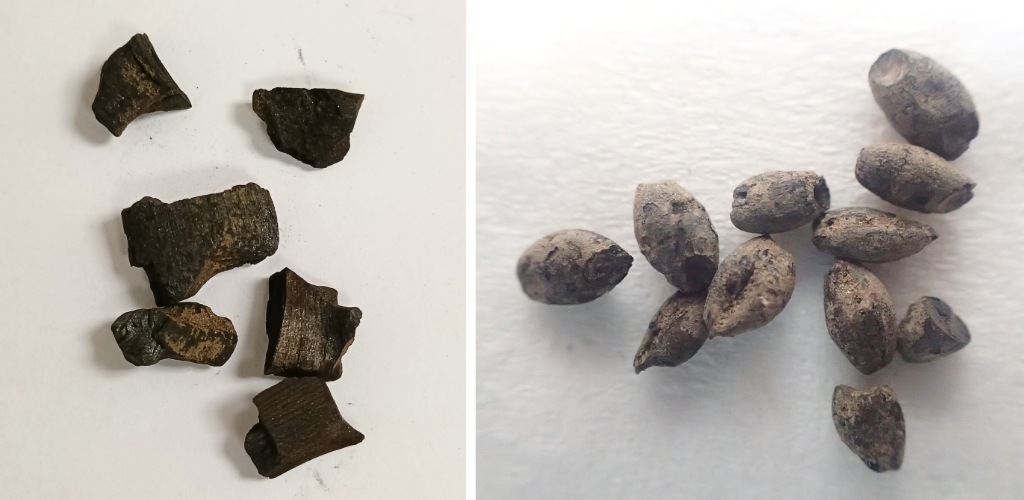
Left; Lumps of carbonised vegetation, and right; burnt cereal grains (© GUARD Archaeology Ltd)
What artefacts are found during post-excavation processing?
The residue is then dried and the sorting process can begin.
This is where eagle-eyed sorters come into play. The residues recovered from each separate soil sample are examined and sorted, bit by bit, with artefacts and botanics pulled out as we go. This creates what we call retents (i.e. what is retained); small bags of finds from each sample we have sorted. Some boring samples may have nothing, the exciting ones will have many, it all depends on the variety of materials present in the sample. These are then given to specialists for further analysis.
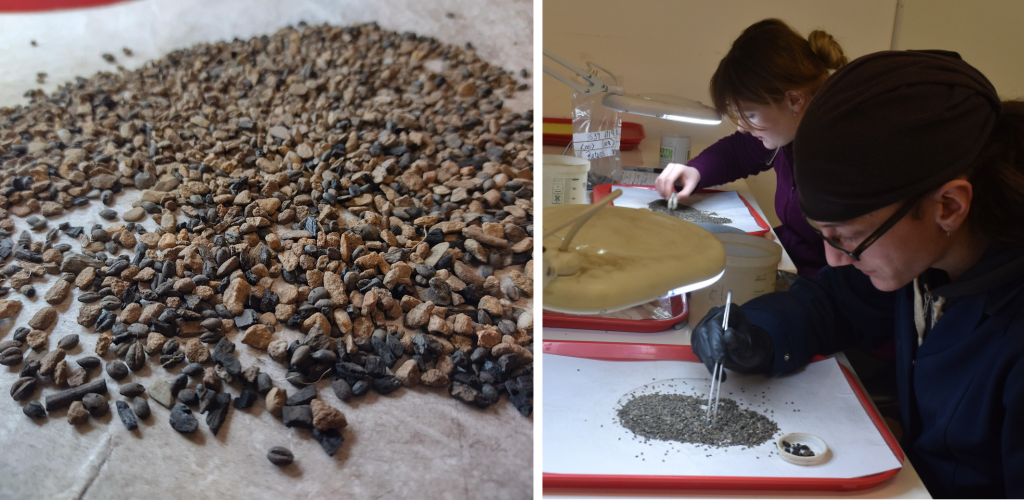
Dried residue ready to sort and GUARD Archaeologists sorting through dried residues (© GUARD Archaeology Ltd)
Artefacts are quite exciting to find. These count as new evidence to help us build a picture of what was going with the humans who were once present at a site we have just excavated. They may tell us when they were there, how long they were there for, what they were doing, what they were eating and what types of things they were making or using.
Pottery is a common find, from modern sherds to medieval and all the way back to the Neolithic period. The kind of prehistoric pottery we encounter is typically small fragmentary sherds as the bigger pieces are usually spotted during excavation. But every now and then we find a piece that was missed on site and that dazzles us.
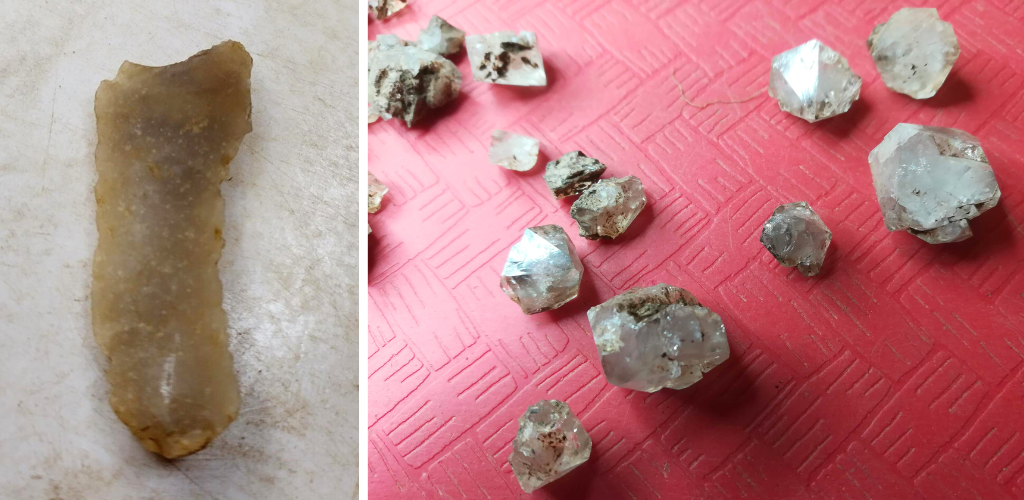
Left; Grey flint and Right; Rock crystal (© GUARD Archaeology Ltd)
Lithics – stone artefacts used as, or created for use as tools such as scrapers, blades and fire flints – were utilised throughout the Neolithic and beyond. They are less common but very eye catching, with colours that vary from pitch-black pitchstone to grey and brown flint to a caramel chert.
A burnt lithic is bright white and not easily missed. White quartz, pink agate and red jasper were sometimes utilised as prehistoric stone tools and my favourite, rock crystal, impressively shaped like diamonds yet somehow not as pretty.
In my opinion, what are the prettiest to behold are flint arrowheads, like this one below recovered during flotation in the early 2020s – still one of the most impressive finds I’ve seen being pulled out of the tank! The arrowhead was dated to the Early Neolithic period (the ‘new’ stone age – 4,100 BC to 2,500 BC), it came from a site in the uplands, just outside of Glasgow where archaeologists also found evidence of a Neolithic settlement and a Bronze Age burial.
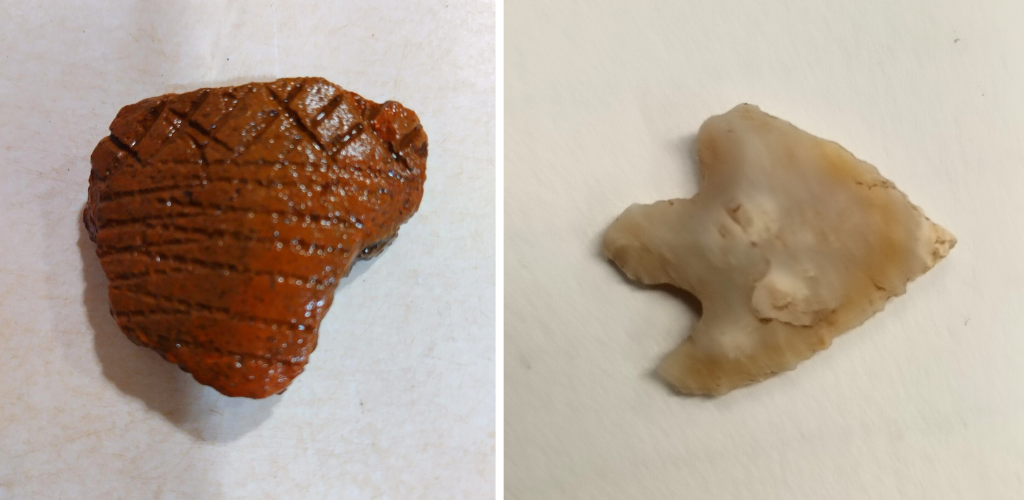
Prehistoric pot and a flint arrowhead found during soil processing (© GUARD Archaeology Ltd)
Other eye-catching finds are bits of burnt bone, these could be animal bones that have been cooked, eaten and discarded or human remains which have been cremated as a ritual burial (though usually found within a cist or an urn). Both human and animal bone can be radiocarbon dated to find out when they roamed the earth. These can be bright white, though some have grey or blue hues depending on the temperature of the fire they had been burned in. Most are small and fragmentary – the bits our excavators didn’t spot during the excavation.
Sometimes we find lumps of clay daub too that have been used to line wicker walls and stones that have been shaped into tools. We’ve found tiny glass beads and a piece of shale bracelet as well – we took special care examining that particular sample as we knew that other bracelet pieces had been found in this deposit while on site – this was its missing piece. It was from a site at Guardbridge near St Andrews in Fife which had been in use for a remarkably long time, with a Palaeolithic camp, Neolithic structures, Bronze Age enclosures and an Iron Age Fort.
Another sample like this was from a deposit that had yielded a late Iron Age Roman brooch with brightly coloured enamel (pictured below). The brooch was missing several colourful enamel patches which we had spotted and recovered while sorting the residues. The site was in Girvan, Ayrshire, up a large hill with a magnificent view of Ailsa Craig where there was evidence of roundhouses, pit alignments, and hearths dating from the Neolithic to Iron Age.
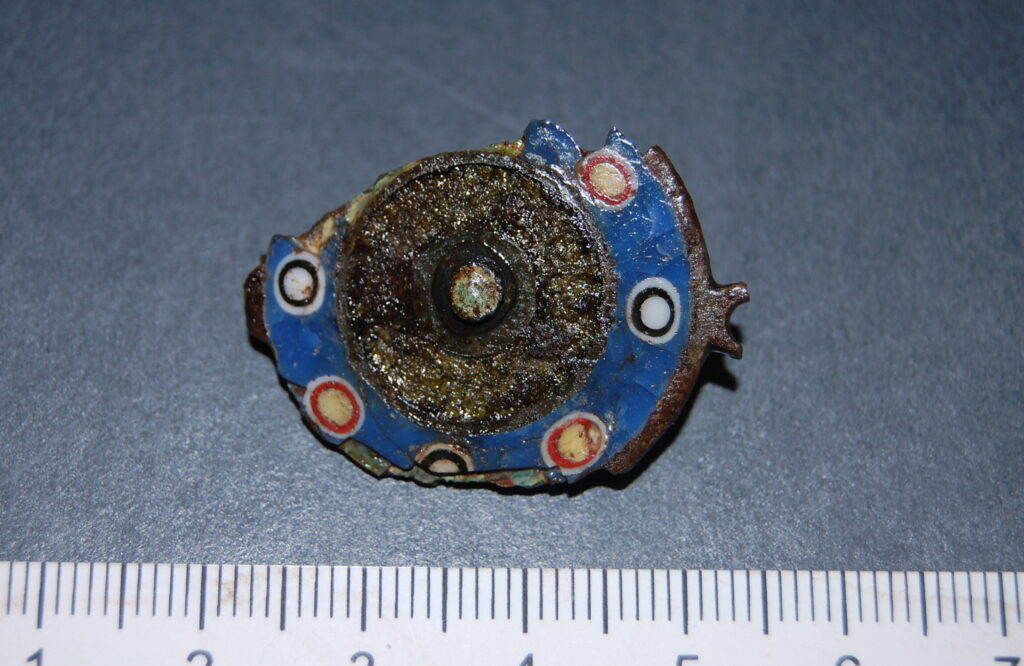
Roman Brooch found during excavation (© GUARD Archaeology Ltd)
In terms of more modern discoveries, we often encounter glass, metal and industrial waste – the waste product of iron ore smelting processes. The waste products include tiny spherical metal hammerscale balls (excess hot ore that flies off a metal working tool, shaped into a perfect orb by gravity!), flat flaky hammerscale (that have flaked off the ore during the process) and lumps of slag (large, impure parts of the iron ore that were discarded), that form as lumpy, bubbly, messy chunks that are easily collected with a magnet.
And even though they are not what archaeologists study, fossils (like the ones below) are also a fun find and are mighty impressive no matter how small.

Fossils found through post-excavation processing (© GUARD Archaeology Ltd)
What happens to artefacts found during post-excavation processing?
Only when we’ve completed our processing of soil samples are we sure that we’ve found all the archaeological evidence.
Then it is the specialists’ turn to take a look at the artefacts. From clay pipes to lithics and stone tools, metalwork, industrial waste and glass, pottery, daub, animal and human bone, archaeobotanicals and textiles – each material type has someone, somewhere, who can tell us more about it. They create catalogues of the material, research the items and write reports, highlighting the significant finds.
The duration of this process varies depending on the amount of artefacts. It can take months for a large assemblage to be processed if every item is to be assessed, studied and recorded. But all the information they provide goes into a final report that is then available for the wider public to read and learn more about the site and the artefacts recovered.
By Rachel Buckley. Rachel is a Post-excavation Project Supervisor at GUARD Archaeology Ltd and has processed numerous archaeological assemblages from across Scotland.
Tweet
Header Image: © GUARD Archaeology Ltd
