What’s a Roundhouse? Exploring the Iron Age wheelhouse at Cnip on Eilean Leòdhais (the Isle of Lewis)

Back in the 1980s, people living in the coastal township of Cnip (pronounced ‘Kneep’) in Eilean Leòdhais noticed that high winter tides had exposed stones and dark midden deposits on the beach.
Since I was then doing my PhD research on the Iron Age in Na h-Eileanan Siar (the Outer Hebrides), I was called in to take a look.
It was quickly obvious that there was lots of distinctive Iron Age pottery in the eroding deposits, and stone walls projecting from the sand dunes. What we hadn’t expected, however, was that subsequent rescue excavation of the site would reveal an incredibly well-preserved Iron Age wheelhouse, dating from around 200 BC – AD 200 (over 1,800 years ago), with parts of its stone roof still intact!
That was just one of the extraordinary discoveries made during the Cnip wheelhouse excavations. But before describing these, it’s worth thinking about the wider context of roundhouses in prehistoric Scotland and beyond.
What’s a roundhouse?
Roundhouses, as the name suggests, are circular domestic buildings, usually with a conical thatched roof. Their walls could be made of timber, stone or even turf. In Britain, they were the dominant settlement form for around 2,000 years, from the Bronze Age to the start of the Roman period.
During the Iron Age, roundhouse architecture was one of the key features that distinguished communities in Britain from their Continental neighbours who nearly all lived in rectangular timber longhouses. This is an important difference, since the shape of your house dictates a lot about how you organise domestic life, and how people move around the building and interact with each other.
When were roundhouses built in Scotland?
The earliest roundhouses in Scotland date mostly to the middle of the Bronze Age, in the second millennium BC (4,000 to 3,000 years ago). The greatest number, however, were built during the Iron Age, from around 800 BC to AD 100 (2,800 to 1,800 years ago), when the landscapes of what is now Scotland would have been dotted about with roundhouses of various sizes, some isolated, and some in larger groups.
In many parts of the country, these farming landscapes would have been densely settled, with smoke from multiple settlements visible for miles around.
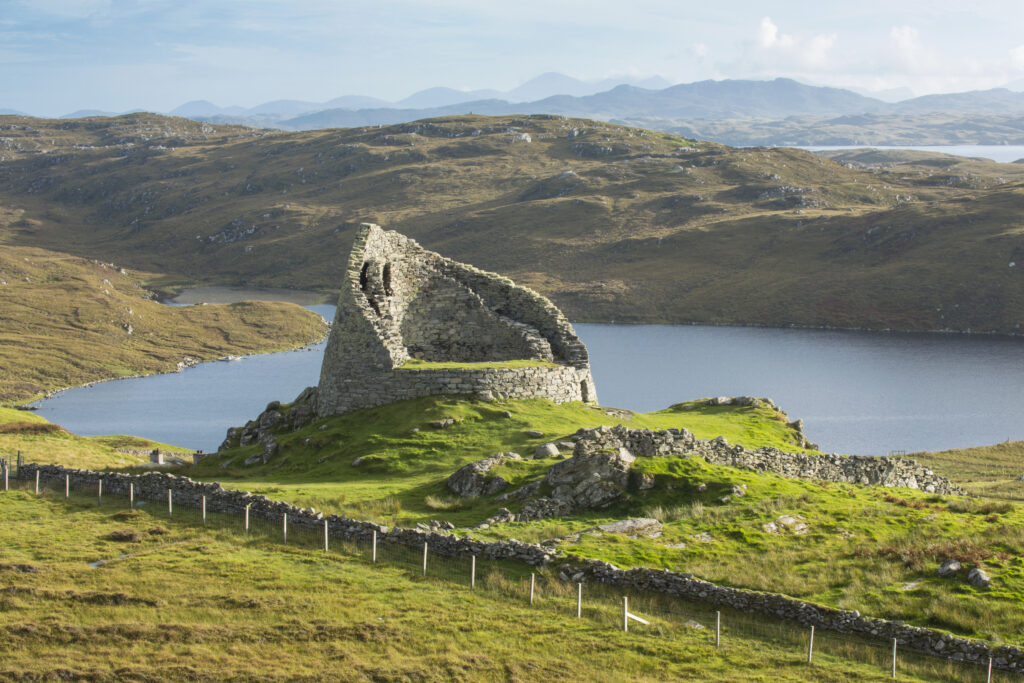
Dun Carlabhaigh (Dun Carloway) in Eilean Leòdhais (© VisitScotland / Kenny Lam)
Where are roundhouses found in Scotland?
Roundhouses are found all over Scotland, from the Borders to Shetland. The most spectacular appeared in Atlantic Scotland (the Northern and Western Isles and the north mainland) between around 600 BC and 100 BC (2,600 years ago to 1,800 years ago). Known as “Atlantic roundhouses”, they were built with thick stone walls, standing several metres tall.
The most elaborate Atlantic roundhouses were the broch towers, like Dun Carlabhaigh in Eilean Leòdhais and Mousa in Shetland. These often had walls more than 10m tall, with multiple wooden floors, and pitched conical roofs adding to their height.
Who lived in roundhouses in Scotland?
Roundhouses came in many sizes and so the composition of the households inside them would have been equally varied. Some were only a few metres in diameter and might have housed a nuclear family (parents and their children).
But others could be very substantial. Some roundhouses from the early phases of Broxmouth hillfort in East Lothian, for example, have been estimated to have housed more than 30 people. These large households probably contained extended family groups who lived and worked together.
What were roundhouses used for in Scotland?
In many ways, roundhouses were the centre of Iron Age life. They were places where people lived, ate, slept and worked. But they were also more than that.
Whereas earlier periods of prehistory were characterised by great monuments for the dead, like barrows and chambered tombs, or monuments to the gods, like henges and stone circles, the Iron Age seems to lack such obvious evidence for ritual and religion.
Looking closer, however, we see that roundhouses often contain small deposits and offerings of animals, objects, or even human remains. These are often dug into pits under the roundhouse floor, or built into the walls themselves, as we can see with the roundhouses inside the hillfort at Broxmouth.
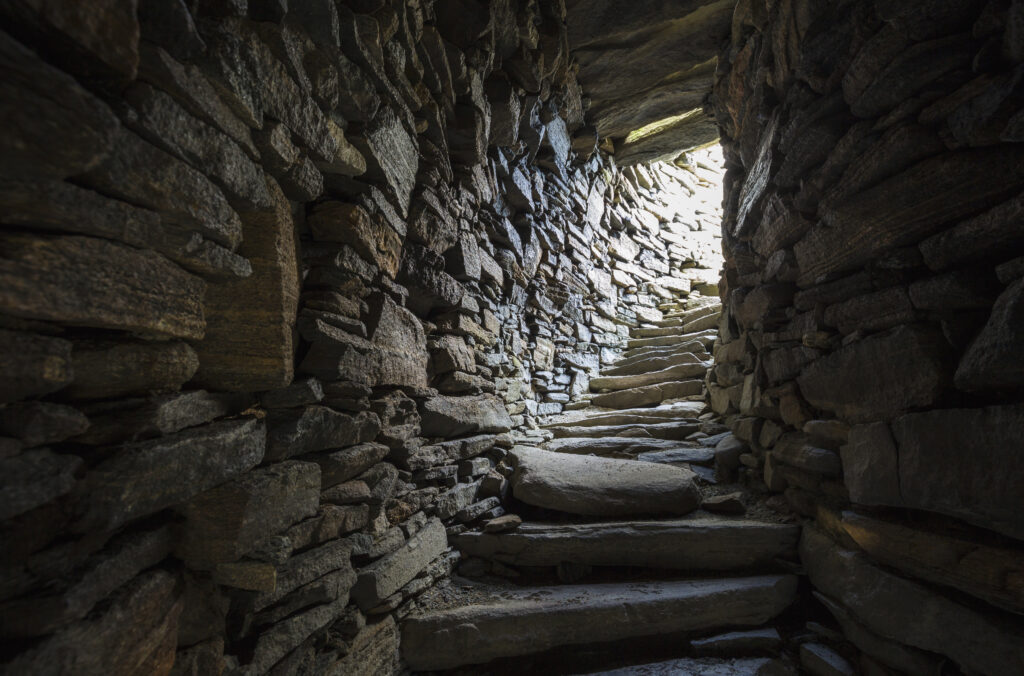
Inside Dun Carlabhaigh in Eilean Leòdhais (© VisitScotland / Kenny Lam)
What are wheelhouses?
Wheelhouses are a specific form of stone-walled Iron Age roundhouse found only in Shetland and Na h-Eileanan Siar. Their name comes from the distinctive radial arrangement of stone piers that supported the roof and divided the interior into a series of regular bays or rooms. From above the radial piers look a little like the spokes of a wheel, hence the name!
Wheelhouses had an open central area, usually containing a hearth, where people would have cooked, worked and spent time together. The surrounding bays would have been used for various purposes, including bedrooms and storage areas.
What’s special about the Cnip wheelhouse?
The Cnip wheelhouse is special in a number of ways. Since it was quickly infilled with windblown sand after abandonment, the walls were incredibly well preserved. This meant we could reconstruct the building process in detail, including the stone-corbelled roofing (some of which survived) that covered the bays around the central area of the wheelhouse.
The Cnip wheelhouse was no rough and ready construction. Although it was dug into the sand, and would have seemed very modest from above, once inside, the visitor would have been greeted by soaring stone piers and a central timber roof rising to around 6m above their heads.
The material recovered from the excavated floor deposits show something of what life was like in Iron Age Eilean Leòdhais. Animal bones showed not just the raising of cattle and sheep, but also the management of red deer herds in the surrounding hills. Rotary quern stones attest to the daily grinding of grain to make porridge or bread. Unusual objects, like the tuning peg of a lyre (a stringed musical instrument), and a gaming piece of antler, give an insight into a household where there was time for leisure and music.
As well as being the centre of domestic life, the wheelhouse was also a focus for ritual and belief. Since we were able to dismantle the walls (as the wheelhouse was going to be destroyed by the sea in any case!), it was possible to see how the inhabitants had marked each stage of construction, repair and modification with the deliberate deposition of objects.
Behind one section of wall were pottery vessels, probably containing food or drink, the head of a great auk (a now-extinct seabird) and the spine of cow. An unbutchered lamb was buried under threshold of one room. Under another was a little group of objects including a Bronze Age human skull, more than a thousand years old when it was buried, which had probably been recovered from a nearby cemetery. Such offerings show how the world of the gods and ancestors was brought into the heart of the house.
You can read much more about the Cnip wheelhouse in a volume published by the Society of Antiquaries of Scotland (who coordinate Dig It!) which is now available as a free eBook: Anatomy of an Iron Age Roundhouse: the Cnip Wheelhouse Excavations, Lewis.
By Professor Ian Armit FSAScot, who is based at the University of York, where he researches the archaeology of Bronze and Iron Age Europe, the role of violence in prehistory, and prehistoric demography using ancient DNA. He has worked extensively in Britain, Ireland, France, Sicily and south-east Europe, and currently runs the COMMIOS Project examining the bioarchaeology of later prehistoric populations of Britain and the near continent.
Acknowledgements: The excavations at Cnip were funded by Historic Environment Scotland and the Department of Archaeology, University of Edinburgh.
Header Image: Traigh na Beirigh beach Lewis cc-by-sa/2.0 (© Steve Houldsworth – geograph.org.uk/p/6890064)
