Lost and found: Why are objects “rediscovered” in museum collections stores?

How do museums lose track of objects? Why do they go missing in the first place? How are they found again?
These questions might have resurfaced thanks to recent news stories about rediscovered and missing objects from museum collections such as the ancient Roman burial urn at National Museums Scotland, the rare Neolithic figurine at Stromness Museum and the wooden artefact from the Great Pyramid at the University of Aberdeen Museums and Special Collections.
To answer these questions, first we need to look at museum stores in more detail.
Why do museums have collections stores?
Museums come in all shapes and sizes and most have collection stores which are used to house objects that are not on public display. They allow museums to change the display, send objects for external loans, and conduct regular conservation procedures that are essential to maintain objects in good condition. They also allow the museum to organise temporary exhibitions so there’s always something new for the public to explore.
Some of the more delicate items are not suitable for long term display and can only be exposed to certain light conditions for a short period of time. These objects also remain in the store until it’s their time to “shine”.
What do museum collections stores look like?
The word “store” can be a bit misleading. It might give the impressions that museum stores are dark places that are rarely visited. This is not true!
Some museum stores are visited daily and include working spaces for curators and researchers to allow them to examine objects. Packing objects in preparation for external loans, some light conservation procedures, documentation, photography, and rehousing objects to enhance the storage conditions can take place in the store as well. During the pandemic, remote teaching using visualisers (visual aid with a camera and mic for remote teaching) was also done by museum professionals within the store space.
You also need to picture a lot of shelves! Shelves are usually the main feature in museum stores with different styles for different objects. Mobile storage roller racks are often installed to maximise the use of space which is essential as objects shouldn’t be overcrowded in one box and new acquisitions are regularly added to the collection.
Archaeological excavations and objects collected during organised field walks, for example, provide museums with these objects which will remain in the store until they’re fully documented and ready for display. In Aberdeenshire, the Mesolithic Deeside group organises field walks in fields along the river Dee and has collected thousands of flints over the years. These objects will go through the Treasure Trove system and eventually become part of a museum collection.
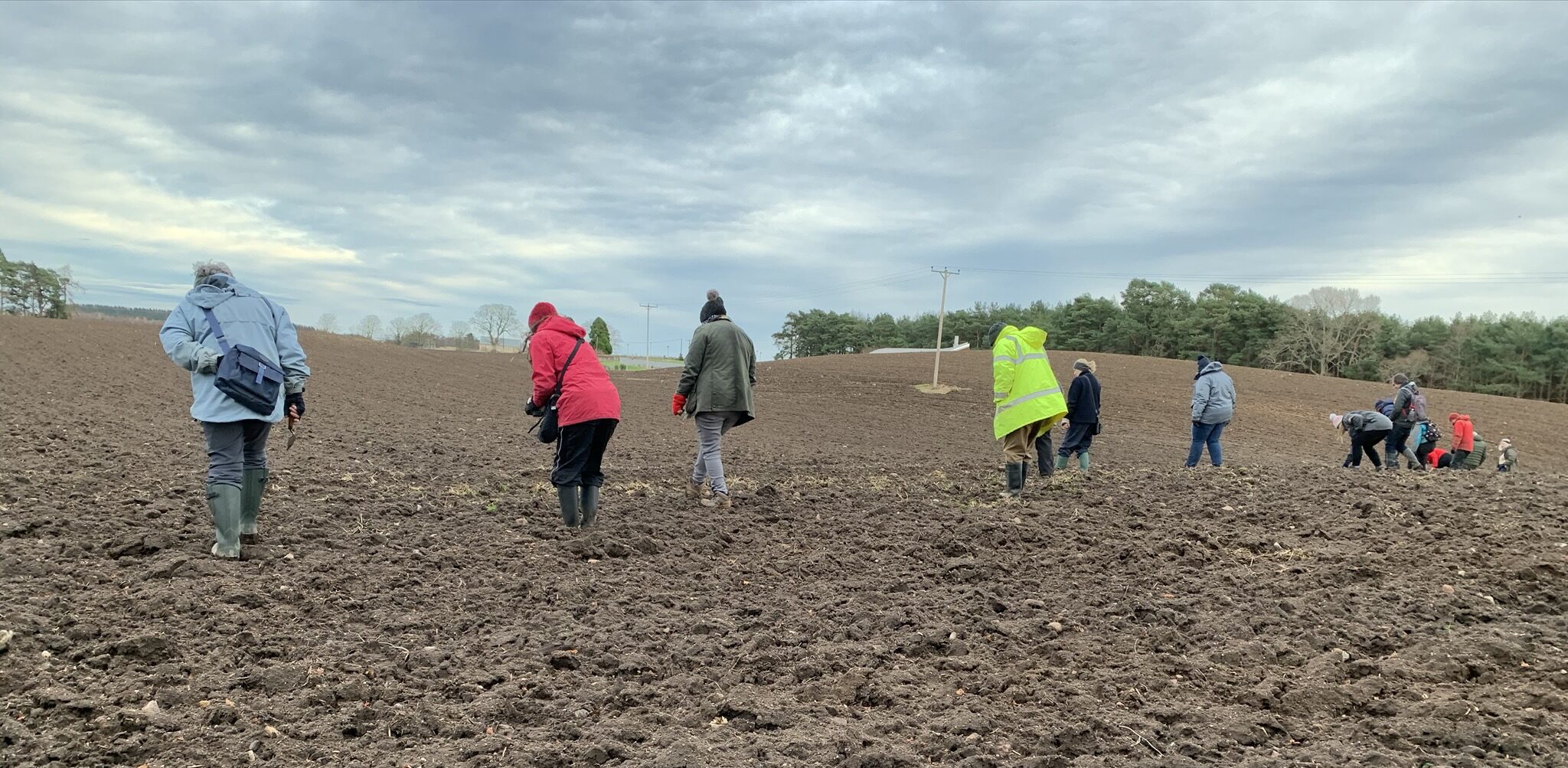
Mesolithic Deeside walking group (Image copyright: Ali Cameron)
There’s also a lot of boxes in museum stores. Curators and conservators aim to keep stored objects in accessible museum-standard boxes in controlled environments with regulated temperature and suitable humidity for each material in the collection. These boxes and the shelves should be numbered, every object should have a unique number, and each area of the store should be allocated to a particular section of the collection – although that isn’t always the case. A database that includes an up-to-date location and information for every object is every museum professional’s dream!
Metal and organic objects (such as wood, leather, and textiles) are usually more sensitive to environmental changes so these have the priority for conservation and often have a designated section in the store. At the University of Aberdeen museums, for example, metal objects are grouped together in a separate location while textiles and bark clothes occupy a whole section of the store.
But not everything is in a box. My favourite area in any museum store is the open display section where objects (often larger items) are visible to visitors.
Museum stores are also very clean, which is essential to the care of the objects. Pest control and regular monitoring of traps are included in the working schedule of a museum professional.

Museum store (Image copyright: University of Aberdeen)
How are museum collections tracked and organised?
It’s always interesting to see how these stores are organised and which system curators and museum teams follow to keep track of objects. Spectrum is the current collection management standard used by most accredited museums in the UK to manage their collections and record all their movements. In fact, there is a large section on Spectrum dedicated to location and movement control.
However, older organisations went through different documentation systems and most probably moved the collections across different stores many times. Keeping track of objects can be a bit tricky especially in larger collections that include hundreds of thousands of objects.

Museum Store (Image copyright: University of Aberdeen)
Why do we sometimes rediscover artefacts in museum stores?
Throughout the 19th and 20th centuries, private or smaller collections were regularly dispersed, combined or added to larger collections. This includes their old inventory numbers as well as auction numbers which created a complicated series of identities and numbering styles for every object.
Some museums are now dealing with two or three types of inventory numbers simultaneously as the term old number appears extensively in museum databases. This can sometimes cause confusion when identifying an item in the stores.
However, the existence of these numbers on objects can sometimes help us trace its provenance and follow it as it moved from hand to hand. It’s very common to see an object with multiple stickers which hold numbers that record different stages of its life with a collector or museum.
As new storing spaces are regularly acquired by museums to accommodate the growing collections, keeping object locations up to date is a continuous challenge. Objects can be misplaced, and museum teams regularly re-identify objects through detective work based on research using different references and clues including the stickers with old numbers.
This is exactly what led to the identification of the wooden fragments from the Great Pyramid. The box that contained the fragments was donated to the University of Aberdeen collection in 1946. A research request to examine the object was received by the curator in 2001, and the search for the object started but unfortunately ended without success.
Despite having a sticker with the old inventory number that was assigned to it upon arriving in the collection on its lid, this number lacked a letter that would identify which part of the world it belongs to. The box remained unidentified until 2018 when a full collection review revealed that it had been placed in a storage box within the East Asia section by mistake.

The box that contained the fragments (Image copyright: University of Aberdeen)
During this time, the museum received numerous research enquiries asking for this particular object due to its importance. It’s one of three objects found inside one of the sealed “air channels” in the “Queen chamber” in the Pyramid of Khufu during a survey conducted by Dr Grant Bey and Waynman Dixon in 1872. The other two objects are in the collection of the British Museum. They are made of stone and metal so not suitable for radiocarbon dating, while the wooden fragment is ideal for this type of analysis.
After being rediscovered, the museum team sent a sample for analysis to verify its identity. The results confirmed the identity of the object, and it was reunited with its inventory number and placed within the Egypt section of the store.
The happy-ending story was announced by the University of Aberdeen in December 2020. A very important object in relation to dating a large monument in Egypt was found right here in Aberdeen. An artefact that was missing for decades was rediscovered in the museum stores.

Abeer in the museum store (Image Credit: University of Aberdeen)
If you’d like to know more about the University Museums, visit their website to learn about their events, exhibitions and collections.
