Scotland’s Rock Art: discovering prehistoric carved landscapes

The first things that often spring to mind when we think about rock art are the rich and colourful prehistoric cave paintings of animals in Spain and France. However, there are many different forms of prehistoric rock art (carved and painted images and marks on natural rock surfaces) known across the world, created from at least 40,000 years ago until the present day, and Scotland is no exception.
Carved Landscapes of Scotland
Some of the oldest forms of decoration in Britain and Ireland date to the Neolithic period (c.6,000 – 4,000 years ago), when people began to scrape, incise, carve and perhaps paint objects made from different materials such as ceramic, stone, chalk, wood and antler. Alongside these portable artefacts, people also carved stones that they built into houses, such as those at Skara Brae (Orkney), or funerary monuments like the passage tomb of Pickaquoy (Orkney). You can explore the decorated lintel from Pickaquoy below.
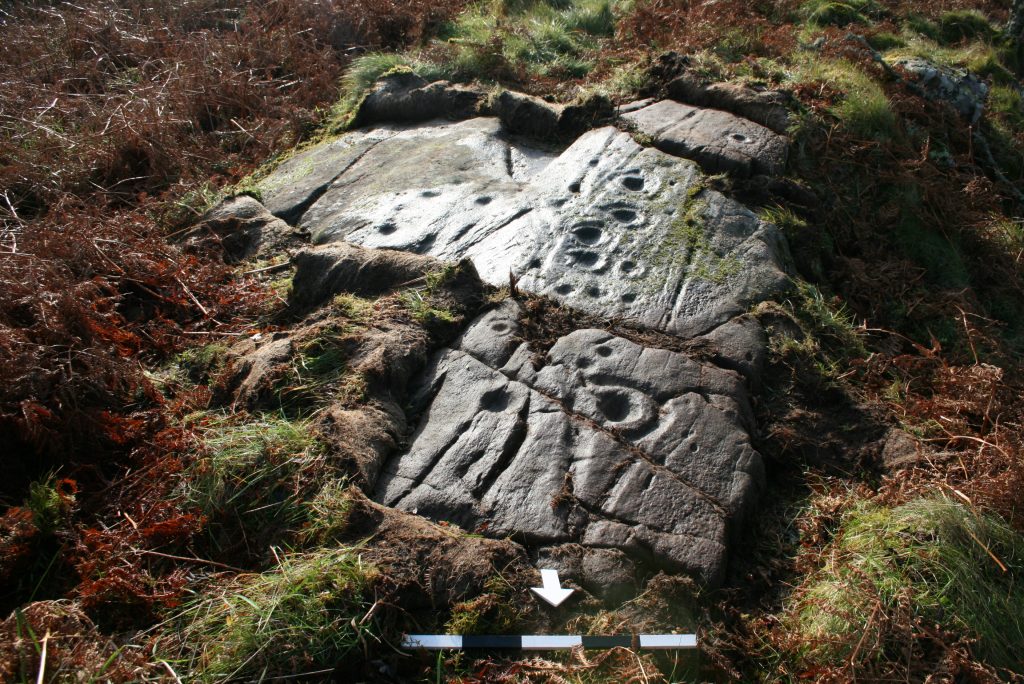
The majority of carvings in Scotland were done on horizontal and flat surfaces of boulders and outcrops, often flush with the ground (ScRAP and Historic Environment Scotland)
3,000+ panels, many thousands of symbols
Scotland’s prehistoric rock art has been known since the 19th century. For more than 150 years, researchers and specialist amateurs have searched for and recorded these enigmatic carvings, and their extensive fieldwork has greatly enriched our knowledge of Scotland thousands of years ago. Similar prehistoric rock art is known elsewhere in Britain and western Europe, including Ireland, Spain and Portugal, demonstrating the long-term connections between these regions.

Cupmarks and cup-and-rings are the most emblematic symbols of this carving tradition, also known as Atlantic Rock Art (ScRAP and Historic Environment Scotland)
More than 3,000 carved rocks are known in Scotland. Some areas are renowned for their density of elaborate rock art; for example Kilmartin Glen (Argyll), where you can find hundreds of panels including the famous rocks of Cairnbaan or Achnabreck, and Dumfries and Galloway with its stunning group of carvings at Drumtroddan. The rock art in both these areas features a wide variety of motifs and often densely decorated panels, and they are acclaimed as internationally important references of Scottish prehistory. Other places have fewer panels or simpler designs, and curiously there are also parts of Scotland, such as the central Highlands, which appear to have no rock art at all.
However, despite the numerous accounts, images and academic work, we still know little about who created the rock art and why.
Scotland’s Rock Art Project (ScRAP)
Scotland’s Rock Art Project (ScRAP) was established in 2017 to enhance awareness and improve our understanding of prehistoric carvings in Scotland. In collaboration with eleven trained community teams, the project set out to record rock art across the country using a standardised methodology, including the production of 3D models for every panel.

New digital technologies such as 3D modelling are helping archaeologists to uncover the secrets of rock art by revealing details of the carvings that are otherwise difficult to visualize (ScRAP and Historic Environment Scotland)
The teams have recorded over 1,600 panels, all publicly accessible on ScRAP’s website, and created hundreds of 3D models that can be seen on the Sketchfab account (and also here). The detailed database co-produced with community teams will allow the project team and future researchers to carry out innovative research and shed new light on these carvings in Scotland.
Want to keep learning? Dig into the Society of Antiquaries of Scotland lecture below and find out more about identifying and understanding rock art in online guides from Historic Environment Scotland.
By Joana Valdez-Tullett and Tertia Barnett (Historic Environment Scotland). Joana was the Research Assistant to Scotland’s Rock Art Project. In her 17 years of rock art research she has investigated sites from the Palaeolithic to the Iron Age, from Iberia to Britain and Ireland. Tertia was Principal Investigator of Scotland’s Rock Art Project and an Honorary Fellow at Edinburgh University. She has been investigating rock art and working with community groups for over 20 years.
Scotland’s Rock Art Project (ScRAP) was a five-year (2017-2021) community-led research project, funded by the Arts and Humanities Research Council and run by Historic Environment Scotland in partnership with the University of Edinburgh and Glasgow School of Art.
Featured Image: Prehistoric carvings are scattered in many landscapes across Scotland (ScRAP and Historic Environment Scotland)
