Ancestor or adversary? Understanding the six-headed medieval burials from St Colman’s Church in Portmahomack | Archaeological Research in Progress
When the Tarbat Discovery Programme excavated a Pictish settlement in Easter Ross, over 80 medieval burials were also recovered – including a “six-headed” grave which made headlines across the country. [NOTE: Article contains images of human remains]
The Tarbat Discovery Programme is best known for the excavation of the 8th-century monastic settlement which lay around and beneath the Church of St Colman in Portmahomack.
In addition to the burials, the results of the 20-year research programme identified exceptional archaeology belong to a later medieval settlement of the 13th to 16th centuries, including evidence for housing, craft-working, farming and fishing.
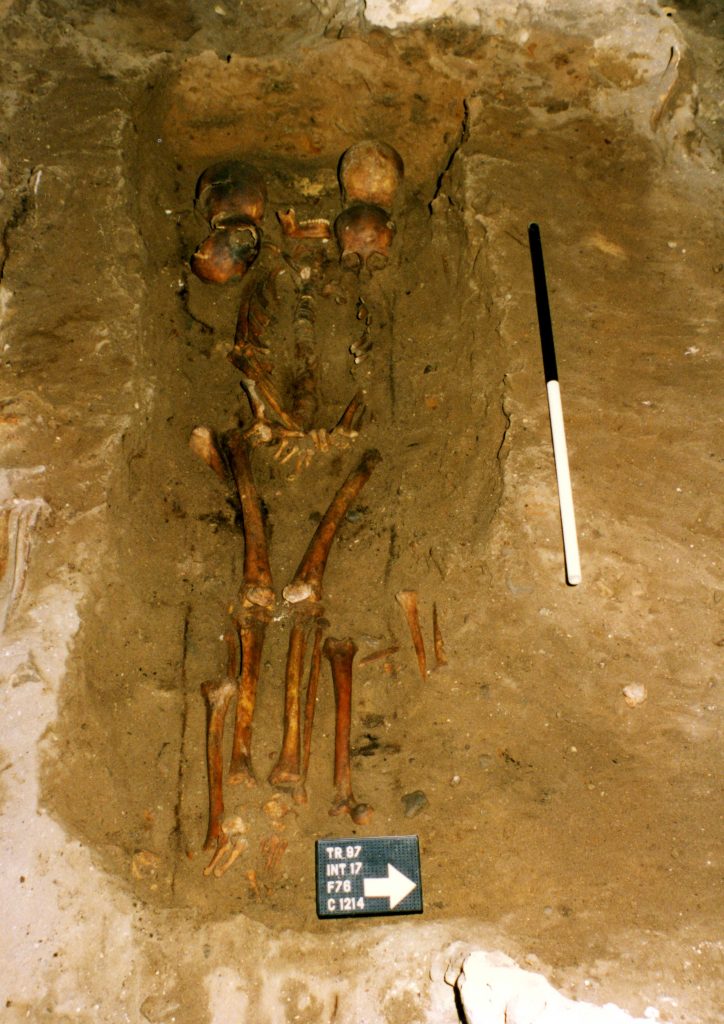
View of the first six-headed burial surrounded by four skulls (Image credit: University of York)
Portmahomack’s six-headed burials
Among the medieval graves was a group of exceptional burials. A large grave, positioned centrally in the nave of the church at the entrance to the crypt, had been dug to bury a large oak coffin containing the body of a man aged between 45 and 60 years, killed by a large, bladed weapon. His injuries included a blow to the left temple followed by a fatal blow across his right cheek which probably severed his jaw from his face.

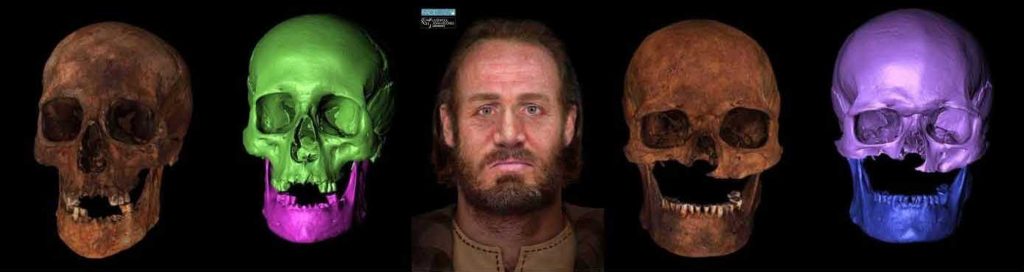
3-D scans of the skull of the first (right) and second (left) six-headed burials; the blade injury across his face can be seen where the upper teeth are missing (Image credit: Visualising Heritage, University of Bradford)
When buried, his body was accompanied by four skulls set surrounding his head. Analysis of the skeletons and bones (known as osteological analysis) by Dr Shirley Curtis-Summers from the University of Bradford shows that these four skulls belonged to three men (aged 46 to 59 years, 26-35 years and 18 to 25 years) and a woman (aged 18 to 25).
Understanding the origin and curation of these skulls is a key question in the current project or – to put it another way – are they the skulls of adversaries or of ancestors? Could the skulls represent vanquished enemies and could the two men have been rivals in life? Or, could the skulls represents ancestors and could the two men have been related to each other?
After a time, perhaps a generation, the grave was reopened and the body of a second man placed within overlying the first (as well as the other four skulls). This act involved the removal of the first man’s skull which was placed at the foot of the grave. The second man was aged 36 to 45 years; there are no signs of how or why he died.
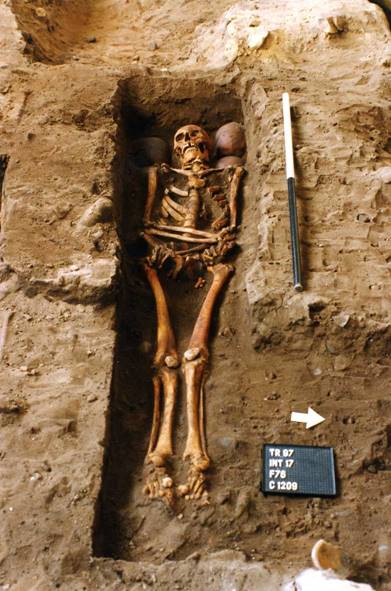
View of the second burial in the grave overlying the first with the four skulls (Image credit: University of York)
Archaeological science is now being used to better understand these incredible burials. Radiocarbon dating, a method for determining the age of archaeological material, and in this case how long ago these people died, has been undertaken on both burials and the skulls.
Stable-isotope analysis, or atomic analysis of levels of strontium and oxygen preserved in tooth enamel, has been undertaken to try to understand whether these people grew up locally or not. This was done to see whether the burials could represent an incoming group of people to the local area.
Stable isotope analysis of levels of carbon and nitrogen has also been undertaken to provide information about their diet. Understanding what people ate can sometimes help understanding of their status in life and whether they enjoyed special privilege.
Ancient DNA analysis is also underway to see whether the individuals share familial or ancestral links. This question is key to understanding the burials; if the individuals are related the possible ancestral connection can be confirmed. Facial reconstruction has also begun on the two men buried in this grave. This technique brings these people back to life and helps us to feel more connected to their story.
What did they look like?
Facial reconstruction has been completed for the second man. This process was begun by scanning the skull and jaw in 3-D, undertaken generously by Visualising Heritage at the University of Bradford (see header image and “3-D scans” image above). This digital image then formed the basis of computer-based reconstruction undertaken by specialists at Face Lab at Liverpool John Moore University.
The team use a European database of average tissue depth measurements to rebuild the likely appearance over the skull. The reconstruction allows us to look into the face of this man who died 700 years ago and will be used as part of an exhibition for the public at the Tarbat Discovery Centre.

Computer overlay of facial reconstruction over skull scan (Image credit: FaceLab, Liverpool John Moore University)
When did they die?
Radiocarbon dating and modelling was also undertaken by the Scottish Universities Environmental Research Centre (SUERC). The results tell us that the first man died around 700 years ago (AD1290 and 1410 – modelled at 95.4% – meaning there is a 95.4% probability the man died between these two dates). The four skulls that he was buried with break into two groups.
One of the individuals – the Pictish man – died hundreds of years earlier (AD770-945). It is possible that this much older skull was selected to make a connection with the early Christians who were buried at Portmahomack and it may have been seen as a holy relic.
The three remaining skulls all returned similar dates to the first (between AD1250 and AD1400) and appear broadly contemporary, although slightly earlier which aligns with the archaeological evidence which tells us that these people must have died before the first man was killed. The second man buried in the grave when it was reopened died slightly later (AD1335 to 1450). This means that – with the exception of the Pictish skull – the individuals group closely together.
While the Pictish skull may represent a holy relic, the spacing of the dates of the remaining three skulls and the two men in the grave could be separated by as little as a generation, or about 25 years or so. Although the radiocarbon dates do not confirm that theory, it still remains a possible explanation. This seems to suggest that there was an ancestral emphasis in the composition of these extraordinary burials.
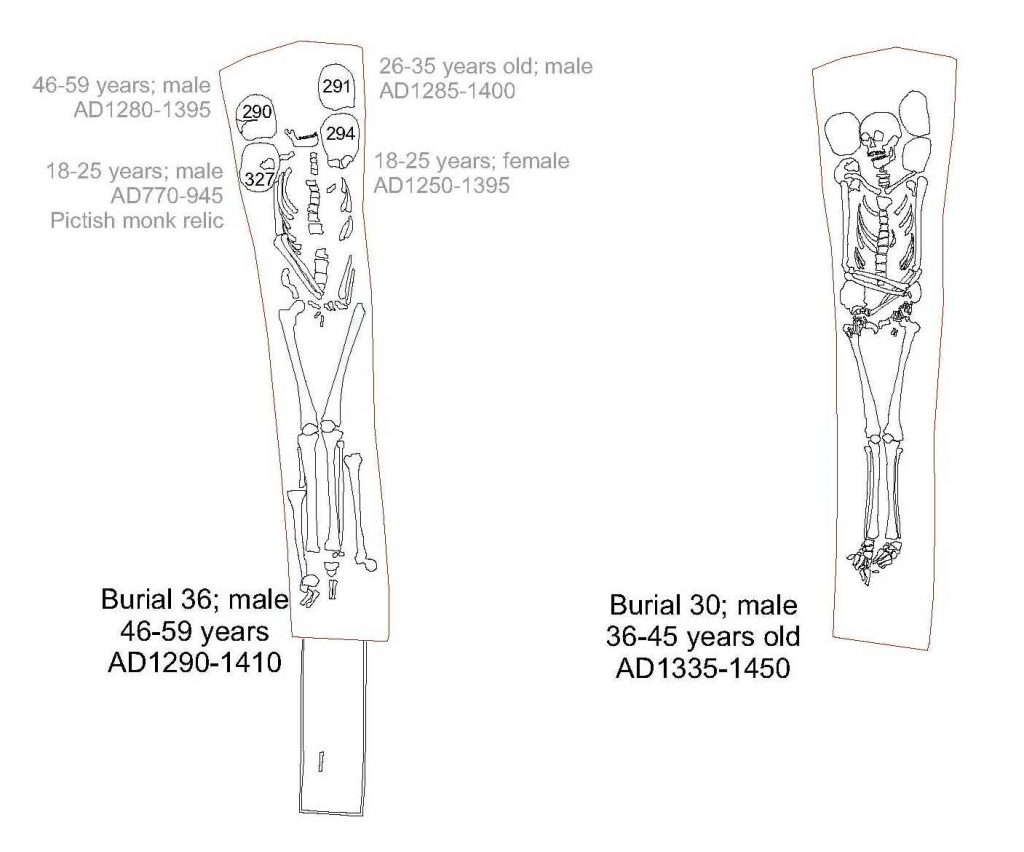
Summary of burials and skulls showing modelled radiocarbon dates (Image Credit: FAS Heritage)
Were they related?
Samples from both burials and the four skulls have been submitted to the David Reich Lab at Harvard University who are generously undertaking ancient DNA analysis for the project and the results are anticipated. Initial processing has indicated that preservation is good and that it will be possible to detect family relationships, and shared ancestry.
Where did they come from?
As well as C14 dating and ancient DNA analysis, multi-isotope analysis has also been undertaken, again by SUERC. Analysis of levels of strontium and oxygen stable preserved in tooth enamel, taken into the body through drinking water and food, influenced by local geology and climate (rainfall), indicates that the first burial and the three contemporary skulls were all likely to have been born locally. Interestingly, the values of the second burial indicate he was not born locally, but moved here during childhood perhaps from the west of Scotland, Shetland or Orkney.
What’s next?
Research continues and will bring together the results of the archaeological scientific enquiry and place them into a historical context. These people lived and died during the 14th century which was a period affected by some natural and environmental events – including climate change, pandemics and crop failures – which impacted life across Europe. It is likely that these people who were buried at Portmahomack lived through extraordinary times.
If you’d like to know more, the results of the overall research programme were published in 2016 and are now available online. The Tarbat Discovery Centre in Portmahomack also presents the results of the archaeological research including Pictish and later medieval artefacts, and a visit is highly recommended once museums can reopen.
By Cecily Spall, FAS Heritage. Cecily has been working as a field archaeologist for over 20 years. Much of her career has been spent researching the archaeological site around St Colman’s Church, Portmahomack with Professor Martin Carver. As of 2020, Cecily was still researching the late medieval archaeology at the site.
The Tarbat Special Burials Project – which began in 2019 funded by Historic Environment Scotland and the Society of Antiquaries of Scotland – aims to use archaeological science to better understand the late medieval population, in particular a group of highly unusual burials, including the “six-headed” grave.
Header Image Credit: Visualising Heritage, University of Bradford and FaceLab, Liverpool John Moore University (Centre)
This article was produced as part of Archaeological Research in Progress 2020, an online version of the annual conference which presents new research findings and best practice in archaeology covering all periods from across Scotland and beyond. It is organised in alternate years by Archaeology Scotland and the Society of Antiquaries of Scotland, with support from Historic Environment Scotland.
