Dogs, Not Dinos! The Truth about Zooarchaeology

Ask any archaeologist what the most common questions they get from the general public, and you’re likely to hear one about dinosaurs. Although both fields deal with very, very old bones, dinosaurs are more of the realm of palaeontology, not archaeology.
But what about very old animals that aren’t dinosaurs…and aren’t humans, either? After all, you don’t have to be an archaeologist to stumble across animal bones – think about how many times you’ve seen sheep bones while hiking through the countryside, or fish bones washed up along the coastline of a beach, or the remaining rubbish of someone’s fried chicken lunch tossed onto the pavement? Whose job is it to look at the fried chicken lunches of prehistory?
Well…that’s my job, actually. Welcome to zooarchaeology!
WHAT IS ZOOARCHAEOLOGY?
Zooarchaeology can be best described as the study of animal bones from the past – after all, archaeological sites aren’t just full of human bones and pottery. The objective of a zooarchaeologist is to identify animal bones retrieved from excavation and analyse them to see what additional information they can provide about a specific site or time period.
This isn’t limited to just species, either – zooarchaeological analysis can reveal seasonality, environmental conditions, local diet, and even a bit about human cultural beliefs from the past.

Cattle bones ready to be excavated from the site of Swandro on Rousay, one of the Orkney Islands (Photo: Alex Fitzpatrick)
LIFE ON THE FARM
When most people think of animals, they often think of farms and settlements – unsurprisingly, this is often the case when zooarchaeologists find animal bones on site.
Archaeological sites such as Broxmouth Hillfort are representative of the more domestic side of the past. Broxmouth is an Iron Age (800 BC – 100 AD) hillfort in East Lothian that has one of the largest assemblages of animal bones in Scotland. When we talk about “domestic” animals, we’re specifically talking about species related to domestication and agriculture: sheep, cattle, horses, pigs, etc.
And these species can be found in huge numbers at Broxmouth, providing zooarchaeologists with a better idea of what sort of animals were raised at the hillfort, which in turn reflects the sort of animal products (such as meat, wool, milk, etc.) available to the inhabitants.
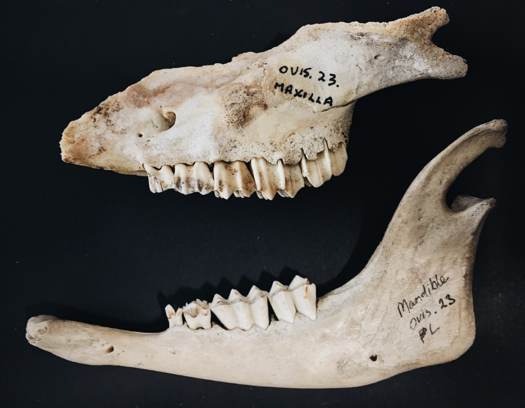
Fragments from a sheep skull (Photo: Alex Fitzpatrick)
INTRODUCTION AND EXTINCTION
Zooarchaeology can also help us understand (and sometimes, even recreate) past environments. Since many species follow certain migration patterns, their presence/absence in certain archaeological sites can give zooarchaeologists a better idea of when spaces were occupied and used by people in the past.
Animal bones can also provide us with more information on the introduction and extinction of certain species. For example, did you know that fallow deer are not native to Britain? Zooarchaeological investigation into the history of fallow deer distribution has revealed the Mediterranean origins of the commonly seen species, which were introduced to Britain twice: once by the Romans, and then again by the Normans.
On the opposite end of the spectrum, we can also use zooarchaeology to learn more about now extinct species – such as the Great Auk, a species of seabird that dwindled, with one of the last surviving birds was killed under suspicion of being a witch by sailors from St. Kilda.
FROM FOLKLORE TO FUNERALS
But animals are more than just part of our shared environment…or part of our meals, either. Animals have always been a significant part of our cultural lives as well, from folklore characters to artistic symbols. Throughout prehistory, animals were also vital to many forms of ritual and funerary practices.
For example, at the mortuary sites within the Covesea Caves in the Highlands, many animal bones have been found alongside human bones, including a significant amount of domestic animals and red deer bone. It is possible that some of these animal bones were important to the ritual practices occurring within these caves.
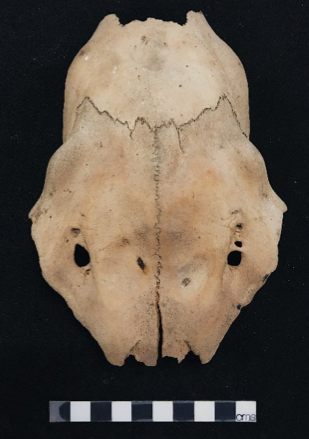
The top of a red deer skull from Covesea Cave 2 (Photo: Alex Fitzpatrick)
Interested in learning more about zooarchaeology? Well, you’re in luck! There are many resources online: blogs, podcasts, Twitter accounts, and even free-to-use eBooks and databases that contain useful images and measurements of various animal bones for reference. Our research stems from so many sources – from archaeology to biology, zoology to osteology, there are so many ways to get involved!
By Alex Fitzpatrick, a zooarchaeologist and current PhD candidate at the University of Bradford. Her current research is on the Covesea Caves of Scotland and examining the role that animals may have played in later prehistoric ritual and funerary rites.
Header Image: A selection of animal bones excavated from the Covesea Caves (Photo: Alex Fitzpatrick)

This article was produced as part of Scotland Digs Digital. In the summer of 2020, we shone a spotlight on Scottish archaeology with the Scotland Digs Digital campaign which brought together online and offline events, as well as live updates from across the country for everyone to enjoy.
