Stunning Photography Series Brings Scotland’s Summer Archaeology into Focus
Excavations at an estate with prehistoric origins, a ‘rare’ medieval burial ground and on the route of Scotland’s first railway have been captured by three photographers as part of a national campaign.
Shot in September in Dumfries & Galloway, the Inner Hebrides and East Lothian, the images were commissioned as part of a series by Dig It! to mark the end of the Scotland Digs 2021 campaign which celebrated the archaeological activity that took place across the country this summer.
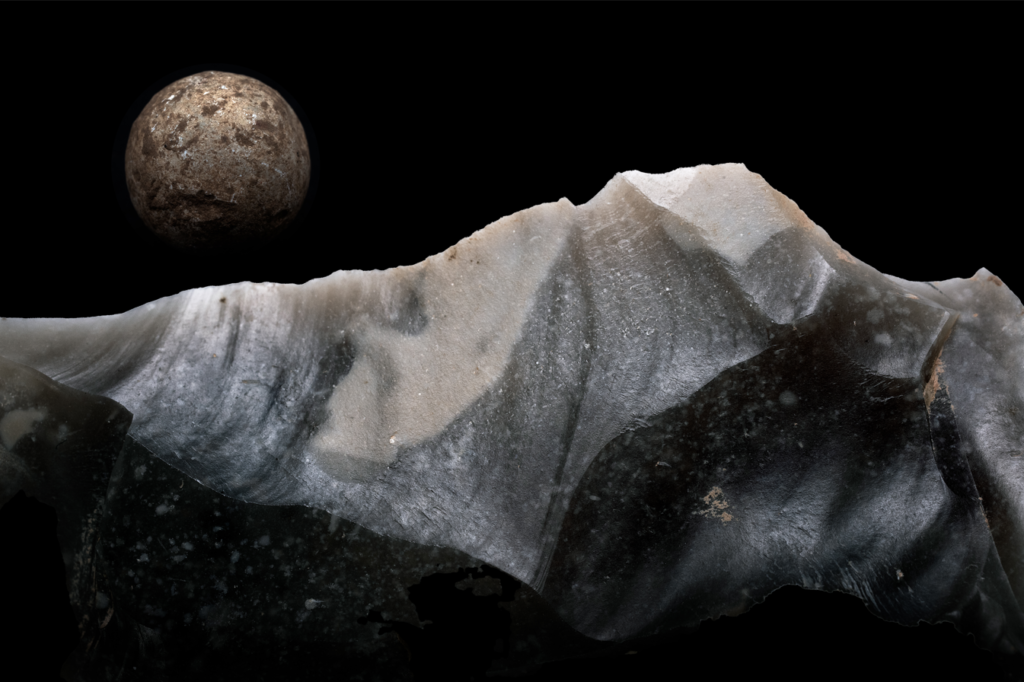
In Dumfries & Galloway, volunteers joined the Galloway Glens Landscape Partnership and the National Trust for Scotland on the Threave Estate to uncover artefacts spanning thousands of years, including a flint flake (waste material produced in the making of prehistoric stone implements) from an assemblage which is potentially late Neolithic/Early Bronze Age in date, meaning it could be around 4,500 years old, and lead shot which could date as far back as the 16th century.
Inspired by the region’s Dark Sky Park, interdisciplinary artist Chris Dooks re-imagined these artefacts as “Hubble Telescope-like” imagery with lunar vistas.
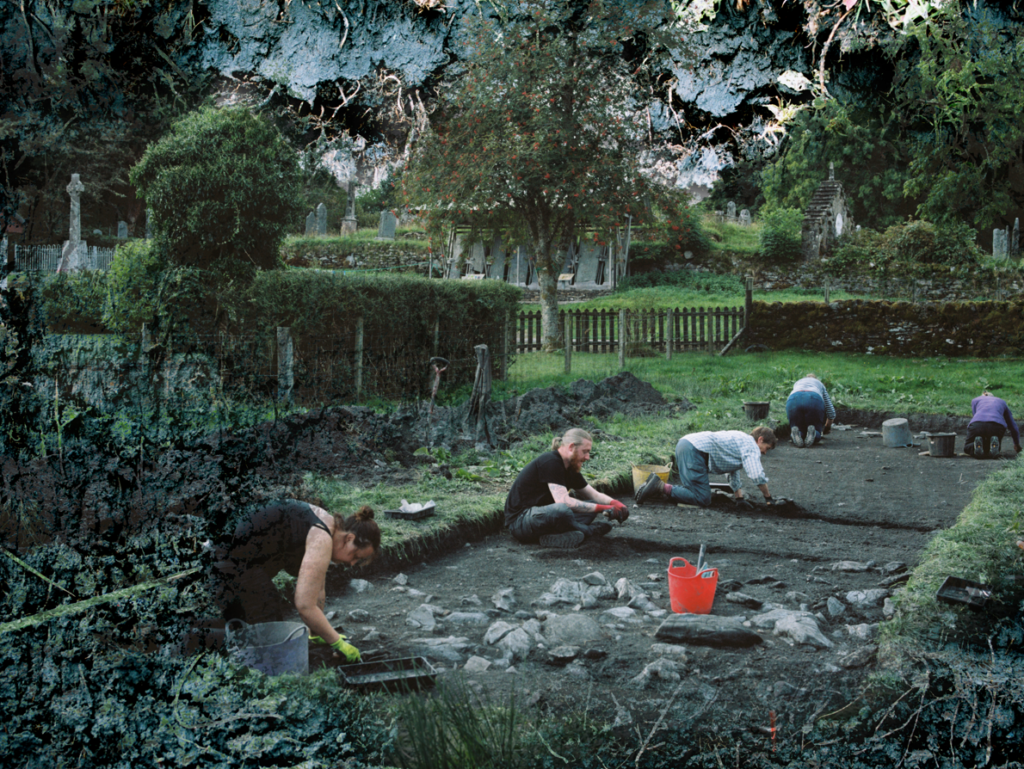
On the Isle of Lismore in the Inner Hebrides, Comann Eachdraidh Lios Mòr called on members of the public to help uncover more of a 1,300-year-old cemetery linked to St Moluag—thought to be Scotland’s first patron saint—which was first discovered on the island in 2018.
Photographer Demelza Kingston chose to convey the feeling of time overlapping as layers of earth and peat were scraped away to reveal finds during the first week of excavation at the rare surviving Early Christian cemetery, which resulted in the unexpected discovery of prehistoric artefacts.
© Demelza Kingston 2021
In East Lothian, award-winning photographer Shahbaz Majeed focused on the 1722 Waggonway Heritage Group’s work on the route of Scotland’s earliest railway.
Majeed wanted to capture the experience of excavation from a different perspective as he observed archaeologists and volunteers uncovering three early wooden railways stacked on top of each other which appears to have been the result of multiple upgrades over a short period of time.

© Shahbaz Majeed 2021
During the campaign, Dig It! shared updates from over 20 fieldwork events across Scotland, most of which were open to the public either as visitors or volunteers with a range of activities available for anyone wanting to try their hand at archaeology. People were also able to follow along at home thanks to posts on the Dig It! website and social media under the dedicated hashtag: #ScotlandDigs2021.
In addition to the photographed sites, this included fieldwork at the Neolithic complex at the Ness of Brodgar in Orkney, the landscape around the Neolithic Calanais Standing Stones in the Outer Hebrides, a possible prehistoric monument on the Isle of Arran, prehistoric rock art sites in West Dunbartonshire, an Iron Age complex in the Highlands, Iron Age and possible medieval structures near Stirling, Pictish sites in Aberdeenshire and Moray, Victorian-era dwellings in Falkirk and more.
The Scotland Digs 2021 campaign, coordinated by the Dig It! project, also highlighted the work of commercial archaeology units, who shared finds that ranged from possible prehistoric metalworking artefacts to medieval leather shoes.
Dr Jeff Sanders FSAScot, Project Manager at the Society of Antiquaries of Scotland’s Dig It! project, said:
“Archaeology is all about discovering Scotland’s stories and these photographs tell tales of stepping into landscapes, uncovering traces of the past and reconstructing lost worlds from the smallest fragments. It’s an imaginative process driven by people – one that can be fun and boisterous or calm and contemplative – so it was wonderful to see the public welcomed back to sites again this summer during the Scotland Digs 2021 campaign.”
Amy Eastwood, Head of Grants at Historic Environment Scotland (HES), said:
“It’s been great to see so many people get involved in exploring Scotland’s rich archaeology during Scotland Digs 2021, and these fantastic photographs really showcase the wonderful range of diverse fieldwork projects that have taken place right across Scotland over the course of the summer.”
Want to keep exploring? Find your next event or dig into over 100 archaeology stories.
Dig It! is coordinated by the Society of Antiquaries of Scotland and primarily funded by Historic Environment Scotland
Header Image: © Chris Dooks 2021
