The Easiest Guide to Scotland’s Archaeological Time Periods and Ages
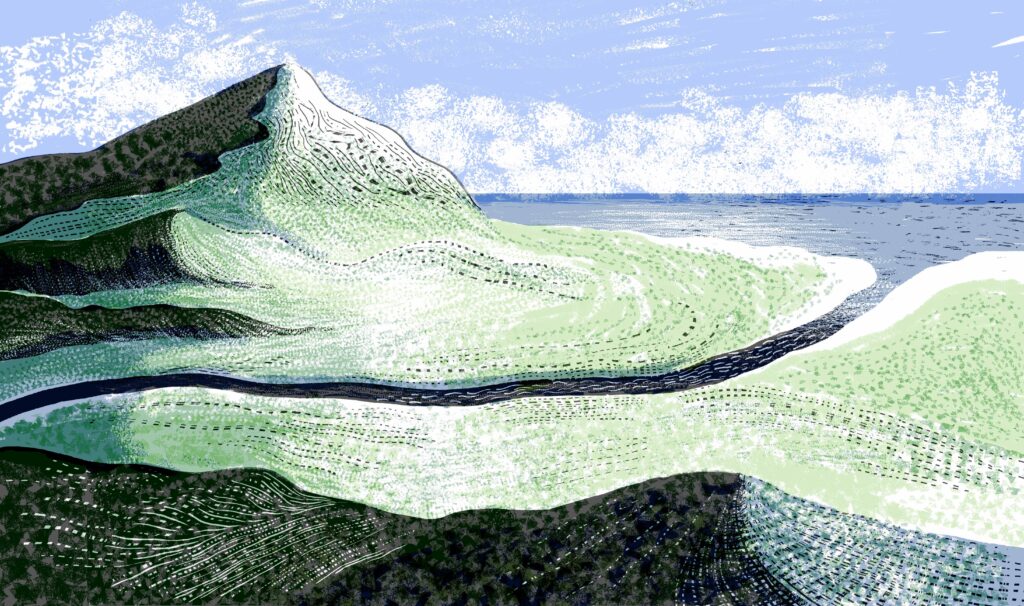
If you’d like to know more about Scotland’s past, it helps to know a bit more about the different time periods.
But if you’ve ever found it difficult to navigate, it might be because there isn’t a “single agreed published list of Scottish periods for use in consistently indexing cultural heritage datasets of artefacts, monuments and sites”.
It doesn’t help that dates and names for archaeological periods are also not the same for all regions of Scotland (or other parts of the UK or other continents, if you’re wondering).
It’s worth noting that this guide will also be regularly updated because history is constantly being rewritten. New research or a new discovery will inevitably change our understanding of Scotland’s timeline since it was first published.
We should also mention that these dates are approximate and “fuzzy” – there was a gradual shift in lifestyle in most cases, rather than a sudden change from one period to another. For example, people didn’t wake up on 1 January 800 BC and start making iron for the first time.
TLDR: these are more like oversimplified guidelines. We’ve included links to further information which we highly recommend you check out.
It will also help to know that AD (“anno Domini”) counts the years from the start of the “conception/birth of Jesus” and BC (“before Christ”) marks years before the start of the era. There is no year zero (so it goes 2 BC to 1 BC to AD 1 to AD 2) and AD traditionally goes before the year number and BC is placed after the year number. [1]
Finally, what is now Scotland wasn’t called “Scotland” until relatively recently (the last 800 years or so), so when we say “Scotland” in this article, we mean the area of land that is now called “Scotland”.
Let’s get started…
When was the Palaeolithic period (or Old Stone Age) in Scotland?
The Palaeolithic period (or Old Stone Age) begins with the first use of stone tools by early humans around 2.5 million years ago in Africa. However, in Scottish archaeology, the Palaeolithic period begins around 14,000 years ago when we have the earliest evidence for people living in Scotland and ends around 12,800 years ago (12000 BC to 10800 BC), which is known as the Late Upper Palaeolithic.
Up until then, most of Scotland was covered in ice sheets. Small groups of generally nomadic hunter-gatherers walked from what is now mainland Europe (sea levels were lower than they are now) and lived off the land by hunting for fish and wild animals and gathering fruit, nuts, plants, roots and shellfish.
The terms “Palaeolithic”, “Mesolithic” and “Neolithic” come directly from the Latin for “Old Stone Age”, “Middle Stone Age” and “New Stone Age” and are still commonly known by those terms although they’re not perfect as they suggest that people only used stone tools.
What kind of Palaeolithic artefacts have been found in Scotland?
Ancient stone tools (known as flints or lithics) are the only artefacts found from the Upper Palaeolithic in Scotland. These are found mainly around the coasts or rivers and sometimes in caves which were often used for shelter. The people who lived here moved around and did not settle anywhere for long, but some sites where people must have stopped for short periods have been found.
What kind of Palaeolithic sites can you visit Scotland?
Since they didn’t stay in one place long enough to build structures sturdy enough to stand the test of time, your choices are limited. However, you can still visit some rock shelter sites and caves.
When was the Mesolithic period (or Middle Stone Age) in Scotland?
The Mesolithic period (or Middle Stone Age) began around 12,800 years ago and ended around 6,100 years ago (10800 BC to 4100 BC). It begins at 10,800 BC because this is the earliest date that Mesolithic-style stone tools have been found in Scotland, but as we mentioned above, it keeps getting slightly earlier with new finds and dating evidence.
People were still living off the land and mainly using tools made from stone, bone and wood – but the climate improved at the end of the Ice Age and they adapted their way of life in response to increased woodland and a wider variety of resources. While still mainly hunter-gatherers, they made more use of a wider range of things they could eat (by fishing more, for example) and started managing the woodland (by clearing trees, for example), which was a stepping stone to different forms of agriculture.
They also learned how to make more sophisticated tools using tiny flint implements known as “microliths” (with many tiny flints often used together to create sickles, spear heads and arrowheads) and – thanks to evidence such as groups of small circles of post-holes cut into the ground – we know that they became more sedentary, building small timber-framed structures (a bit like tents) and staying in camps for longer periods.
What kind of Mesolithic artefacts have been found in Scotland?
The main evidence from this period is coarse stone tools, lithics (particularly very small microliths used in what are known as “composite tools” rather than just single arrowheads, for example) and the waste that was produced during their production since most organic artefacts (plant and animal materials) generally don’t survive well in Scotland’s acidic soils. However, bone artefacts such as antler tools have been found in certain conditions, as well as shell middens (dumps of waste materials – including fish bones), charred remains (including hazelnut shells) and some timber where the conditions allow it.
What kind of Mesolithic sites can you visit in Scotland?
You won’t find the remains of any structures, but you can find a few shell middens and interpretation panels at a handful of dwelling sites.

Mesolithic Scotland (Illustration by Ed Kluz)
When was the Neolithic period (or New Stone Age) in Scotland?
The Neolithic period (or New Stone Age) began approximately 6,100 years ago and ended around 4,500 years ago (4100 BC to 2500 BC), which begins with the earliest evidence of a farming way of life and ends when copper tools are first used.
During this time, farmers arrived from what is now mainland Europe – and since people were now staying in one place for longer periods of time (rather than having to roam around for food), they also started building permanent structures such as stone dwellings and tombs. This means that there are a lot more clues for archaeologists compared to the Palaeolithic and Mesolithic periods.
What kind of Neolithic artefacts have been found in Scotland?
In addition to farming equipment such as hoe-blades made from stone, we start to find flint arrowheads all over the country, pottery (often as fragments) in burials and rubbish piles known as middens, and polished stone tools (axeheads). And unlike the Mesolithic period, archaeologists begin uncovering examples of prehistoric art like carved stone balls.
What kind of Neolithic sites can you visit Scotland?
Neolithic structures are often associated with large stones (megaliths) which is where the term “megalithic monuments” comes from. Sites that are open to visitors include tombs (also known as cairns), settlements, stone circles, rock art panels, henges and more.

Neolithic Scotland (Illustration by Ed Kluz)
When was the Bronze Age in Scotland?
The Bronze Age began approximately 4,500 years ago with the first evidence of copper tools and ended around 2,800 years ago (2500 BC to 800 BC) with the first evidence of iron tools in Scotland. This one is fairly easy to remember because it does what it says on the tin: it’s primarily characterised by the arrival of metalworking from what is now mainland Europe.
When was the Chalcolithic (Copper Age) in Scotland?
Some believe that there’s a need for a Chalcolithic period before the Bronze Age, when copper was the most popular metalworking technology (particularly in what is now mainland Europe and the Middle East). However, others have argued that by the time metalworking reached Scotland (much later than what is now mainland Eastern Europe), they were mainly producing bronze (a stronger mix of copper and tin). The debate rages on.
What kind of Bronze Age artefacts have been found in Scotland?
During the Bronze Age, people started using materials such as gold, amber or jet to display their wealth and status which tells us about social hierarchies. Grave goods (usually personal items like knives or daggers) were sometimes included in cremations and cist (stone coffin/chamber) burials as part of funerary activities.
Burials also move from having lots of bodies placed into single, large, stone-built tombs to separate burials of single individuals with grave goods accompanying them (sometimes in stone cists or graves). A specific form of pot called a “beaker” (due to its size and shape and its use as a drinking vessel) is often discovered in early Bronze Age graves and sometimes on habitation sites.
And in addition to pottery, several hoards have been unearthed which included axes (used to manage woodland more extensively), armlets, anklets, necklaces, ear pendants and swords.
What kind of Bronze Age sites can you visit Scotland?
People in the Bronze Age continued to build tombs and large stone monuments, but they also altered pre-existing Neolithic monuments (often adding burials) and added hill forts and roundhouses into the mix. Pack sturdy boots for a trek to a fort or head to one of Scotland’s replica roundhouses to get the full experience.
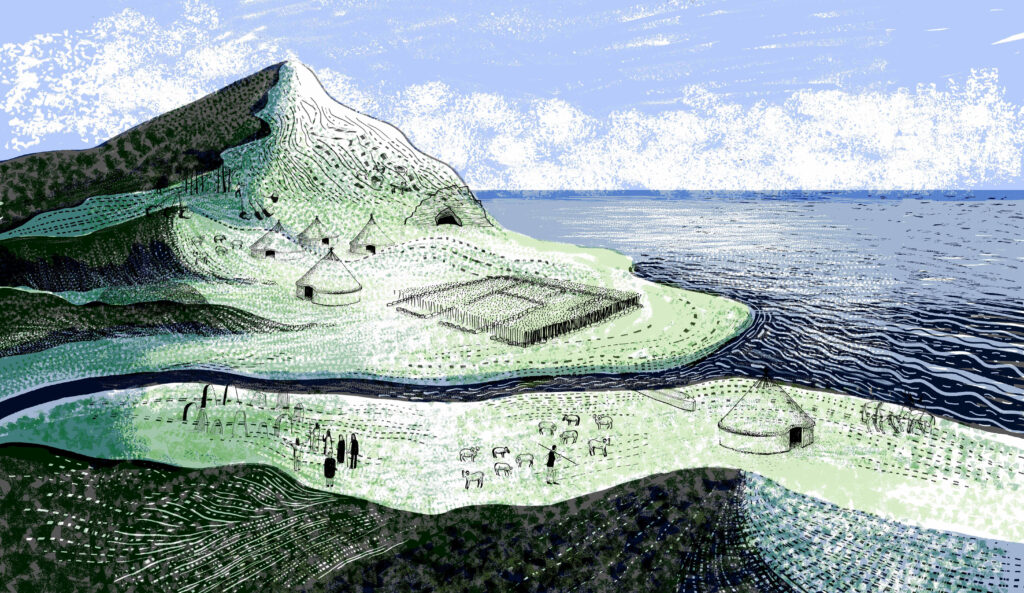
Bronze Age Scotland (Illustration by Ed Kluz)
When was the Iron Age in Scotland?
The Iron Age began approximately 2,800 years ago (when we first see iron tools in use in Scotland) and ended around 1,600 years ago (800 BC to AD 400).
At this point we stop seeing obvious cairns/tombs/cists (people began dealing with death in a very different way) and start to see new types of house and fort construction which they used to show their status.
When were the Romans in Scotland?
The Romans arrived in southern Scotland almost 2,000 years ago (in the AD 70s) and built forts along the Gask Ridge in Perthshire and along what would later become the line of the Antonine Wall. Troops were withdrawn a few years later until Antoninus Pius chose to re-invade Scotland and began building his turf wall in AD 142 with stone foundations and earthworks stretching across the Central Belt. It was abandoned in AD 165 only a few years after completion when the legions were ordered to withdraw to Hadrian’s Wall in England.
Over the next century, the Romans made several other forays into Scotland and their temporary camps can be found as far north as Aberdeenshire, Inverness-shire and Morayshire.
When does prehistory end in Scotland?
The arrival of the Romans marks the beginning of written records, so this is where “prehistory” ends.
When were the “Celts” in Scotland?
There’s no answer to this question because – unlike what popular culture might have led people to believe – there was never one group of people in Scotland called the “Celts”.
It’s really a term for people across Europe (including the Picti – see below) who shared some cultural traits specifically with regards to art (although these shared traditions are a continuation from prehistory and not limited to the Pictish period).
It’s around this time (AD 300) that Scoti or Scotti is first used (for one of these groups of people), which is where the name Scotland comes from.
What kind of Iron Age artefacts have been found in Scotland?
Well known artefacts from this period include rotary querns (stone tools for grinding – such as turning grain into flour), intricate collars called torcs (often made in silver or gold), and pins of all materials. Martial objects like swords and shields have also been found in graves, and discoveries which include the remains of a chariot and pony cap suggest that horses were important to Iron-Age society.
New types of artefacts also arrived with the Romans, including board games, coins (used as diplomatic gifts/bribes rather than currency) and objects to show off with such as feasting ware like glass vessels and strainers for drinking wine imported from the continent in barrels and amphora (vessels often used to transport wine). Feasting was likely used to cement hierarchical relationships or similar social bonds, and appeared to be important for relations between communities.
What kind of Iron Age sites can you visit Scotland?
In addition to the introduction of souterrains (underground structures probably used for storing food) and Roman sites, the Iron Age was a time of monumental circular architecture such as brochs (drystone towers unique to Scotland) and wheelhouses. Take your pick.

Iron Age Scotland (Illustration by Ed Kluz)
When was the Medieval period (or “Middle Ages”) in Scotland?
The Medieval period began approximately 1,600 years ago and ended around 500 years ago (AD 400 to 1500).
Since this period covers a lot of ground (from the increasing impact of Christianity and a decidedly rural way of life to one that included towns and taxes), it’s often split into three distinct periods with dates based on the death/installation of kings and big shifts in how Scotland was organised:
The Early Medieval Period (around AD 400 to 900): when Pictish and other “kingdoms” appear, the Romans leave Britain, Christianity takes root in Scotland, and we see the first Viking raids.
The High Medieval Period (around AD 900 to 1286): when we see the formation of the Gaelic and Pictish Kingdom of Alba in the South and North East of Scotland (AD 900), the establishment of Scandinavian Norse settlement in the North and West, and the development of “towns” and Christianity being fully established in most of Scotland.
The Late Medieval Period (around AD 1200 to 1500): when people begin building large cathedrals/monasteries, written documentation is now common, and kingship, burghs (locally governing towns/cities) and the central control of the state and trade (with regards to taxes and law) is established.
When were the Picts in Scotland?
Around 1,700 years ago (AD 300), the Romans mentioned “a collection of troublesome social groupings north of the Roman frontier” known as the Picts or Picti. They dominated northern and eastern Scotland for hundreds of years before disappearing from the written records around 1,100 years ago (AD 900). Those records could be considered a bit like searchlights flitting across Scotland, highlighting certain people at certain times. To understand the whole picture, the Early Medieval period still requires a lot of archaeological research.
When were the “Dark Ages” in Scotland?
In the past, the Dark Ages were associated with the Early Medieval Period (see above) – following the (short) Roman period where things were considered to go – “dark” in terms of the perceived social chaos and lack of development, as well as a relative lack of surviving written sources.
But new archaeological and historical evidence gleaned from written sources and sites are casting new light on the people of the era and we now know that complex societies were forming, new technologies and art were emerging, and agricultural technologies were developed so historians and archaeologists no longer use the term.
When were the Norse/Vikings in Scotland?
Scandinavian people often known as “Vikings” (a term mostly used for the people who did the raiding and travelling) started raiding coastal areas around AD 793 (during the Early Medieval Period), but soon started to settle and build new communities mainly on the islands and the North-West regions. The term “Viking” dies out from around AD 1000 (during the High Medieval Period) because there were no more Viking raids as we know them.
These settlers are known as the “Norse” (used in Scottish archaeology to refer to people that permanently settled) and their culture eventually became assimilated into Scotland.
Some regions of Scotland (like Shetland) have a distinct Norse period where they were part of Norway and Denmark rather than ruled from the Scottish mainland. The final end point of Norse rule anywhere in Scotland is AD 1472 (during the Late Medieval Period) on Shetland.
What kind of medieval artefacts have been found in Scotland?
Specialised craft activity, the emergence of burghs and increased trade with what is now mainland Europe mean that archaeologists have uncovered a wide range of items from the Medieval Period, including more objects from abroad. We also have more written records which tell us about the finds, such as burgh records for major ports like Aberdeen and Perth which detail imports and exports, as well as contract and tax documents between traders.
Early Medieval artefacts are relatively scarce as people may have been using more organic material that didn’t survive (which makes every discovery even more exciting) and don’t tend to reflect everyday life, but a handful of rare finds such as massive silver chains and hoards show that a new elite were recycling Roman silver to produce prestige artefacts to display their power and wealth. Finds like ingot moulds – probably used for melting down Roman silver – also show the development of measured weights and a form of currency. Pottery and glass vessels from what is now mainland Europe and beads from England discovered on high status sites also show wide-ranging contacts and relations with southern counterparts. Some finds such as weights, needles, crescent shaped knives, suspended pumice rubbers and pegs for wooden stretchers also hint at thriving monastic settlements which were creating vellum (animal skin) for illustrated Christian gospels and other books.
High Medieval artefacts include grave goods (like axeheads) found in rare Norse burials and finds which reflect the intertwining of pagan and Christian religions like stone crosses/cross slabs.
Late Medieval artefacts are often discovered at urban excavations like the one in Perth in the 1970s, where archaeologists discovered evidence left behind by normal people (rather than the elite) and objects that show how burghs, towns and cities developed, including leather shoes, wooden objects, barrels and window glass.
What kind of medieval sites can you visit Scotland?
In addition to Early Medieval hillforts, churches and Pictish symbol stones, castles are the stereotypical medieval site. Motte-and-bailey castles (usually consisting of a wooden keep on top of an artificial earthwork mound) were first built in Scotland around 900 years ago and were followed by stone-built castles from around 1200, which can be found across the country.

Early Medieval Scotland (Illustration by Ed Kluz)
When is the Modern (or “Post-Medieval”) period in Scotland?
The Modern period began approximately 600 years ago (1500 onwards) and hasn’t ended yet.
What kind of modern artefacts have been found in Scotland?
Archaeologists start finding a lot more “disposable” items (like clay pipes), as well as textiles and organic materials. They also find evidence of mass industries (such as pottery, glass bottles and bricks) now that these activities were happening on a large scale. In addition to pipes, textiles and ceramics, the major categories of artefacts include silver, pewter, glass, furniture, weapons, lots of different coins, jewellery and dress.
What kind of modern sites can you visit Scotland?
Sites from this era can be found across Scotland, including battlefields, harbours, pre-Highland Clearance (Fuadaichean nan Gàidheal) sites like townships and shielings (huts), railways, bridges and remains from World War One and Two. If this is your favourite time period, you’ve got plenty of options.
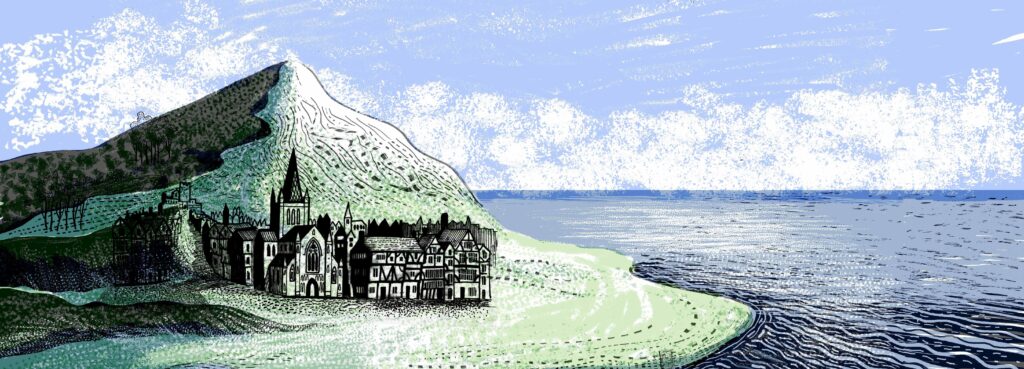
Modern Scotland (Illustration by Ed Kluz)
Want to keep reading? Click here to dig into over 100 Scottish archaeology stories or sign up to the Dig It! Digest to get events, updates and more delivered straight to your inbox once a month.
By the Dig It! and Scottish Archaeological Research Framework (ScARF) teams at the Society of Antiquaries of Scotland.
[1] You might also see B.C.E. (before common era) and C.E. (common era) – place of BC and AD or BP (Before Present) – which is the number of years before 1950 and mainly used when talking about sites that have been dated using radiocarbon dating techniques. Dates that have been derived from radiocarbon analyses will also usually have “cal” in them, such as calBC or calAD, meaning that the dates are calibrated to be as accurate as possible.
