Looking Up: Searching for Prehistoric Hunter-Gatherers in the UK’s Largest National Park

Over 6,000 years ago, Scotland was home to groups of hunter-gatherers. Evidence of their existence mostly comes from the lowlands but a new project is hoping to further develop our knowledge of how these people lived in Scottish mountains, including Scotland’s highest upland area: the Cairngorms.
Who Were Scotland’s Hunter-Gatherers?
Following the end of the last Ice Age around 12,800 years ago, Scotland was mainly a wooded landscape, and its rivers, coasts and forests were settled by hunting and gathering communities. This was a slow process which ebbed and flowed with changing climates, but by about 10,000 years ago, many different parts of Scotland were occupied by hunter-gatherers during a period we call the Mesolithic.
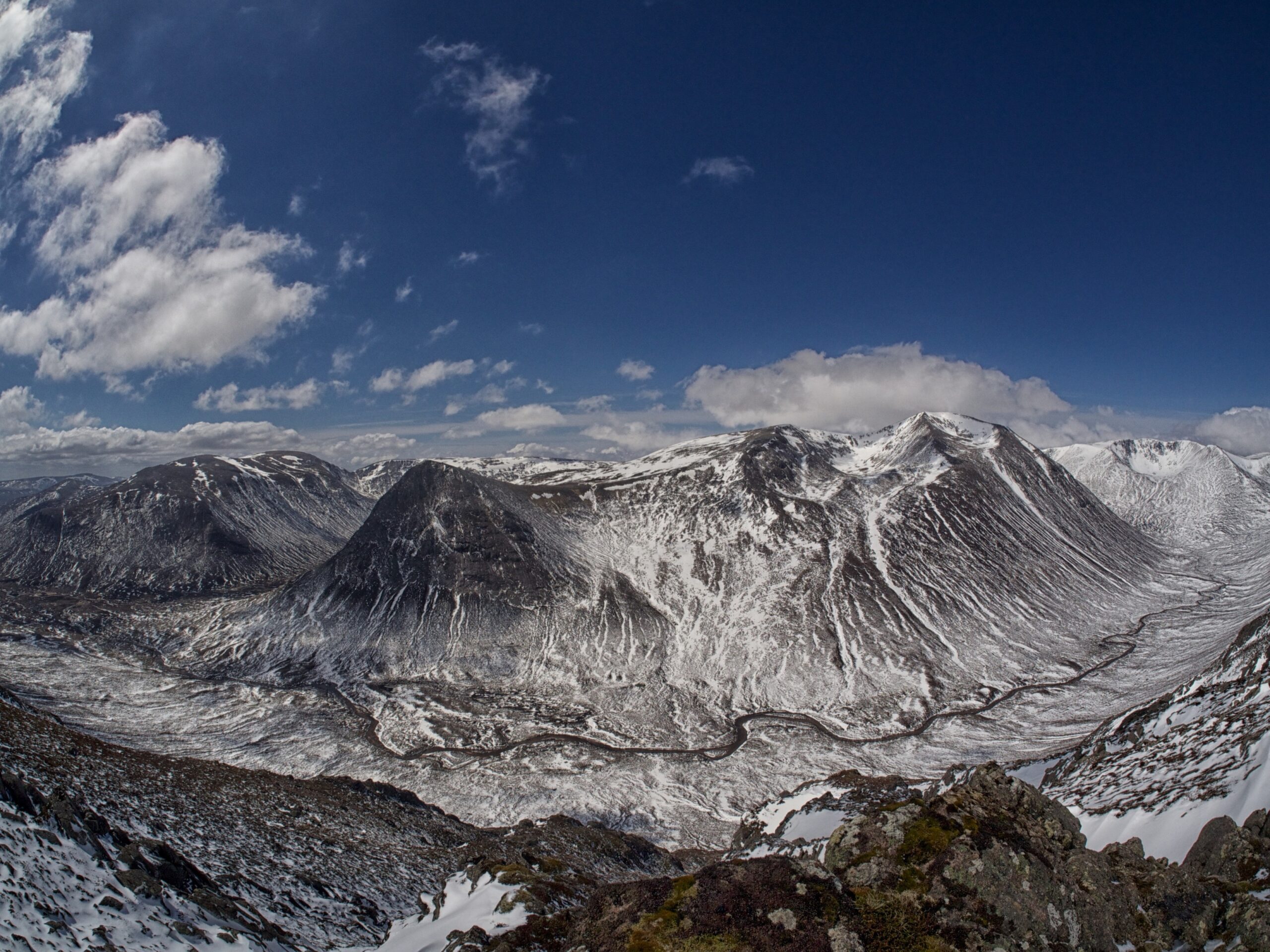
The summit of Carn a’Mhaim looking down over the Lairig Ghru (Credit: Jim Frost)
The Mesolithic lasted until about 4,000 BC, when the arrival of agricultural technologies in the following Neolithic period – probably accompanying the migration of Neolithic farmers from the European Continent into Scotland – saw substantial changes in Scotland’s archaeological record.
The Evidence for Hunter-Gatherers in the Cairngorms So Far
A lot of our Mesolithic evidence comes from the coasts, which probably highlights the importance of coastal resources to Mesolithic hunter-gatherers. It’s also true that finding Mesolithic sites inland, and especially in mountain landscapes, is very challenging.

Devil’s Point (Credit: Rowena Hepple)
However, ongoing excavation and survey since 2013 on Mar Lodge Estate (managed by the National Trust for Scotland) has shown that hunter-gatherers were living in valleys high in the Cairngorm mountains in the Mesolithic period. Two sites – Chest of Dee and Caochanan Ruadha – were excavated as part of the Upper Dee Tributaries Project (2013-2016), a collaboration between the Universities of Aberdeen, Stirling, University College Dublin and NTS, as well as many others.
At the Chest of Dee, excavation revealed that hunter-gatherers had repeatedly returned to a site near the junction of the River Dee and Geldie Burn over many thousands of years. We know this because the site has radiocarbon dates spanning most of the Mesolithic period, although gaps in the timeline suggest that there may have been periods when this location was not used. Sites this far up in the mountains are unlikely to have been occupied in winter, and we assume that Chest of Dee was used seasonally. Places like this where rivers meet are a common location for inland Mesolithic sites in Scotland.

Excavations at Chest of Dee (© University of Aberdeen and the Upper Dee Tributaries Project)
At Caochanan Ruadha, above the Geldie Burn, archaeologists excavated a very small site with a tight scatter of stone tools around an ancient fire setting. The precise way the tools were distributed showed that there may have been a small structure on the site, and the limited quantity and diversity of the group of stone tools suggests that the structure had a specialized and short-term use rather than being settled for a long time with a subsequent range of activity. We think this was a small tent that might have held no more than two or three people and was probably only occupied for a night or two at about 6200 BC.
In 2021, a team from University College Dublin started excavation of another Mesolithic site at Sgòr an Eòin on a prominent river terrace (flat land that used to be beside a river, but the river eventually cut down into the land and created another river valley floor, leaving the terrace as an elevated ‘shelf’ of land) around 475m above sea level in Glen Dee (below). Further work is planned for 2022 and 2023, but early results suggest this is another very small site with a specialised stone tool assemblage. Could this be a similar site to the one found at Caochanan Ruadha?
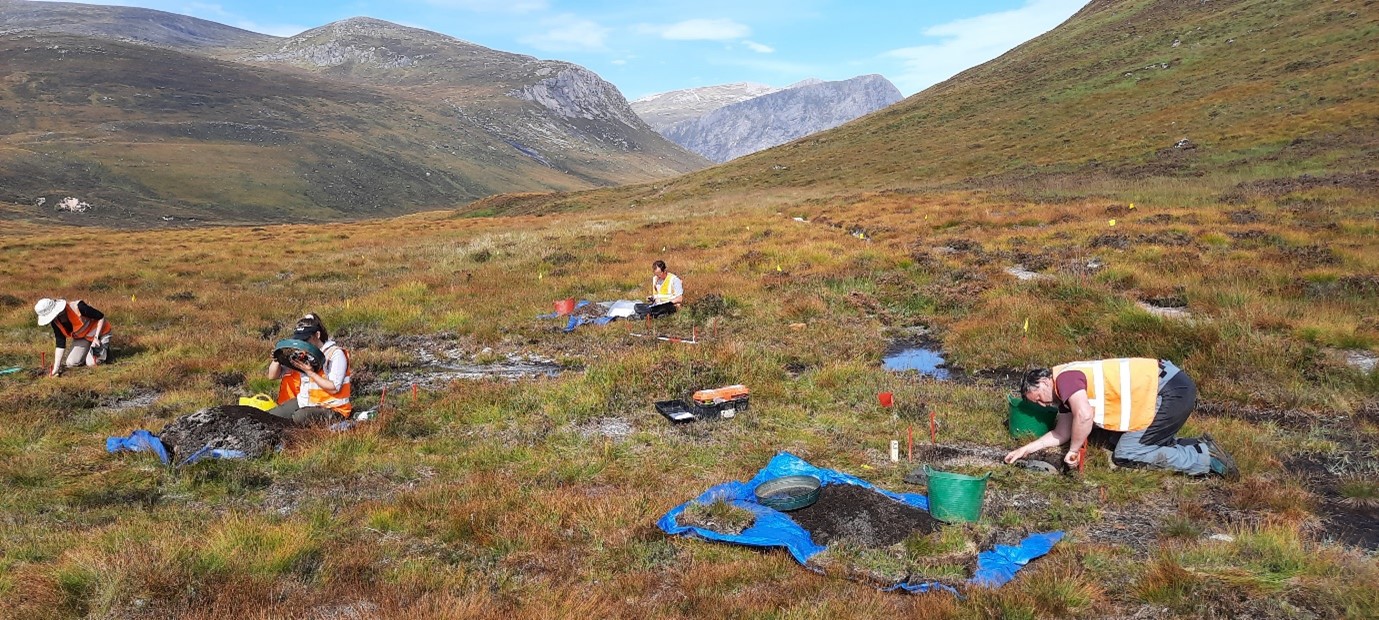
Excavations at Sgòr an Eòin in 2021 (Credit: Professor Graeme Warren)
Although sites such as these are rare, we know enough to suggest that hunter-gatherer settlement of the Scottish mountains was varied in character and quite extensive in scale. We see use of mountain landscapes through much of Mesolithic Europe, with sites also found high in the Alps or the Norwegian Highlands. Mesolithic sites in highland regions, which can only be identified through the presence of small stone tools where peat has been eroded, are very hard to find. As such we are only beginning to understand the details of how hunter-gatherer lives were entwined with the Scottish mountains.
Finding More Mountain Hunter-Gatherers
Today, mountain landscapes are dynamic, with climate change and socio-economic development transforming the landscape. In Scotland, the rewilding movement, including afforestation (when new trees are planted or seeds are sown in an area where there were no trees before, creating a new forest) and peat restoration, is a further significant cause of change. Given that archaeological sites in the mountains are so hard to find, it is difficult to develop effective management strategies for the fragile archaeological evidence contained in these dynamic landscapes.
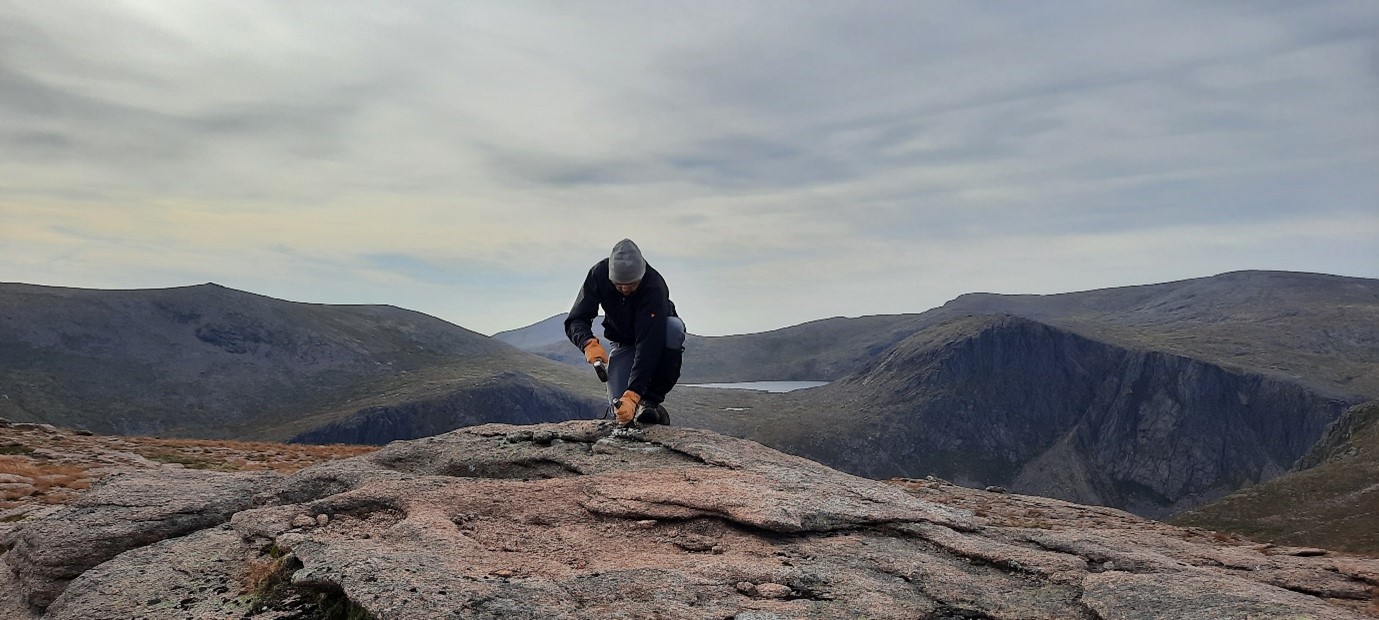
Sampling granite exposures in the high Cairngorm (Credit: Professor Graeme Warren)
A new project based at University College Dublin seeks to address this challenge. ‘Looking Up: the future of early prehistoric heritage in Europe’s mountains’ (2021-2023) is generating new geological data on the timing and pattern of the disappearance of ice in the Cairngorms, especially following about 15,000 years ago. Experts do this by using dating techniques that analyse when rocks were first freed from ice and exposed to the atmosphere, this then gives us a date for when the glaciers retreated (pictured above).
This new data will be combined with the wealth of previous work in the area and feed into the development of a model of snow and ice cover in the Cairngorms in this period. This will then help experts to build a predictive model of areas that hunter-gatherers might have settled, which can then be tested through fieldwork and excavations.
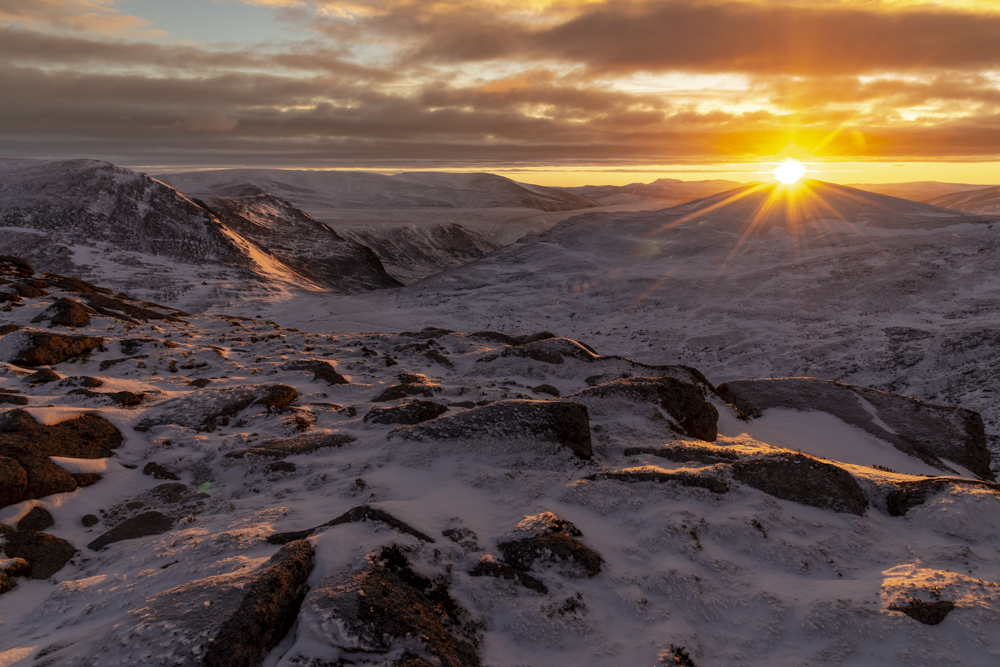
(Credit: Cranford Guest House)
Experts will also test a theory about areas on the Cairngorm plateau which have long-lived snow each year. These places are attractive environments for animals – the snow proving cool and giving some respite from biting insects. Because of this, we think they may also have been good places for hunters to target animals. If we’re right, we may find more ancient hunter-gatherer sites like those at Chest of Dee, Caochanan Ruadha and Sgòr an Eòin here. Stay tuned for more digging in the Cairngorms soon!
Now you know what the experts are up to, why not learn how you can help find prehistoric hunter-gatherers in the Scottish mountains?
The UK’s largest National Park, in the Scottish Highlands, offers masses of things to do including watersports, snowsports, wildlife watching, and some incredible high and low level walking and cycling routes. Whether you want to stay in a boutique hotel or sleep under the stars, the options are endless. Start planning your visit right now.
By Professor Graeme Warren (UCD School of Archaeology, University College Dublin), a specialist in the archaeology of hunter-gatherers and mountain landscapes and a keen mountain runner. His new book Hunter-Gatherer Ireland: making connections in an island world is just out. Follow him on Twitter at @graememwarren or email him at graeme.warren@ucd.ie
Excavations at Sgòr an Eòin are funded by the Society of Antiquaries of Scotland and UCD School of Archaeology, with significant support in kind from NTS Mar Lodge Estate. We are very grateful to Bruce Mann and Aberdeenshire Council for significant backing of all aspects of our work in the Cairngorms.
‘Looking Up: the future of early prehistoric heritage in Europe’s mountains’ (2021-2023) is a collaboration between Graeme Warren (UCD School of Archaeology), Sam Kelley (UCD School of Earth Sciences) and Alice Doughty (University of Maine) and is funded by the Irish Research Council’s COALESCE (Collaborative Alliances for Societal Challenges) scheme. It combines archaeological and geological perspectives on the deglaciation of mountain landscapes and the likely locations of archaeological sites to contribute to the development of policy on these landscapes. Looking Up is supported by a panel of stakeholders who will help guide our discussions to areas of compelling relevance for the challenges and opportunities facing early prehistoric heritage in the mountain landscapes of Scotland, with significant implications for other areas.
Header Image Credit: VisitCairngorms
