The Archaeology of Scotland’s Natural Larder: Shellfish

Shells appear in their hundreds and thousands on archaeological sites in Scotland and are a very rich source of information.
But despite their importance to archaeologists and historians, they often fall under the radar in our interpretations and understanding of the past.
Author’s note: First things first, “shellfish” is an umbrella term for aquatic animals with shells and encompasses a huge number of species. This article focuses on molluscs (invertebrate animals like sea snails, clams, and oysters). We’ll leave crustaceans (like crabs, lobsters, crayfish, shrimp, and prawns) for another article.
[Note: this article contains images of human remains]
Which marine molluscs are native to Scotland?
There’s an amazing variety of species of marine molluscs native to Scottish shores, which range in size, shape, colour and habitat.
On the rocky shore you will find species like limpets and periwinkles grazing on algae attached to rocks. Here you’ll also find the carnivorous dog whelk, hunting its fellow molluscs in the intertidal zone.

A dog whelk (the smaller white spiral-shelled creature on the right) in amongst its limpet prey (Credit: Holly Young FSAScot)
If you ever find shells on a beach with small holes drilled into them, that’s a sure sign that the creature inside became the victim of the dog whelk!
In amongst the fronds of seaweeds in Scottish waters you’ll find delicate and dazzling blue rayed limpets with their almost neon blue stripes flashing in the sunshine.
On the sands of wide stretches of beach, bivalve species (animals with two shells connected at a hinge) like razor clams and scallops can be found, filtering and consuming microscopic plankton from the water.

Left, a blue rayed limpet and right, a scallop (Credit: Holly Young FSAScot)
What’s the archaeological evidence for the use of molluscs throughout history?
The shells of molluscs appear across many different types of archaeological contexts. The most dramatic examples are large shell middens (heaps or deposits), with some of the most well-known examples found in Na h-Eileanan Siar (the Outer Hebrides) in places like Colbhasa (Colonsay) and Orasaigh (Oronsay). At the site of Cnoc Sligeach in Orasaigh, one such midden has been recorded as 38 metres long and 3.2 metres high — a monument in its own right. These middens were created by prehistoric communities depositing large quantities of empty shells in one place.

View of Cnoc Sligeach, first trench from east face (© Courtesy of HES (Early photographs of sculptured stones))
However, shells are found scattered throughout all manner of human-made deposits, including feasting deposits. An example of this is a large cooking pit excavated at the site of The Cairns in South Ronaldsay in Orkney, which dates to the 5th or 6th century AD (around 1,425 to 1,625 years ago). After a fire had been lit and the food cooked, the 18,637 shells of the limpets and periwinkles that were eaten at this feast were then carefully placed back inside the pit, stacked one inside the other. This turned the functional cooking pit into a monument, potentially to commemorate the feast.
Some shells are even associated with burial and ceremony, which we’ll explore later.
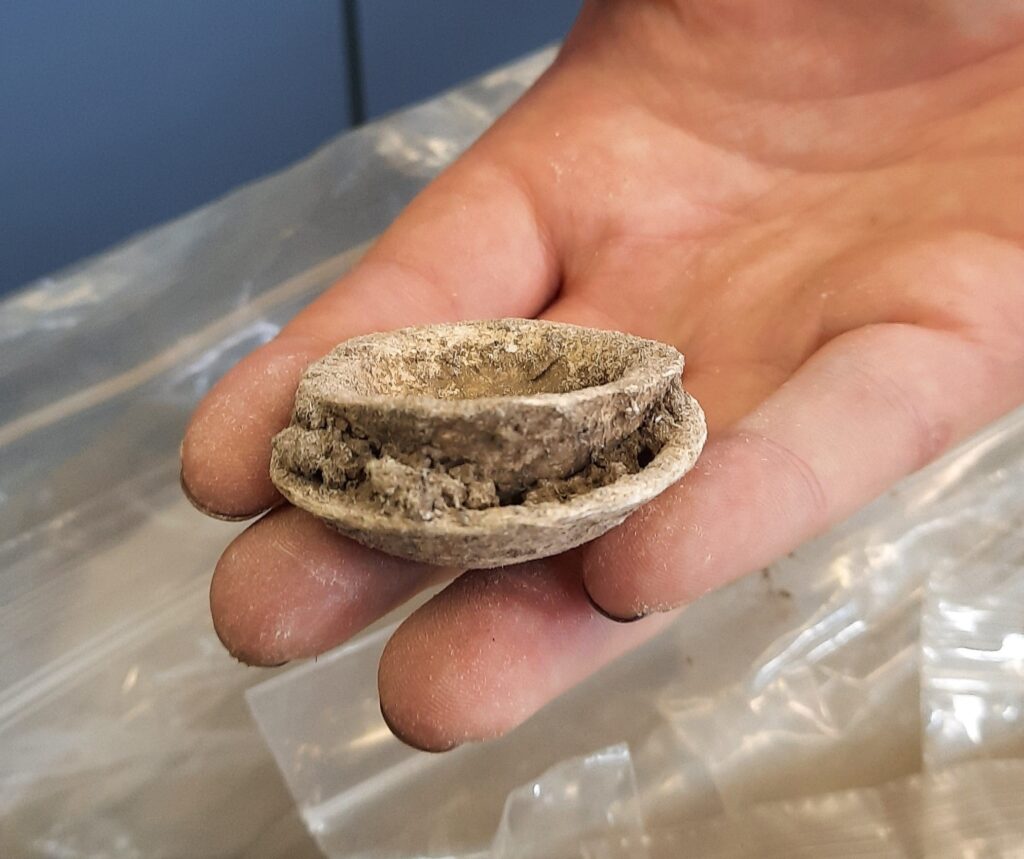
Limpet shells from The Cairns cooking pit (Credit: Holly Young FSAScot)
How long have people eaten molluscs in Scotland?
Some of the earliest evidence of shellfish consumption worldwide comes from Pinnacle Point in South Africa where shellfish were being eaten by early humans 165,000 years ago. So, there is a long-standing tradition of people enjoying shellfish!
In Scotland, shellfish has been consumed since at least the Mesolithic period, which began around 12,800 years ago. Deposits of shells are often used to identify the areas where the nomadic (roaming) peoples of that period lived. There’s relatively little evidence for structures that date to the Mesolithic period, so it’s usually the remains of their diets that tell us the most about their lifestyles.
For example, at Ulva Cave in na h-Eileanan a-staigh (the Inner Hebrides), the earliest evidence of occupation was recovered from shell middens with radiocarbon dates revealing activity from 5850 BC (over 7,850 years ago).
Enjoyment of shellfish also has trends and fashions of its own. For example, the oyster has fallen in and out of favour many times throughout history. Due to their great abundance in English estuaries and bays, the native oyster became a favourite of the Romans over 1,900 years ago, and they were exported across the empire for consumption. Oyster shells were recovered from the Roman fort of Newstead in the Scottish Borders that are likely to have been imported from the south of England as a luxury food item.

Three oyster shells from the Roman site at Newstead, 80 – 180 AD (© National Museums Scotland)
However, due to how readily available and easily accessible they were, they quickly became stigmatised as the food of the poor working class up until the 19th century. Oysters are easily affected by the water quality in which they live and due to the pollution levels in Victorian British waterways, they became contaminated, and disease associated with the shellfish quickly cause them to fall out of favour. Since then, as is obvious when entering any high-end restaurant, oysters have once again returned to being viewed as a delicacy in 21st-century food culture.
How else were molluscs used in the past?
Beyond being harvested for food, shells have been used for a variety of different purposes in Scotland’s past.
Bait
Throughout human history, molluscs have been used as fishing bait and this practice is still happening today. In 19th and 20th century Orkney, limpets were known for being popular among fishermen for catching haddock. Further north in Bressay in Shetland, mussels were frequently used for ground bait, where the animal was crushed and turned into a mash which was then spread on the water to tempt the fish closer to the surface.
Using molluscs as bait is also a practice recognised in the Norse period. The large shell middens at the Orcadian site of Quoygrew, which date from the 10th to 13th centuries AD (around to 720 to 1,125 years ago), have been interpreted as refuse which was created after the creatures were used as bait.

Quoygrew shell midden in Orkney (© Courtesy of HES (Papers of Dr Raymond G Lamb, archaeologist, Keith, Moray, Scotland))
Jewellery
Shell beads can be found from across the world at nearly all points in human history. The aesthetic qualities of shells make them perfect for jewellery, with species such as the flat periwinkle coming in an array of attractive colours and patterns.
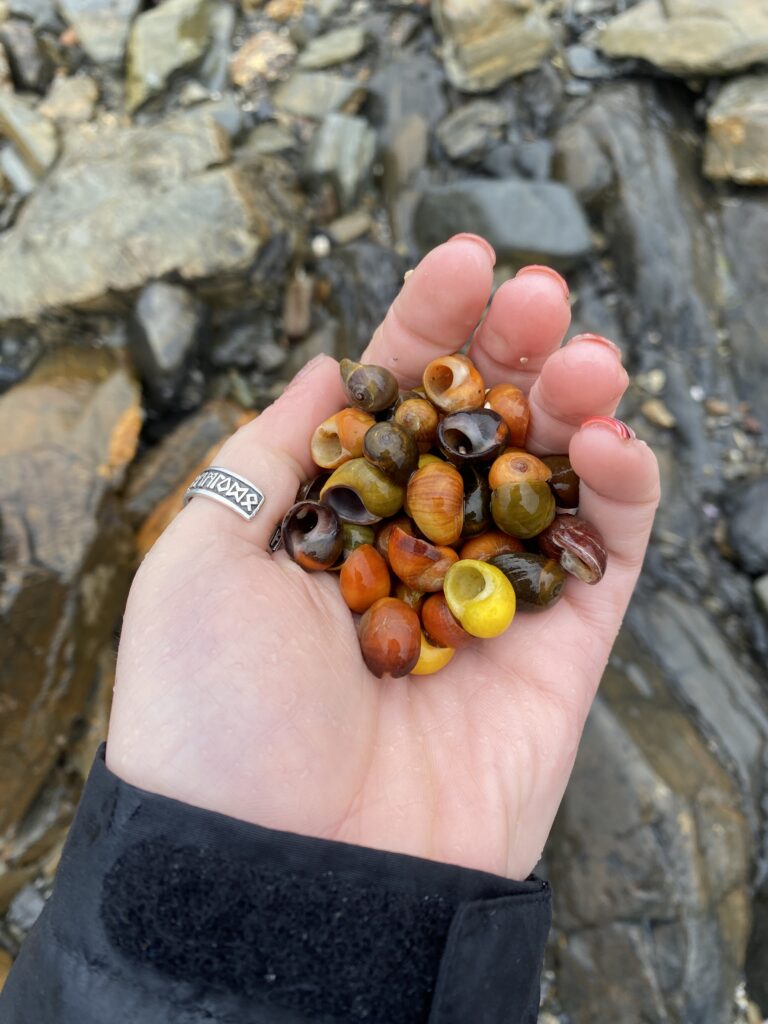
A selection of flat periwinkle shells in bright colours (Credit: Holly Young FSAScot)
For as long as shells have been consumed in Scotland, they’ve been turned into beads. At the site of Tarradale near the Muir of Ord in the Highlands, two examples of cowrie shell beads have been recovered from within the Mesolithic shell midden deposits.
It’s also possible to see changes in the bead making process over time. The ones created in the Mesolithic, for example, appear to have been created with a sharp implement or by making use of shells that have already been pierced by dog whelks (see below left).
Whereas in the Neolithic period onwards (from around 6,100 years ago), some examples – like the Iron Age cowrie bead from Berst Ness Knowe of Skea in Westray in Orkney, pictured below – were made by a process of grinding which leaves a distinctive flat surface around the hole; a very clear sign of human alteration.

Left, the Tarradale Mesolithic cowrie bead made by piercing, and right, an Iron Age cowrie bead from Berst Ness, created by grinding (Credit: Holly Young FSAScot)
And many more!
Jewellery and bait are only two examples of many and various ways that humans have used shells throughout Scotland’s past. Crushed shell can also be used as tools, for fertiliser, for the creation of lime (a building material) and in pot temper, a material added to clay to prevent shrinkage and cracking during drying and firing process.
Shells can also be used as décor on walls. This practice was particularly favoured during the 18th and 19th century at sites such as Newhailes in East Lothian where the ‘shell grotto’ (which sadly no longer survives) originally had walls studded with shells.

The skull of a man in his 20s who died around AD 1300 and was buried with a scallop shell in his mouth at the monastery on the Isle of May in the Firth of Forth near Edinburgh (Credit: Peter Yeoman FSAScot).
They also have a role to play in the inhumation (burial) of the dead and have been found in deposits associated with ritual and ceremonial practices across Scotland (see above). Scallop shells for example are a common symbol of Christian faith and were frequently used as ‘pilgrimage badges’ and incorporated in Christian graves from the medieval period onwards.
These shells in particular were used to indicate that a person had undertaken the journey to Santiago de Compostela, a major pilgrimage site in Spain. For the same reason, the scallop shell is also a popular image found etched in gravestones or left at the base of headstones, like the one below from Stirlingshire.
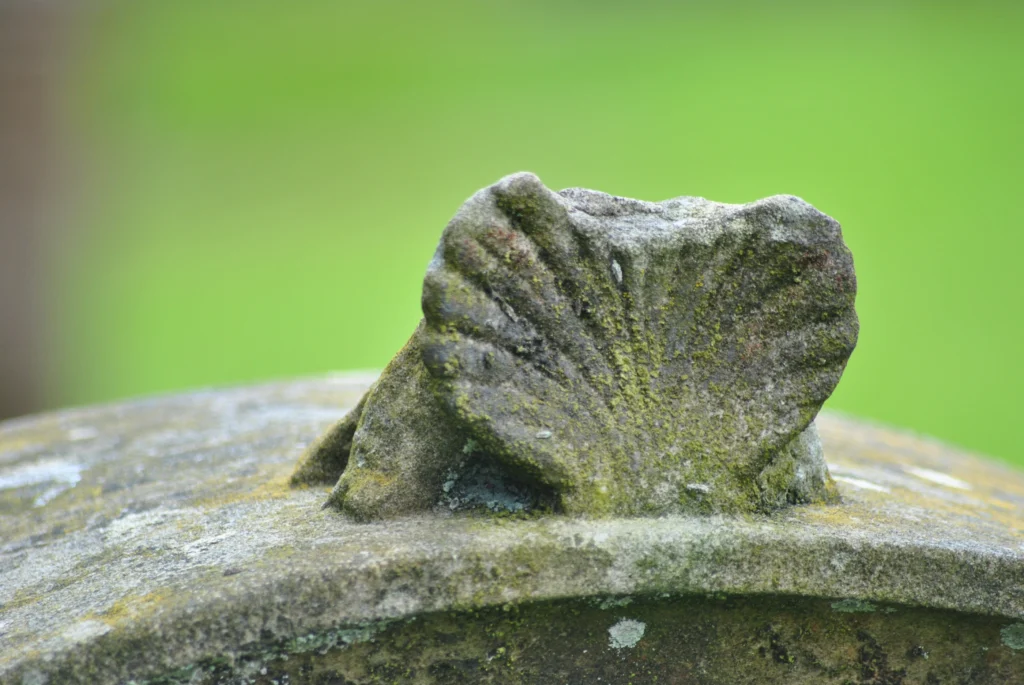
Scallop shell on a grave stone in Muiravonside, Stirlingshire (Credit: Nellie Merthe Erkenbach)
Is eating Scottish shellfish sustainable?
Shellfish has played an important role in human life since at least the Mesolithic period, not only as a source of food but also as an important resource in all aspects of day-to-day life.
And like with all natural and wild resources, marine molluscs can be utilised in a sustainable way if we as humans respect them. This means not over exploiting them. Once a population of molluscs has been diminished, it can be very hard for it to become re-established. This means that it’s possible to easily destroy an entire community of a species by consuming too much shellfish.
By looking at shell sizes over time, we can tell that this has happened throughout history. Returning to the Norse Orcadian site of Quoygrew, the limpets got progressively smaller over time as demand for them grew. We know from the middens that people there were being forced to harvest a larger quantity of smaller limpets to keep up with demand, meaning that the animals weren’t being given the chance to grow older and larger. If such over exploitation isn’t carefully managed, it can result in the loss of the resource.
With careful planning and knowledge of their habitat can marine molluscs be harvested sustainably so as not to permanently damage the animal populations. Going forward, we can use archaeology to learn from past to better manage our relationship with nature.
By Holly Young FSAScot. Holly is in the midst of completing a PhD entitled ‘Shore Life: The contribution of marine molluscs to Iron Age subsistence and social life in Northern Scotland’ at the University of the Highlands and Islands Archaeology Institute. Keep up with her research on BlueSky at @archaeoholz.bsky.social
If you’d like to keep reading, dive into the Dig It! articles on deer and seaweed.
Header Image: A collection of shells (Credit: Holly Young FSAScot)
