Top Five Archaeological Discoveries from Scottish Islands That You May Not Have Heard Of
Did you know that Scotland has over 900 offshore islands? Humans have been travelling between these islands – found in Shetland, Orkney, Na h-Eileanan A-Staigh (the Inner Hebrides), and Na h-Eileanan Siar (the Outer Hebrides) – for millennia and have left plenty of evidence of their existence behind.
[NOTE: Article contains images and descriptions of human remains]
The Knowes of Trotty Discs, Orkney
The Knowes of Trotty is one of the biggest Bronze Age cemeteries between Orkney and southern England. It makes up one of Orkney’s earliest groups of Bronze Age barrows and was in use from approximately 2000 BC – 1600 BC, some 3,600 to 4,000 years ago
The site is made up of a series of 16 barrows – earthen mounds erected over individual burials – though geophysics work in 2001 confirmed that at one time there were probably as many as 20.
Though the site is less well-known relative to Orkney’s other archaeological gems, the Knowes of Trotty are renowned for producing one of the most spectacular finds in the islands’ archaeological history. During an 1858 excavation, a stone cist (box) containing four exquisitely crafted gold “sun” discs was discovered, along with 27 amber beads and a number of burnt human bones.
Thought to be covers for decorative “buttons”, the gold discs were made from paper-thin sheets of gold, decorated with concentric circles of zig-zags and lines. The largest of the undamaged discs had a diameter of 76mm and was holed in the middle. The artefacts probably belonged to a high status person, perhaps a matriarch or leader of a local tribe and are now on display in the National Museum of Scotland in Edinburgh.
While the gold originated from Scotland, the design is a style from the contemporary English kingdom of Wessex, and may have been prized by powerful people of the time. The discs clearly show that Orkney had some connection to the people of southern England.

The Knowes of Trotty discs (© National Museums Scotland)
Over 4,500 Years of Human Habitation on Hirta, Hiort (St Kilda)
Between 2017 and 2019, GUARD Archaeology carried out the largest archaeological excavation ever undertaken on the island of Hirta in the Hiort archipelago, some 40 miles off Uibhist a Tuath (North Uist) in the North Atlantic Ocean.
Their investigations added to our understanding of early habitation on Hirta, which stretches back to the Neolithic period (over 4,500 years ago). The team radiocarbon dated food remains – which had been turned into carbon or charcoal (typically by heating or burning) – which had been found stuck to sherds of unearthed Iron Age pottery. These tests indicated that people were living here at some point between the early part of the 4th century BC to almost the end of the 1st century BC.
Most of the pottery archaeologists found dates from the Iron Age, although a sherd of a possible early Bronze Age Beaker and two sherds of medieval pottery were also unearthed, showing that people were living on the island regularly for thousands of years, until the last community left in 1930.
Want to explore further? Gamers can traverse the entire island of Hirta using a detailed and accurate virtual map (built on a 1:2 scale) in the world of Minecraft, which includes Gaelic song, archaeology and tales from the island’s more recent past. The St Kilda map is freely available to download from the Crafting The Past website, a project coordinated by Dig It!.

Overhead view of the excavated channel (© GUARD Archaeology Ltd)
Old Scatness Broch, Village and Bear Carving, Shetland
Old Scatness in Mainland Shetland has been a settlement for thousands of years, with medieval, Viking, Pictish, and Iron Age remains – each new generation adding buildings and flattening old ones.
The site was an undisturbed, pristine time capsule when first discovered in 1975 when a road was almost put through what was thought to be a natural mound but which turned out to be the broch.
Since 1995, University of Bradford staff and students, professional archaeologists and local volunteers have been excavating the site and cataloging the finds. Together they unearthed the Iron Age broch, surviving to nearly four metres in height, as well as a substantial Iron Age village built around it. A date from a barley grain found in the construction debris, and another from articulated bone found under the base of the wall, revealed that it was constructed between 400 to 200 BC, some 2,200 to 2,400 years ago.

Old Scatness Dig (© Steve Jones via Wikimedia Commons, CC BY-SA 2.0)
Five Pictish (later Iron Age) structures were built into the top of this Middle Iron Age village and several Pictish stone carvings, including a boar, an arch and V rod, and a number of “painted pebbles”, were found in the houses.
A particularly fascinating Pictish carving of a bear was discovered in 2002 on the floor of one of the cellular buildings. Interestingly, there’s no evidence of bears ever having inhabited Shetland. Now in Shetland Museum, experts believe that the stone was possibly an orthostat (large upright stone) which stood across from the door to the wheelhouse.
Viking soapstone artefacts and the remains of a Viking floor and hearth (fireplace) in the Pictish buildings indicated that occupation continued into the Norse period. Old Scatness therefore provides archaeologists with a rare opportunity to understand Pictish-Viking transition in Shetland, a period for which archaeologists still have a lot of questions.
The site has since been open almost every year during the summer, with costumed guides provide guided tours to visitors who can also spend time by the fire in the reconstructed buildings or try their hand at Iron Age and Viking crafts.
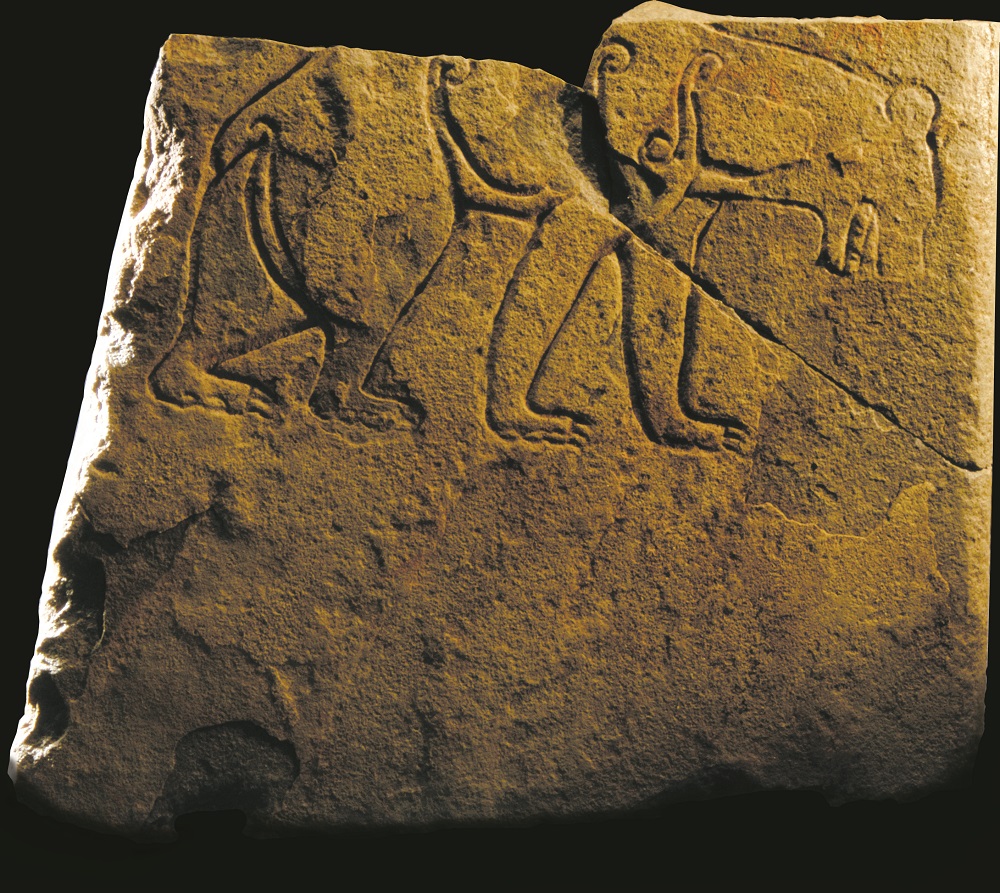
(© Shetland Museum and Archives)
Iron Age Village of Bostadh, Na h-Eileanan Siar
Overlooking the white sands of Bostadh Beach on the north-western tip of Beàrnaraigh Mòr (Great Bernera island) in Na h-Eileanan Siar lies the remains of an Iron Age village, probably first occupied more than 1,500 years ago. It was hidden beneath the ground until 1993, when a severe storm exposed the site.
At risk of being washed away in another storm, a rescue mission began in 1996 which revealed a Norse settlement just beneath the ground’s surface and eight Pictish (or later Iron Age) houses below it with their contents perfectly preserved by the sand.
The houses are thought to be around 1,300 years old and were in a distinctive figure-of-eight structure which are sometimes called a ‘jelly baby’ house due to the shape.
After the excavation, the huts were covered over with sand once more to preserve the structures. Much of the information from the dig and some of the finds can be seen in the nearby museum at Breacleit, such as pieces of bone combs held together with iron rivets.
The site on the beach can be visited at any time, and during the summer months visitors can get a sense of what life was like here by visiting a nearby replica Pictish hut built by the local history society in 1998.
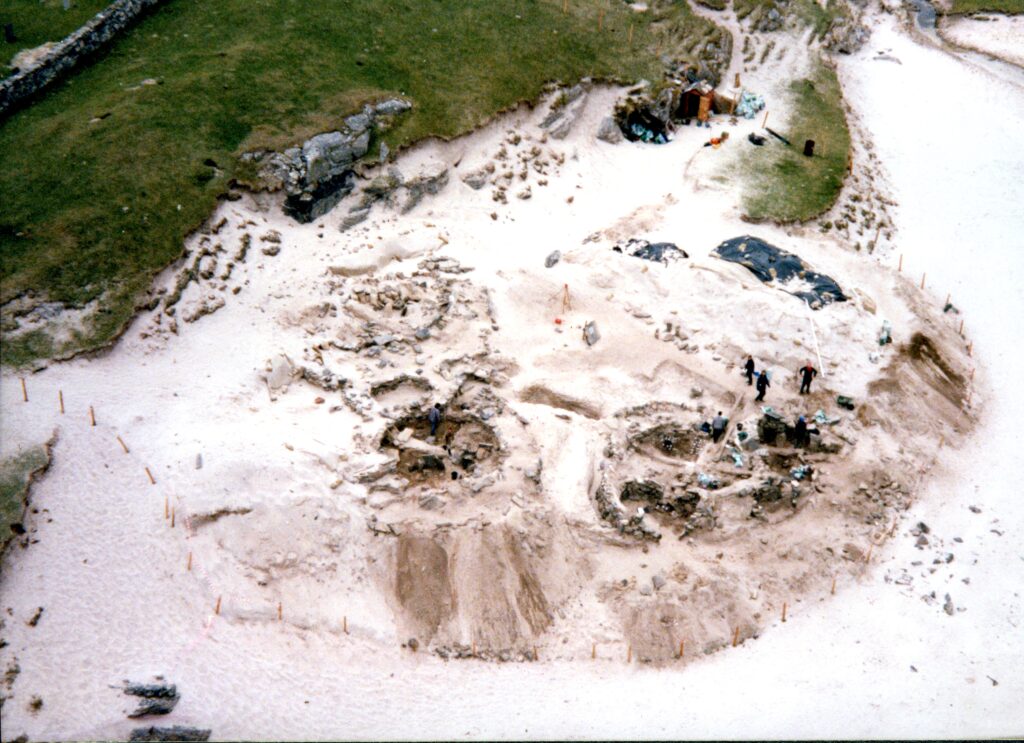
View of the excavations (Courtesy of Bernera Museum)
Evidence of Disease and Health Care on the Isle of May, Firth of Forth
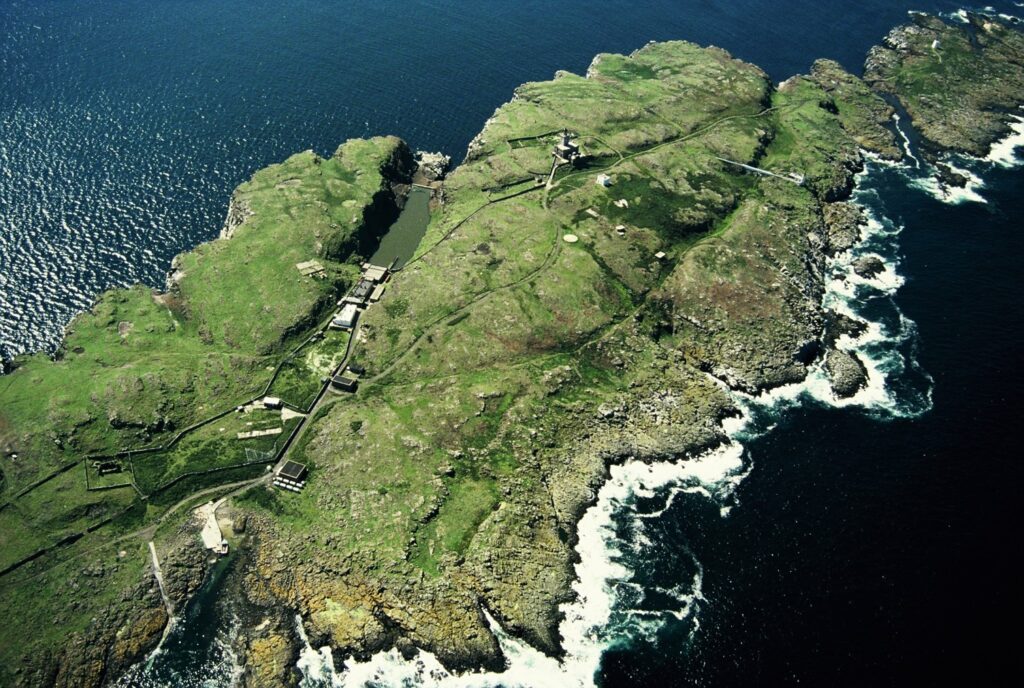
The Isle of May in the Firth of Forth was long considered a place of pilgrimage and healing and in recent times, archaeologists have uncovered “the best evidence of disease and health care ever found from early medieval Britain”.
Human presence on the island goes back millennia, with excavations revealing pottery, flints, and a piece of stone axe which may have been made around 2000 BC (4,000 years ago) during the Bronze Age. King David l later founded a priory for nine Benedictine monks around AD 1145 on the site of an ancient monastic settlement. The origins of this are traditionally associated with the shrine of St Ethernan. The later priory was ruinous by AD 1300, however the May remained an important destination for pilgrimage.
Excavations in the 1990s led by Peter Yeoman tells the story of the island as a focus for Christian pilgrimage for a thousand years, revealing some of the oldest church buildings ever found in Scotland and dozens of graves dating from 500 AD to 1,500 AD. Approximately 50 of the pre-Benedictine phase burials were sampled, and recently benefiting from significant re-analysis.
Important new research on the excavated human remains has yielded fascinating insights into life and death during the early medieval period. Dr Angela Boyle explains that one skeleton, an older adult male aged upwards of 45 years (skeleton 859), exhibits evidence of an injury from a sword or axe to the back of the head, which healed in his lifetime. It’s amazing that this man survived the injury as the blade penetrated right through the skull to the brain, leaving a c.5 mm gap even after the wound had healed. Significantly, there is also evidence that this man had prostate cancer, which is likely to be one of the earliest recorded examples in the UK. Isotope analysis by Dr Janet Montgomery at Durham University also suggested he may have come from the northern or western Isles.

Isle of May excavations in the 1990s (© Fife Council)
Another man aged 26 to 35 years (skeleton 959) also displayed skull injuries, though these were fatal and were possibly inflicted from an attacker on horseback. Strontium and oxygen analysis provides strong evidence that this man was not indigenous to the Isle of May, and had origins distinct from skeleton 859.
Recent doctoral research by Dr. Marlo Willows determined that the monastic site became a place of healing (traces of medicinal plants used as pain relievers and anaesthetics have also been found through archaeological investigation) so it is not hard to imagine the aged warrior with terminal cancer travelling here for a cure. By contrast, the man identified as skeleton 959 is likely to have been murdered elsewhere, but like many in the cemetery was transported here by boat across the Forth, dead or dying, to gain more rapid entry into heaven by being buried ad sanctum – near the bones of St Ethernan.
These are just a handful of the amazing archaeological discoveries that have been found on Scottish islands. Hungry for more? Explore other sites on Eilean Arainn (Isle of Arran), Orkney, Shetland and more in our Discover articles.
Header Image: Aerial view of the Isle of May (© Fife Council)
