Top 10 Artefacts Found in Scottish Waters (English)

Scotland’s coasts and waters have shaped our history: from fishing and textiles to whisky and wave power; they have influenced our culture, our stories, and our way of life.
Thanks to a hugely varied coastline, many islands, and a rich offering of inland waters in both rural and urban settings, some of the country’s most exciting artefacts have been found underwater.
1) THE PIECE TO A MUSICAL PUZZLE IN PERTHSHIRE
In February 2019, the remains of a 2,500-year-old musical instrument which had lain for centuries at the bottom of a Perthshire loch was rediscovered.
The notched wooden object, believed to be the bridge from a plucked string instrument dating back to 500 BC, has been described as an “internationally significant” find and will help reveal secrets about Scotland’s prehistoric social life. The bridge was uncovered during an underwater excavation at Fearnan on the banks of Loch Tay and is thought to be a piece of one of the earliest musical instruments ever found in Western Europe.

Curator of the Scottish Crannog Centre, Frances Collinson with a 3D copy of the bridge (Image © DC Thompson)
2) A WOODEN GODDESS IN THE HIGHLANDS
In November 1880, a stunning carved wooden figure which had lain dormant under deep peat for more than 2,500 years was unearthed in Ballachulish in the Highlands.
Standing almost 1.5 metres tall, the life-sized figure of a girl or goddess was carved from a single piece of alder, with pebbles for eyes. She may represent a supernatural being to which travellers would have made offerings in exchange for safe passage across the dangerous straits linking Loch Leven with the sea.

Ballachulish Figure (Image © National Museums Scotland)
3) A SYMBOL STONE IN ABERDEENSHIRE
In summer 2018, a carved Pictish symbol stone was discovered by fishermen on the banks of the River Don in Aberdeenshire.
Finding a new genuine symbol stone is a very rare occurrence; it was thanks to the low water levels – after the recent warm and dry weather – which partially exposed the stone on the river bank that led to its discovery.

A carved Pictish symbol stone was discovered on the banks of the River Don in Aberdeen (Image Credit: Historic Environment Scotland)
4) MEDIEVAL MUSICAL NOTATION IN PAISLEY
Numerous artefacts have been discovered in the medieval drain discovered by fishermen in Renfrewshire, including a large intact chamber pot, buckles, coins, a knife handle, a tuning peg, slate fragments and thousands of pottery sherds.
In 1991, experts noticed curious handwriting on a seemingly ordinary piece of slate. This led to an examination of all the slate fragments recovered from the drain and one 600-year-old piece was found to display the earliest example of polyphonic music (music with simultaneous notes) ever recorded in Scotland.
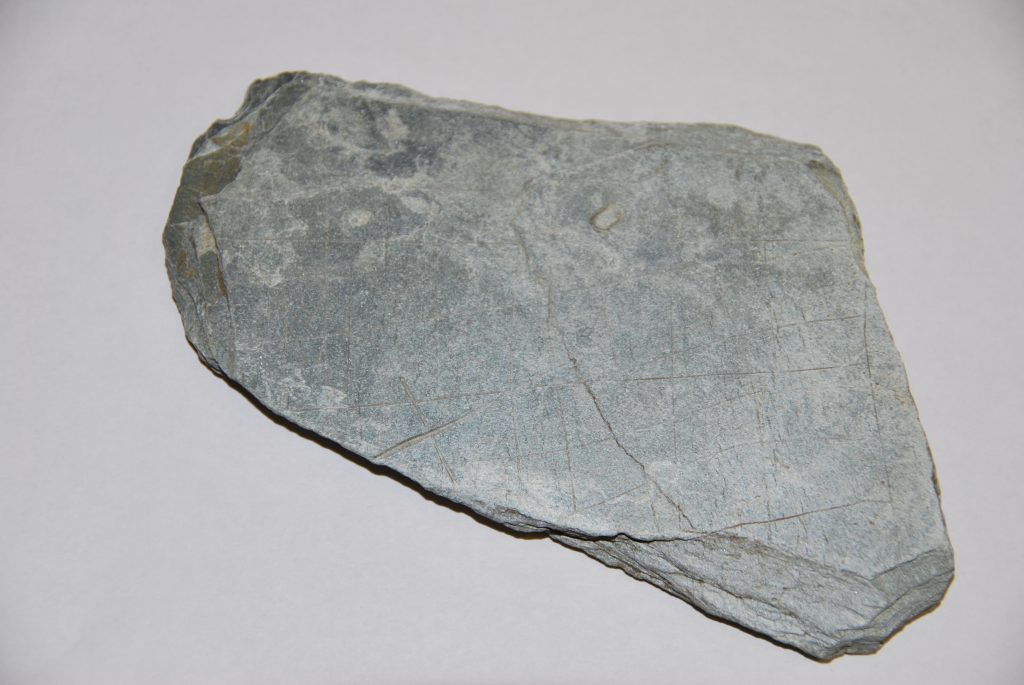
Carved slate from Paisley Abbey Great Drain (Image Credit: Coatsobservatory, CC BY-SA 4.0)
5) A BRONZE AGE LOGBOAT NEAR PERTH
In 2006, Perth and Kinross Heritage Trust excavated and recovered a unique Late Bronze Age logboat from the Tay estuary. From its initial discovery in 2001, the project took over 10 years to complete and resulted in two major publications and exhibition of the vessel in Perth Museum and Art Gallery.
Dating to around 1,000 BC, the 3,000-year-old Carpow logboat is one of the best–preserved prehistoric logboats in Britain, and is the second oldest known boat ever found in Scotland.

The excavated logboat propped up with sandbags before extraction (Image © Perth and Kinross Heritage Trust)
6) AN UNDERWATER FOREST IN THE OUTER HEBRIDES
In early 2019, it was reported that archaeologists had found incredible evidence of early human activity at a submerged prehistoric forest on Beinn na Faoghla (the island of Benbecula) in the Outer Hebrides. Lionacleit is one of more than 20 recorded sites of ancient woodland that once grew in the islands.
The forest was at its peak size about 7,000 – 10,000 years ago and boasted a rich mix of birch, hazel, willow, aspen, rowan, oak, Scots pine, alder, ash and elm. Archaeologists also found an early butchery site and stone tools used for preparing food, including a quartz flint, preserved against the animal bone it was used to butcher.

The red interior of a prehistoric willow root revealed in a freshly cut sample (Image Credit: SCAPE)
7) A HIDDEN MEDIEVAL BRIDGE IN THE SCOTTISH BORDERS
In October 2020, it was announced that one of the “most important structures of medieval Scotland” had been rediscovered after being hidden beneath the River Teviot for centuries.
The timber from the bridge – which was constructed in the mid-1300s and would have once carried King James V and later his daughter Mary, Queen of Scots on journeys between Edinburgh and the Scottish border – are the oldest ever to be found in their original position across one of Scotland’s rivers.
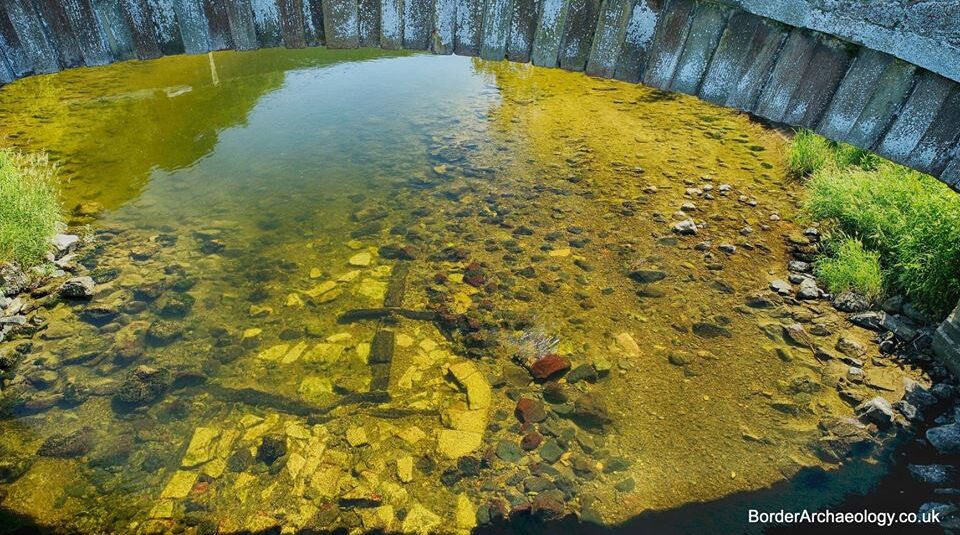
The foundation of the medieval bridge are visible below a more recent construction over the River Teviot (Image © Border Archaeology)
8) A PREHISTORIC HOARD OF WEAPONS IN EDINBURGH
A not-so-recent, but nevertheless astounding discovery was made in Duddingston Loch in Edinburgh in 1778. A hoard of Late Bronze Age metalwork, including swords and spears, was found at the bottom of the loch together with human bones, skulls and animal horns.
Curiously, the weapons were burnt and otherwise destroyed around 2,800 years ago before being thrown into the loch. It appears that the overall intention was to make sure these objects could not be used again, but whether this was meant as a sacrifice, so that their owners could not use the weapons in the afterlife, or that they were simply destroyed as scrap remains a mystery.
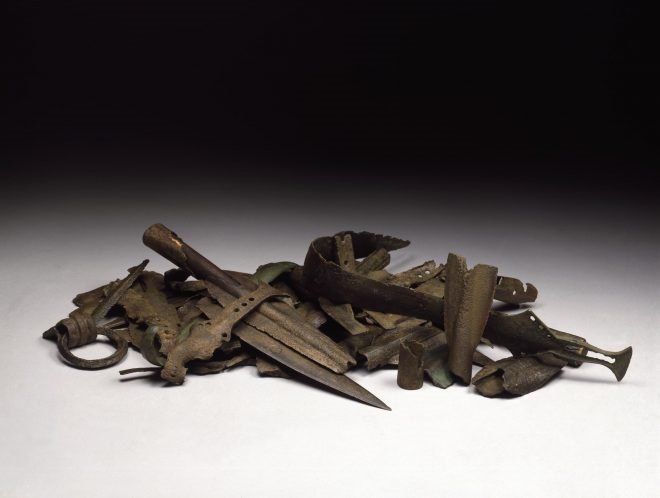
The Duddingston Loch hoard (Image © National Museum of Scotland)
9) A WWII SUBMARINE IN EAST LOTHIAN
Fan of military history? These WWII-era submarines were used for training purposes and have been moored on the Aberlady Beach in East Lothian since 1946. They are free to visit, whenever the tides allow you to.
There is only one other submarine of this type left in the world, which can be seen (in a slightly better condition) at Gosport’s Royal Navy Submarine Museum in England.

Submarine (Image © Richard Webb via geography at http://bit.ly/2NkaJrx, CC BY-SA 2.0)
10) NEOLITHIC SECRETS IN THE OUTER HEBRIDES
In 2016, exciting evidence of ancient artificial islets were found in lochs on Leòdhas (the Isle of Lewis). Pottery discovered on the loch bed helped to date the islets (sometimes known as crannogs) back to the Scottish Neolithic (over 4,000 years ago).
This was an incredibly important discovery because it suggests that crannogs they were used for much longer than previously thought.
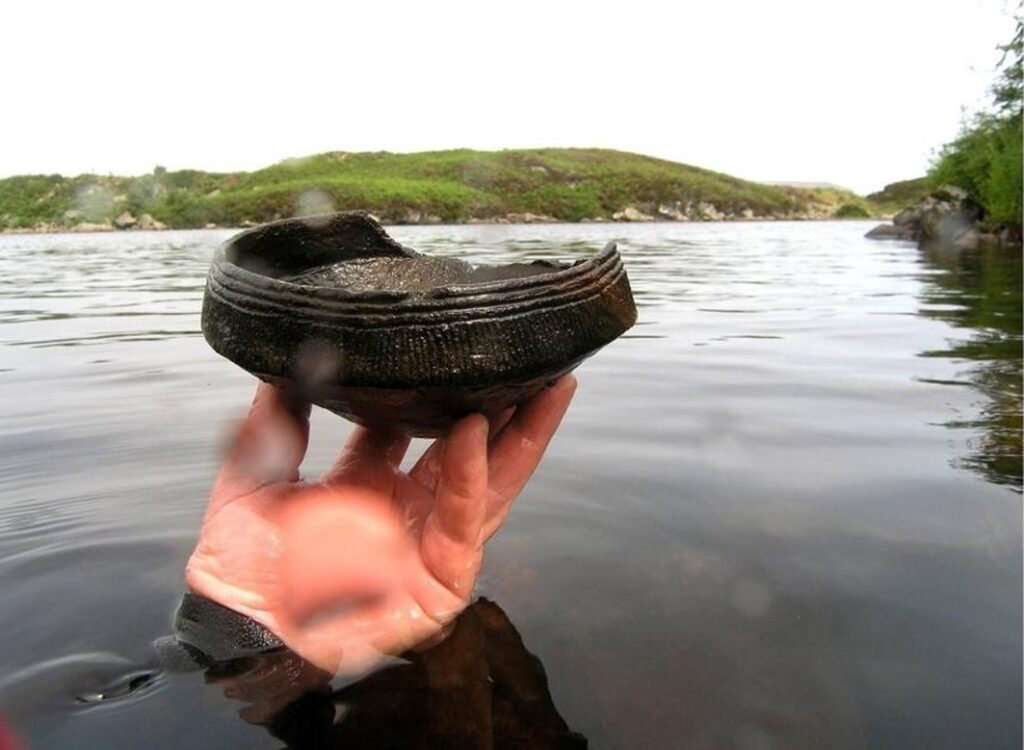
Unstan bowl being raised from the bottom of a loch on Leòdhas (Image © Chris Murray)
WRITTEN BY MARIA GUNDESTRUP-LARSEN, PROJECT OFFICER AT ARCHAEOLOGY SCOTLAND AND FREELANCE LANGUAGE PROFESSIONAL, AND SALLY PENTECOST, DIG IT! COMMUNICATIONS & EVENTS OFFICER
This article was produced in support of Scotland’s Year of Coasts and Waters 2020-21

