Top Six Archaeological Hoards in Scotland

A hoard is a deposit of multiple artefacts often made up of valuable items such as coins, precious metals and jewellery, which has been deliberately stowed away – and they’re the closest thing to “buried treasure” that we’ll ever find in Scotland. There are many theories as to why hoards were hidden in the first place and every example is different. Were the objects were buried for protection and the owner Never returned. As a form of ritual sacrifice? Seen as rubbish to dispose of? Maybe we’ll never know.
Dig in to our list of the top six hoards from across Scotland and what makes them unique.
(While we love a hoard of precious metals, they tend to tell us only about the wealthiest and most powerful in past societies. Once you’ve explored these glittering hoards, learn how waste materials and even tiny things like pollen and micro-fossils are helping archaeologists uncover the stories of everyday folk.)
Duddingston Hoard
Around 3,000 years ago, a hoard of Late Bronze Age weapons, including swords and spears, was deliberately destroyed before being deposited in the waters of Duddingston Loch in Edinburgh. These artefacts remained at the bottom of the loch until a dredger dragged them up in 1778. It was then donated to National Museums Scotland from the Society of Antiquaries of Scotland in 1781.
Dated to around 1,000-800 BC, for many years the Duddingston Loch hoard was thought to simply be a pile of scrap metal that was abandoned in the Bronze Age, but experts at National Museums Scotland have recently re-examined the hoard and have come up with some exciting alternate theories.
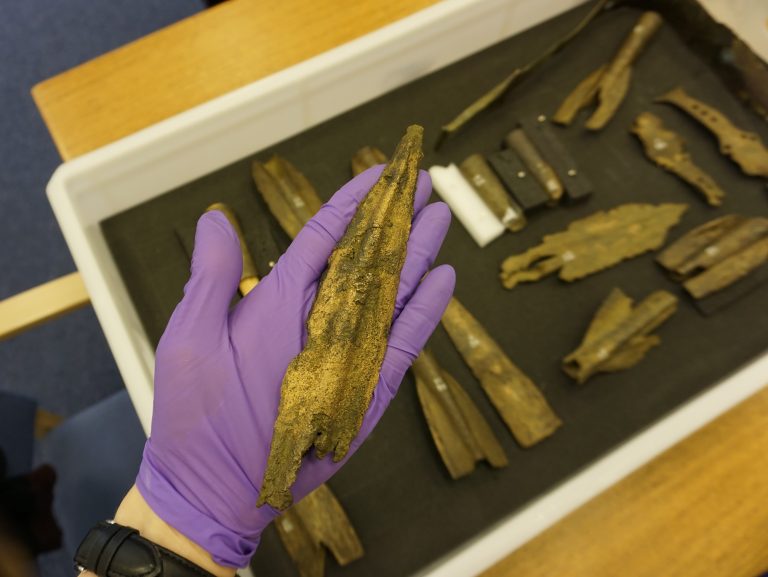
One of the broken bronze spearheads from the Duddingston Loch Hoard (Dr Matthew Knight)
Why Is It Special?
The bent, broken and burnt nature of the objects in the hoard suggest that the objects were thrown into the loch as a kind of sacrifice. Archaeologists have suggested that the collection may have been the equipment of a band of warriors which was deliberately sacrificed, perhaps as offerings to the gods. Another explanation is that the weapons could be a war booty taken from an enemy and destroyed so that the enemies could not use them in the afterlife.
Norrie’s Law Hoard
In 1819, a collection of 6th-century silver was discovered at a small mound called Norrie’s Law in Largo, Fife. The Norrie’s Law hoard is one of the largest Pictish hoards ever found. It originally contained 12.5 kg of late Roman and Pictish silver, but sadly less than 1 kg of the hoard remains as most items were illegally sold or given away.
The hoard is made up mostly of hacksilver (fragments of cut and bent silver items that were used as currency by weight in ancient times) and includes four complete silver pieces including a penannular brooch (a ring shape with a small part of the circumference missing), a leaf-shaped oval plaque with Pictish symbols, a large hand-pin, and a worn spiral finger-ring. Incomplete items include part of a Roman spoon, pieces of silver sheet from a plate and spiral bracelets.
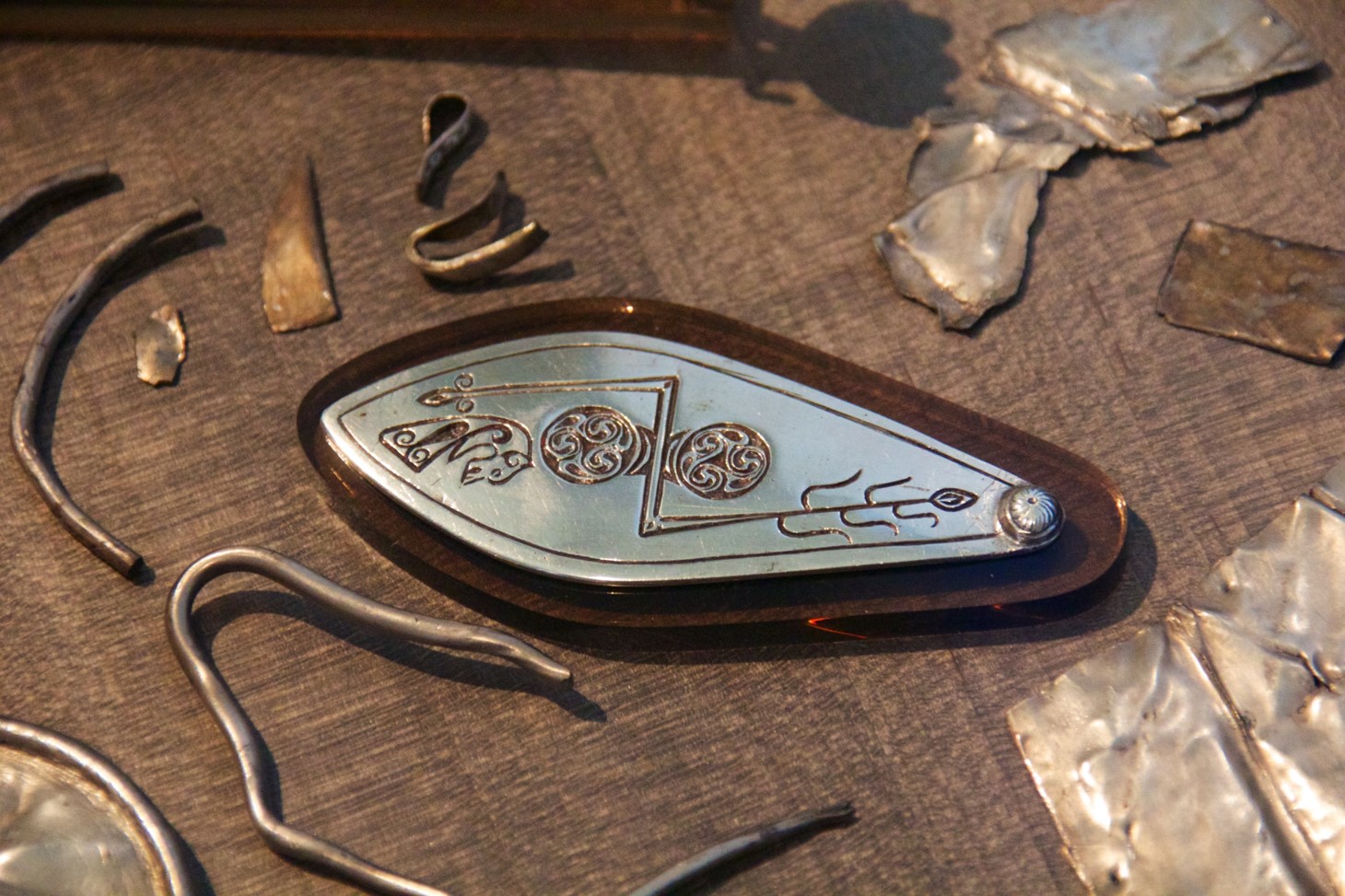
A symbol-decorated plaque from the Norrie’s Law hoard in the National Museum of Scotland, Edinburgh (Mike Peel via Wikimedia Commons at http://bit.ly/3rQcDik, CC-BY-SA-4.0)
Why Is It Special?
The hoard contains several unique finds, including a pair of silver plaques decorated with Pictish symbols. The collection also tells us about the use and reuse of silver in Early Medieval Scotland – about the source of the raw material (Roman silver), how it was recycled and remade into new types of powerful objects.
What’s more, modern research conducted at National Museums Scotland has dated the hoard to be around 1,500 years old. But the same study also found that the collection contained two Victorian silver copies of the Pictish-decorated plaque (above) and large hand-pin; so good are the copies that until recently they were believed to be original 6th-century metalwork.
During their investigation, the experts discovered that in 1839, a Fife newspaper man named George Buist became convinced that more of the hoard could be recovered from Norrie’s Law if the discovery was more widely known. The owner of the land lent Buist a selection of the hoard so that he could commission a jeweller to make copies. Buist then showed these at meetings of local societies and other interested people to drum up interest in the site.
Galloway Hoard
Buried at the beginning of the 10th century in Dumfries and Galloway, the Galloway Hoard lay undisturbed for a thousand years before being unearthed by a metal detectorist in September 2014. It has been described as “the richest collection of rare and unique Viking-age objects ever found in Britain or Ireland”.
Made up of more than 100 objects, the hoard includes Viking Age silver jewellery and ingots, a unique gold bird-shaped pin and a decorated silver-gilt vessel. The vessel was found to contain more unusual objects: beads; amulets of glass and rock crystal; new types of brooches never seen before; and pointers used to read and mark places within medieval manuscripts.
Why Is It Special?
The Galloway Hoard brings together a wide variety of artefacts in one discovery and suggests previously unknown connections between early medieval people across Europe and beyond. It also contains objects which have never before been discovered in a hoard of this age, some of which are unique.
Incredibly, textiles, leather and wooden fragments have also survived, providing an extremely rare opportunity to research and reveal many lost aspects of the Viking Age.
Peebles Hoard
In June 2020, a metal detectorist found a bronze object buried half a metre underground in a field near Peebles. After reporting the object to Treasure Trove, experts were brought in to investigate the site.
They soon uncovered an astonishing 3,000-year-old Bronze Age hoard of “national significance”. Included in the collection was a complete ancient horse harness, a sword still in its scabbard (above), decorated straps, buckles, rings, ornaments and chariot wheel axle caps.
Why Is It Special?
The soil in the Peebles field also preserved the leather and wood attached to the bronze objects, allowing experts to trace the straps that connected the rings and buckles of the harness. This was a unique find and allowed the experts to see for the very first time how Bronze Age horse harnesses were assembled.
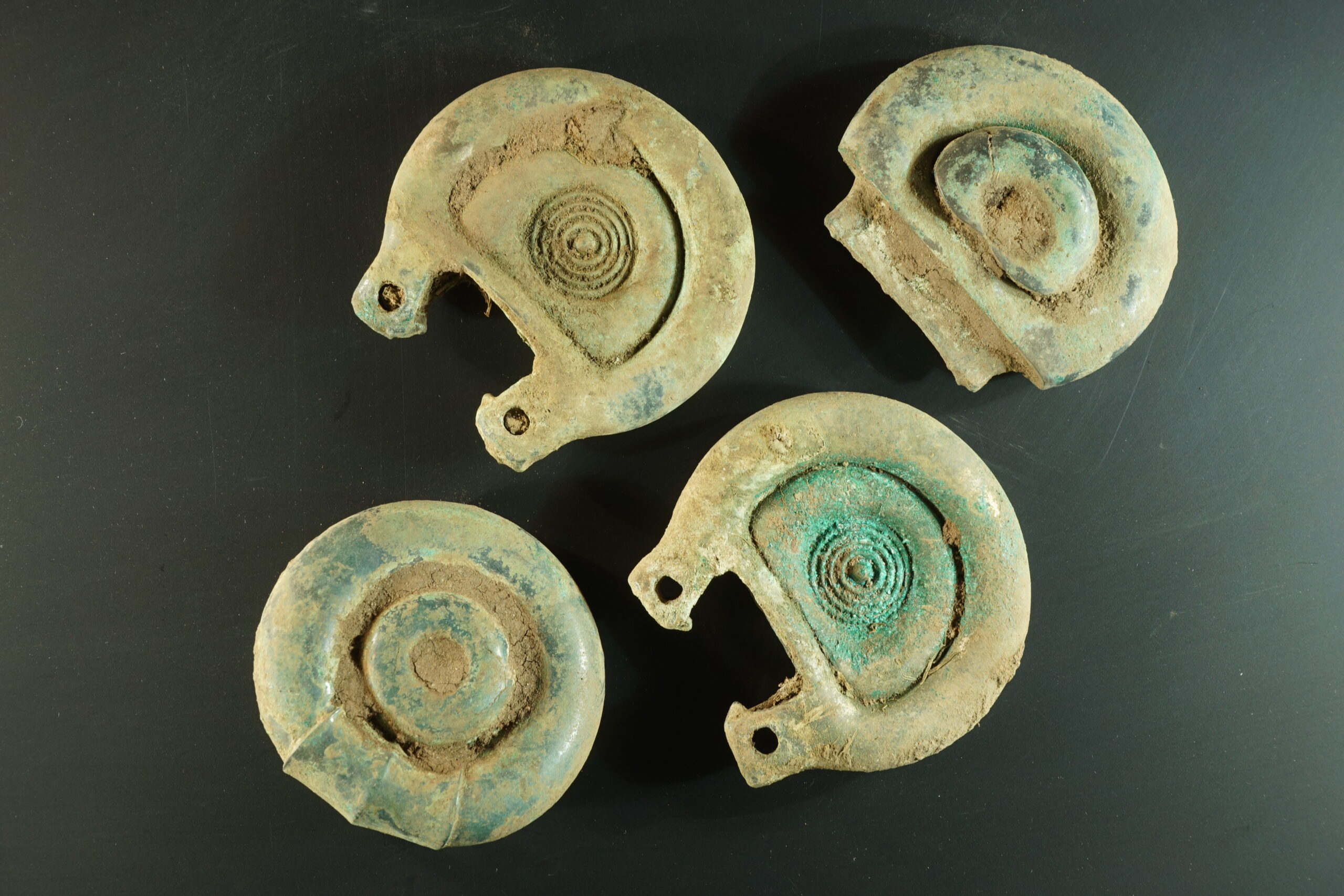
Bronze buckles from a 3,000-year-old horse harness found in the Peebles Hoard 2020 (Crown Copyright)
St Ninian’s Isle Treasure
In 1958, a local schoolboy uncovered a 28-piece hoard of silver Pictish-age objects beneath a cross-marked slab in the floor of an early medieval church on St. Ninian’s Isle in Shetland.
Dating to around 1,250 years old, the fine silver artefacts can be connected to Early Medieval feasting, jewellery, and weaponry, and include twelve penannular brooches, bowls, chapes (the metal point of a scabbard, which is the casing for a sword), and a pommel (a rounded knob on the end of the handle of a sword). It’s thought that some of the pieces, including the bowls, spoon, and cones, may have been used in religious ceremonies or community rituals.

St Ninian’s Isle (© VisitScotland / Stuart Brunton)
The only non-silver item in the hoard is a fragment of a porpoise jawbone. We don’t know why the porpoise remains were buried with the hoard but it’s been suggested that the owner considered the jawbone lucky or of great value.
Why Is It Special?
The St Ninian’s Isle treasure is the best example of surviving silver metalwork from the Early Medieval period in Scotland. The different styles of decoration present in the hoard also suggests that the different kingdoms of the British Isles over 1,000 years ago were in connection with each other.
The brooches in the collection, for example, show a variety of typical Pictish decoration, whereas one of the buried weapons has an inscription with a prayer in Old English. This has led some experts to believe that the items in the St Ninian’s Isle treasure may have once been gifts exchanged between Pictish and early English rulers.
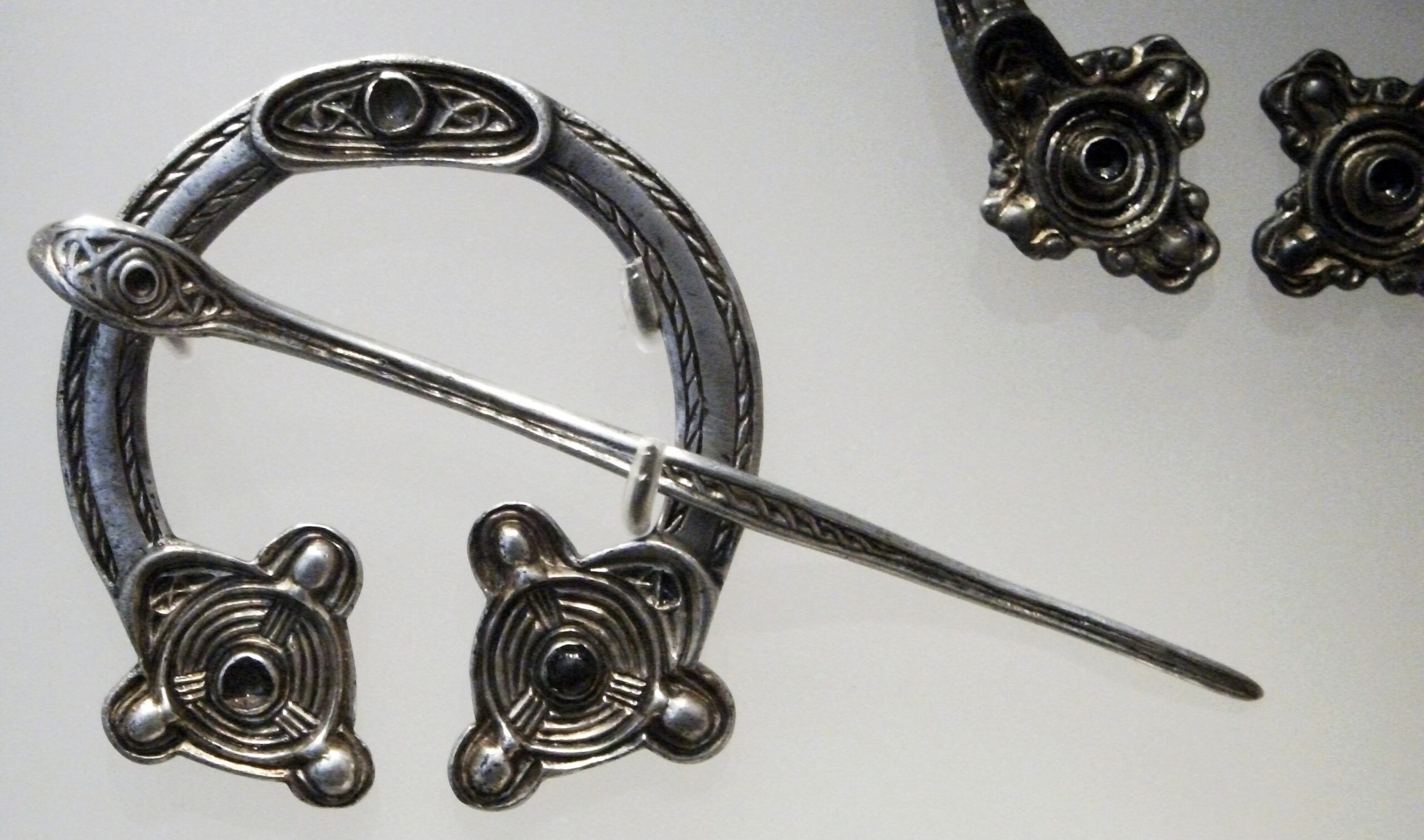
One of the twelve penannular brooches in the St Ninian’s Isle Hoard (Johnbod via Wikimedia at http://bit.ly/2ZbZxzS, CC BY-SA 3.0)
Traprain Law Hoard
Just after the First World War, a hoard of Roman silver was uncovered at a hill near Haddington in East Lothian. This late Iron Age site was once the capital of the Votadini, the ancient Celtic tribe who governed a vast territory spanning what is now south-east Scotland and north-east England more than 1,600 years ago.
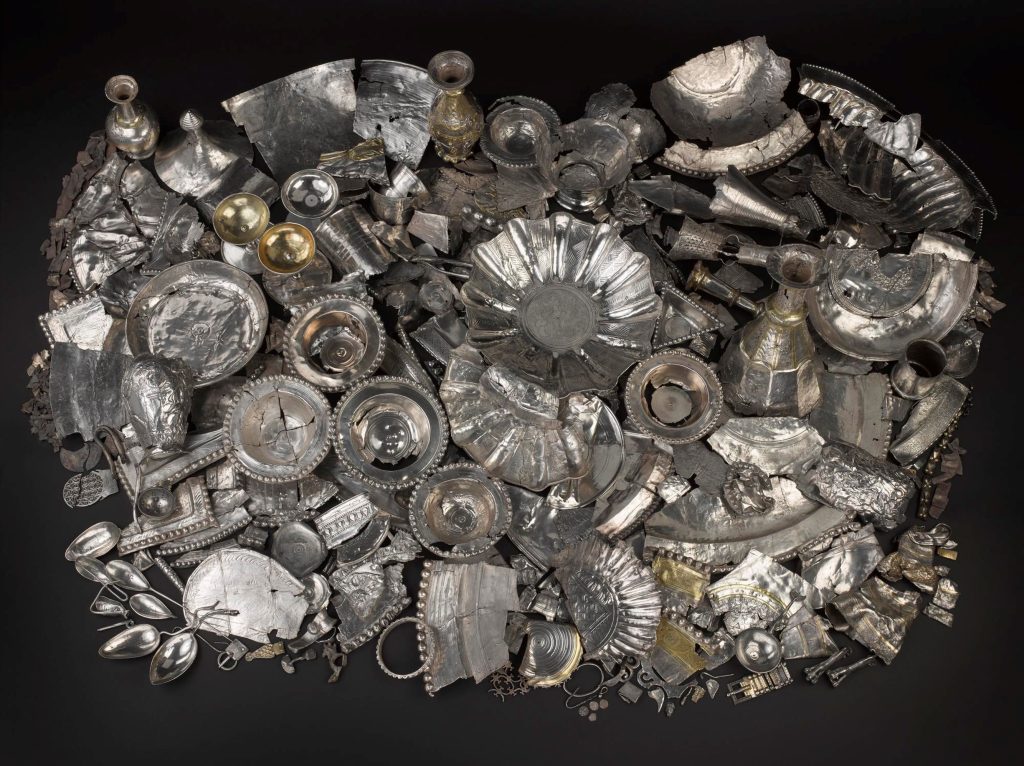
The Traprain Law Hoard (© National Museums Scotland)
Experts have dated the collection to around 1,600 years old and believe they were buried in the middle of the 5th century AD. As with the Norrie’s Law Hoard, most of the objects from Traprain Law had been crushed and hacked to pieces (known as hacksilver).
A great deal of the find was silver used in Roman table items such as spoons and bowls, but there were also items bearing early Christian symbols, as well as the remnants of a Roman officer’s uniform.
It’s thought that the silver may have been brought back to Traprain Law by the Votadini following a raid across Hadrian’s Wall into territory occupied by the Roman Empire, or perhaps it was given to the Votadini by the Roman army as tribute or in payment for mercenary service.
Why Is It Special?
Made up from more than 250 pieces and weighing in at 22kg, the Traprain Law hoard is the largest collection of Roman silver found outside the Roman Empire.
Remember, if you find something, you are required by law to report it to Treasure Trove. If you think you’ve come across something important, find out what to do next in our handy guide.
Have we missed your favourite? Let us know on Twitter or Facebook.
Header Image: A selection of objects from the Viking age Galloway Hoard (National Museums Scotland via Wikimedia Commons at http://bit.ly/3beUNis, CC-BY-SA 4.0)
