Carvings, Crosses and Human Remains: Top Six Archaeological Discoveries in Scottish Caves
People have been using caves in Scotland for thousands of years and have left behind carvings, objects and bones which offer glimpses of their life stories.
You may already know about the famous finds and features from the Covesea Caves in Moray, Wemyss Caves in Fife, Uamh an Ard Achadh (High Pasture Cave) on An t-Eilean Sgitheanach (the Isle of Skye), and King’s Cave on Eilean Arainn (the Isle of Arran), but we’ve put together some other exciting examples of human activity in caves which you may not have heard of.
‘Scandinavian sea monster’ in Torrs Cave, Dumfries & Galloway
Torrs Cave is located on the eastern shore of Kirkcudbright Bay and is also known as “Dirk Hatteraick cove” after the smuggler character from the Walter Scott novel Guy Mannering.
It’s thought that Torrs Cave was possibly a dwelling spot for many people throughout the ages from the recent 18th century all the way back to the Iron Age (which began around 2,800 years ago) and possibly beyond. The site was excavated in the 1930s by S. V. Morris and the findings were published by the Society of Antiquaries of Scotland (who co-ordinate Dig It!).
Among the finds was black-glazed pottery from the 18th century, 2,000-year-old Roman pottery, fragments of iron weapons and numerous bone implements. The worked bone finds most likely date to the Iron Age and included scrapers, sharply pointed tools, a fishhook, two finely worked bone pins and a bone toggle (a fastener often used in place of buttons or buckles), which can be seen today in the Stewartry Museum in Kirkcudbright.
What’s more, in 1977, a German cave and mine explorer discovered curious stone carvings of a stag and ‘Scandinavian sea monster’ towards the back of the cave. The stag was originally dated to the Iron Age (which also fits well with the age of the antler and deer bone recovered during the excavation), and the ‘sea monster’ was thought to possibly date to the 9th to 10th century, over 1,100 years ago. But experts have debated when exactly these carvings were made and if they are indeed historic. Importantly, S. V. Morris didn’t report them when he excavated the cave in the 1930s; did Morris just miss them? Or were they carved more recently, and why?
Today, the cave can still be visited on foot but the site lies within the Dundrennan Training Range and visitors should be aware that access is not possible when the range is in use.
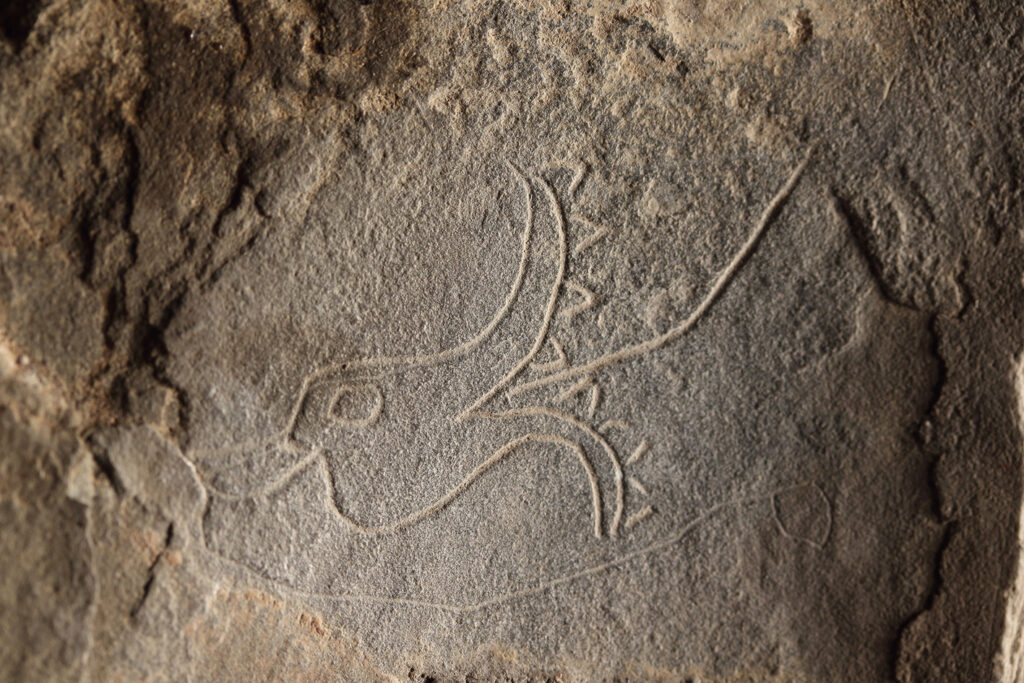
The ‘Scandinavian Sea Monster’ carving in Torr’s Cave (© Galloway Glens)
Medieval Boat Repairs in Smoo Cave, Highlands
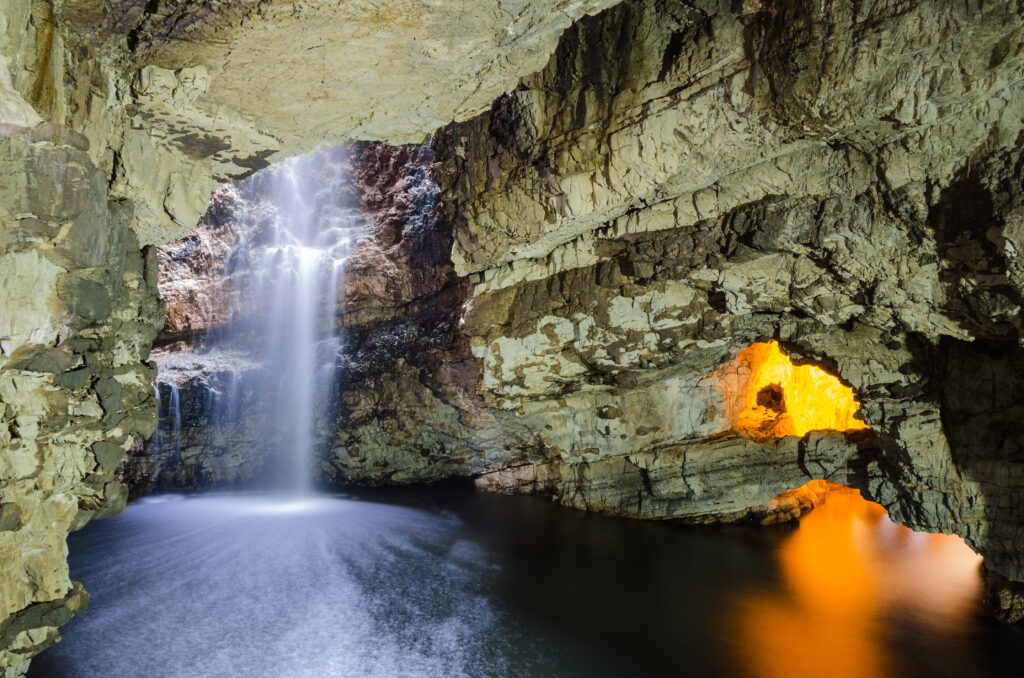
There are many stories associated with Smoo Cave in Sutherland and for centuries it was believed to be the residence of the Devil.
It’s also said that in the 1700s, two excisemen (government agents who collected taxes and prevented smuggling) were searching the caves for a suspected illicit whisky still when they were murdered by the local boatman (who is thought to have been the illicit still operator).
Whether or not this legend is true, we do know that the cave has a long history connected with boats, due to the iron slag and boat nails found there which have led archaeologists to suggest that boats were repaired in the sheltered inlet centuries ago.
In 1995, investigations at the cave also uncovered a host of artifacts including finds related to Viking/Norse activity in the medieval period. Radiocarbon dates from Smoo Cave and nearby Glassknapper’s Cave provide evidence for use of these sites between the 8th and 11th centuries AD, around 900 to 1,300 years ago.
Smoo Cave is freely accessible year-round with a walkway into the waterfall chamber, and tours are also available.

Entrance to Smoo Cave (© Florian Fuchs via WikiCommons, CC BY 3.0)
Human Remains in Macarthur Cave, Oban
In 1894, quarrymen discovered a cave in the centre of the busy town of Oban. It was excavated the following year and around 140 bone implements were discovered along with parts of the skeletons of at least four individuals.
The age of the human remains was not known at the time, but radiocarbon dating of one bone undertaken for Professor Ian Armit FSAScot and Professor David Reich’s GENSCOT ancient DNA project in 2016 revealed that one, at least, of the individuals dates to the Early Neolithic period[1]. This is among the earliest dates for Neolithic human remains anywhere in Britain and Ireland.
The DNA analysis of that individual and of another from that cave, undertaken for the GENSCOT project, not only confirmed their sex as male but also revealed that they were descended from immigrants from the European Continent who settled in Scotland around 6,000 years ago. Even more thrillingly, they were close relatives, most likely brothers.
The findings were revealed by Dr Alison Sheridan FSAScot (courtesy of Professors Reich and Armit) in her 2021 Rhind lecture series for the Society of Antiquaries of Scotland which are available to watch free on YouTube.
She noted: “The DNA of the incomers contrasts starkly with that of the Mesolithic inhabitants of Britain and Ireland and we can also say that the incomers probably looked different from the indigenous groups, with slightly lighter skin and different coloured eyes.”
Dr Sheridan described the new information as “fantastically valuable” to our understanding of the transition from the Mesolithic period (also known as the Middle Stone Age) to the Neolithic period (or New Stone Age) when migrant farmers from Northern France came to Britain around 4,000 BC.
She adds that cave burial was not a practice used by the Mesolithic inhabitants of Scotland (in contrast to other parts of Britain), and it seems to be one of the new practices introduced by the Continental settlers, along with burial in megalithic chamber tombs such as Achnacreebeag to the north-east of Oban, and in non-megalithic monuments elsewhere in Scotland. Interestingly, cave burial is not a feature of the parts of France from where the immigrant farmers are believed to have come. There is much we still have to find out about the funerary practices of Scotland’s first farming communities.
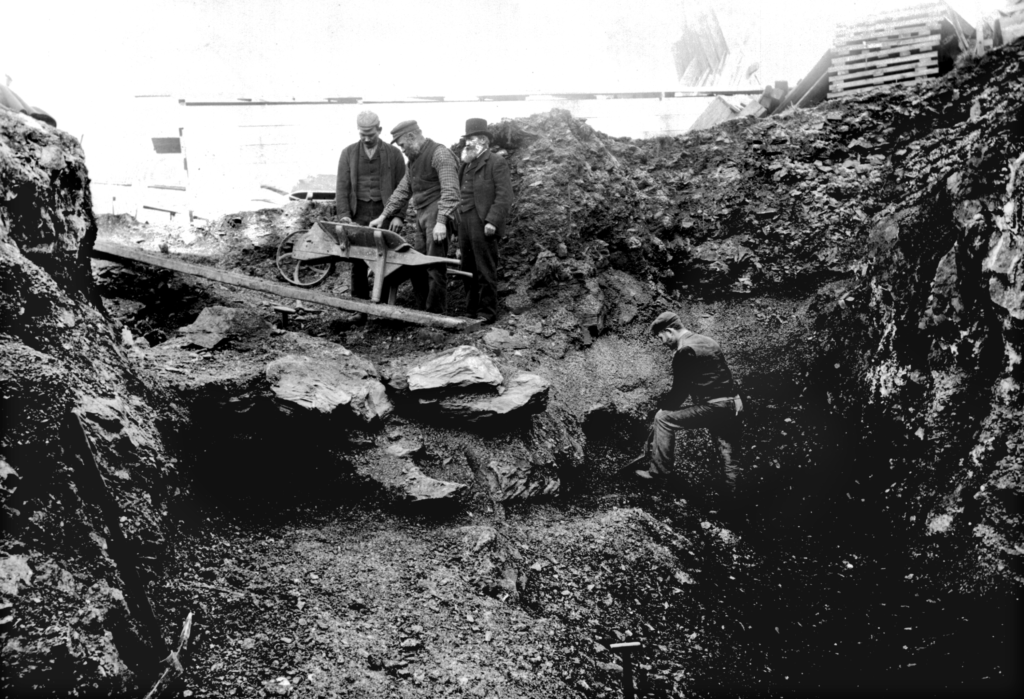
View of the excavations of Macarthur Cave, Oban by J Anderson in 1895 © Courtesy of HES (Society of Antiquaries of Scotland
Collection)
Crosses and Celtic-Style Animals in Constantine’s Cave, Fife
Local legend tells that King Constantine I of Scotland was killed by Vikings at this natural sea cave near Craig in AD 877, but there is no evidence that this was actually the case. However, archaeologists did find evidence that the cave was occupied (although not continuously) from the prehistoric period into the 19th century when it was first excavated in 1914.
The earliest occupation layer found around 30cm below the current land surface contained a variety of animal bones, including red deer, ox, horse and whale, along with some antler and bone tools. This layer also contained evidence of iron working as well as Roman glass and pottery, including several pieces of amphorae, made in Africa or on the European Continent (possibly modern-day Spain, Italy or France) over 1,800 years ago and which may have been salvaged from a nearby shipwreck.
Around AD 800-1000, several incised crosses and Celtic-style animals were carved on the cave walls. The construction of a wall across the entrance suggests the cave was used as a chapel or hermitage for some time during or after this period, and the people who used the space as such may be responsible for the carvings.
Visitors can still see the carvings today – the entrance to the cave is via a path running along the seashore, close to Balcomie Golf Course.

Constantine’s Cave (Public Domain)
Some of Scotland’s Earliest Signs of Human Habitation in Ulva Cave, Argyll and Bute
In the late 1980s and early 1990s, excavations inside Ulva Cave by Clive Bonsall and colleagues unearthed the clearest example of a midden (rubbish) deposit connected to both Mesolithic and Neolithic activity in a single site ever found in Britain.
The midden was discovered at the cave entrance and contained mammal bones, 22 species of shellfish (mostly limpets, periwinkles and dog-whelks), flint artifacts, a bevelled bone implement dubbed a “limpet scoop” (possibly used to remove sea creatures from their shells), a cowrie shell ‘bead’, and several pieces of Neolithic pottery which the excavators described as ‘Unstan Ware’[2] (but which would benefit from fresh examination by a pottery specialist). If it is an Unstan Bowl – a fine, collared bowl with decoration around the collar – then it is likely to date to between 3600 BC and 3300/3100 BC, over 5,000 years ago.
Radiocarbon dates from the midden, and the type of artifacts found inside, indicate that it grew over a period of 2,000 to 3,000 years, from sometime before c.5,750 BC to c.3,650 BC (between c.5,600 and c.7,700 years ago).
The archaeologists investigating the site suggested that people didn’t actually live in the cave over a long time but rather camped there seasonally or occasionally, returning repeatedly over an extended period of time. Indeed, how the cave was used may well have varied over the millennia.
As a natural shelter and conveniently situated close to the Mesolithic shoreline, Ulva Cave would have made an appropriate location for a camp site, particularly during wet weather when lighting fires in the open air would have been difficult.

Ulva Cave (AKA Livingstone’s Cave) (© Tom Parnell via Flickr, CC BY-SA 2.0)
Ready for more? Dig deeper into cave use with Footsteps in the Dark: Caves and Cave Use in Scotland, and Society of Antiquaries of Scotland’s book The Caves of Mid Argyll which you can access free online.
[1] 3952–3781 cal BC (SUERC-68701, 5052±30 BP; the date was published in Discovery and Excavation in Scotland vol 17, 195).
[2] If you want to find out more about Scottish Neolithic pottery, see Alison Sheridan’s 2016 publication’ and you can do a hotlink to the Sidestone Hunter & Sheridan book, Ancient Lives.
Header Image: Smoo Cave (© VisitScotland / Paul Tomkins)
