Six of the Best Ancient Sites on Eilean Arainn (Isle of Arran)

Eilean Arainn (Isle of Arran) is packed with prehistoric sites. Their accessibility, however, ranges from ‘ok with stout shoes, a mac and midge repellent’ to ‘a detailed map, compass, ice picks and Mountain Rescue on speed dial’. This is a guide for the former.
Fallen Forts
Dun Fionn is a hill fort with a spectacular view of Holy Isle. Though no physical remains survive today, the fort once had up to three lines of defence. A 2019 field visit also recorded the remains of a later timber roundhouse on the site.
Following the coast road south to Am Bàgh (Whiting Bay) is the Fort at Kings Cross Point, which may be home to a later Viking grave. An excavation in 1909 found a wealth of artefacts including human bones, pieces of decorated whalebone, pieces of iron including Viking boat rivets, and a bronze coin with the face of Styca of Wigmund, Archbishop of York from 831-854 AD.
Here Be Giants
The Giant’s Graves at Largymore are two neighbouring chambered cairns that are well worth the climb to reach them. According to Irish folklore, the giant warriors asleep inside the dual cairns are said to be the legendary god-like warrior Fionn mac Cumhaill and his warrior band, the Fianna.
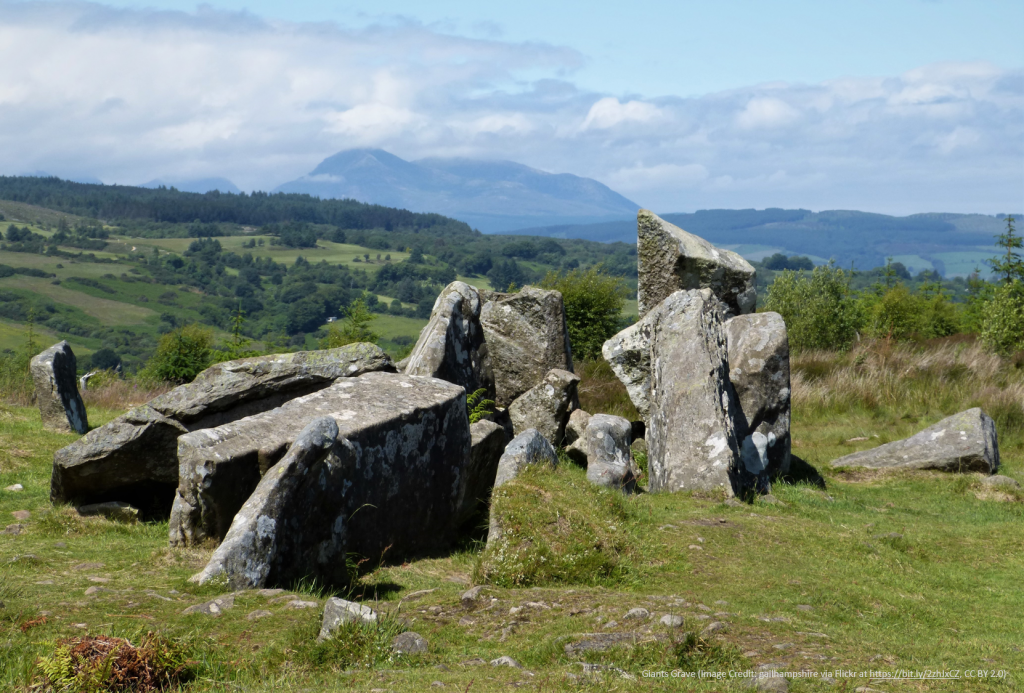
Giants Grave (Image Credit: gailhampshire via Flickr at https://bit.ly/2zhJxCZ, CC BY 2.0)
Chambered cairns are burial monuments, usually constructed during the Neolithic period (around 4,500 to 6,000 years ago) and consisting of a sizeable (usually stone) chamber around and over which a cairn of stones was constructed. Human remains, beaker sherds, flint knives and leaf-shaped arrowheads were found at the northern cairn in 1902.
Another chambered cairn can be found in the south of the island at Torrylin. The main stones of the cairn are in a straight line with the iconic island of Ailsa Craig, 15 miles away on the horizon.

Torrylin Cairn lined up Ailsa Craig, 15 miles distant (Image Credit: Megan Fyfe)
Sadly, over the years stone-robbing has severely reduced the mound of the cairn and it’s hard to be certain of its original shape. However, three excavations in the late 19th century uncovered some interesting finds; four human skulls from the third chamber and the remains of at least six adults, one child and an infant from the fourth, as well as a fine flint knife and the bones of many domesticated and wild animals.
The ox, pig, lamb (or kid), bird and fish bones probably represent the remains of ritual feasts, but the otter and fox may be the remains of animals who used the tomb as a den. The bones of exotic mammals and birds have been found in other Neolithic tombs and the animals may have played a part in the ritual life of the communities on Arainn many thousands of years ago.
Among Gods and Kings
On the west coast of Arainn you’ll find the famous King’s Cave. According to a story by Sir Walter Scott, this is where 14th-century king, Robert the Bruce, encountered a spider while defeated and on the run. The spider’s determination to keep attempting to spin its web inspired Bruce to return to the mainland and defeat the English army.
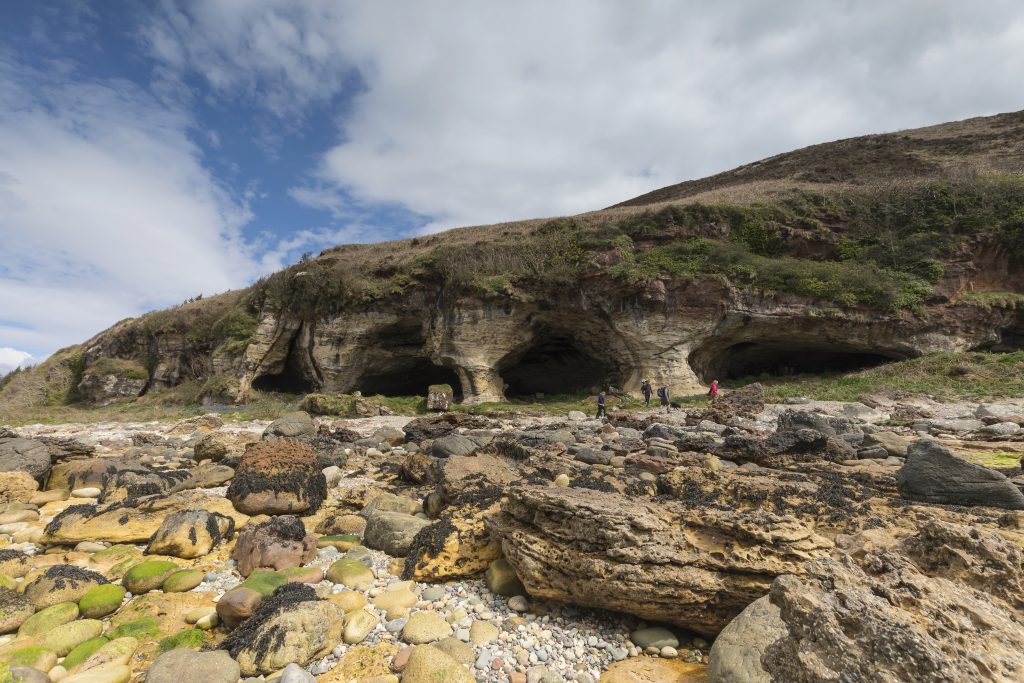
King’s Cave (Image Credit: © VisitScotland / Kenny Lam)
The legend of Bruce and the spider may just be a story, but the King’s Cave hides many other secrets, including examples of ogham script (an Early Medieval alphabet) and carvings, both Iron Age (around 800 BC to 400 AD) and later. There are figures of horses, deer, serpents, cup and ring marks, two crosses, and a carving of a man with his hands joined above his head, possibly in prayer. A row of small holes cut in the inside of the cave in a sloping line may have been sockets for small bars of wood, perhaps for a roof or ceiling structure, suggesting that the cave was inhabited hundreds of years ago.
Just a few miles north of the King’s Cave lie the Machrie Stones. The area of Machrie Moor boasts six visible stone circles, as well as standing stones and chambered cairns (one near the car park). The stone circles were built around 2000 BC, but archaeologists have found that human activity on the moor stretches back even further and may have begun as early as 5,500 years ago. It’s thought that the circles were associated with the religious and ceremonial activities of the Neolithic and Bronze Age farmers living on Machrie Moor, who may have gathered here to celebrate the midsummer sunrise as it rose over the head of Machrie Glen.
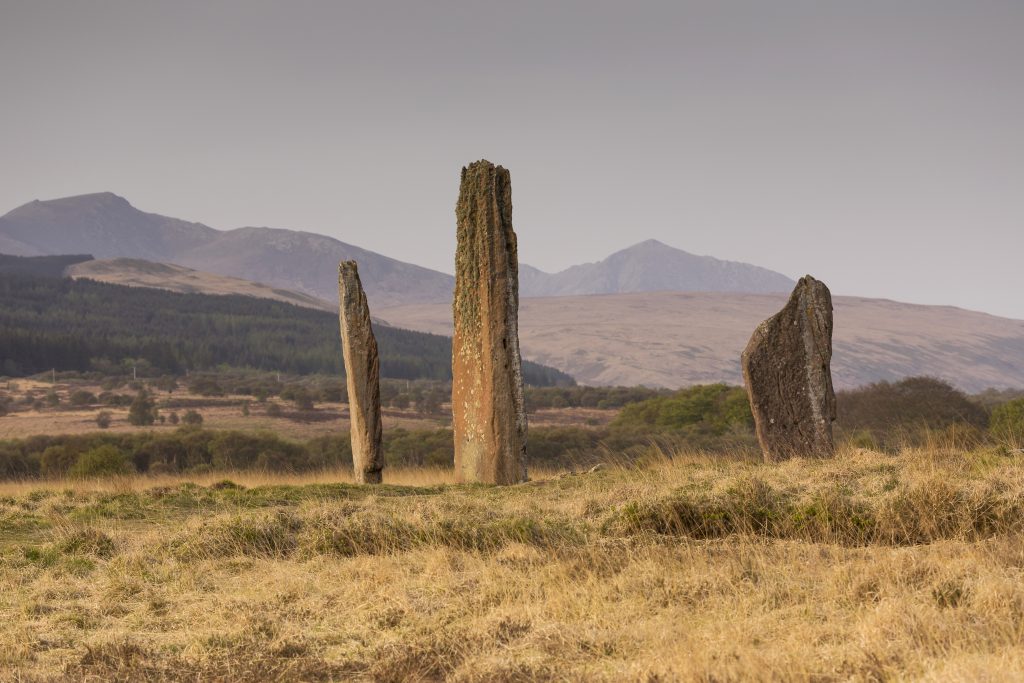
Machrie Moor Standing Stones (Image Credit: © VisitScotland / Kenny Lam)
Later on, the circles were used for burials (including cremations and inhumations) perhaps for prominent members of the community. A fine food vessel was found in the middle of one of them, perhaps a donation to the deceased from a mourner. The stone circle known as ‘Fingal’s Cauldron Seat’ is named after Fingal the giant – another name for Fionn Mac Cumhail. According to Historic Environment Scotland, one of the stones has a hole in it; it’s said that Fingal used this to tether his dog Bran while he ate a meal in the inner ring.
If you visit Arainn in the future, be sure to stop by the Arran Heritage Museum in Tràigh a’ Chaisteil (Brodick) with it’s amazing collection of archaeological artefacts – not that we’re biased, of course!
Getting around Arainn: Arainn’s 50 miles of coastline also hosts the main road. Of the two roads that cross the island, the southern Ross route is the highest on the island, is single track and has some hair-raising bends. Do not attempt in snow. Or ice. The middle String Road does have two carriageways, and if it’s not foggy you can even see them. The good news: there are no roundabouts or permanent traffic lights on the island and the views can be spectacular. The less good news is the roads can be narrow and twisty and there are few places to overtake safely, if at all. If you are relying on buses, CHECK THE TIMETABLES BEFORE YOU GO! It’s an awfully long walk back.
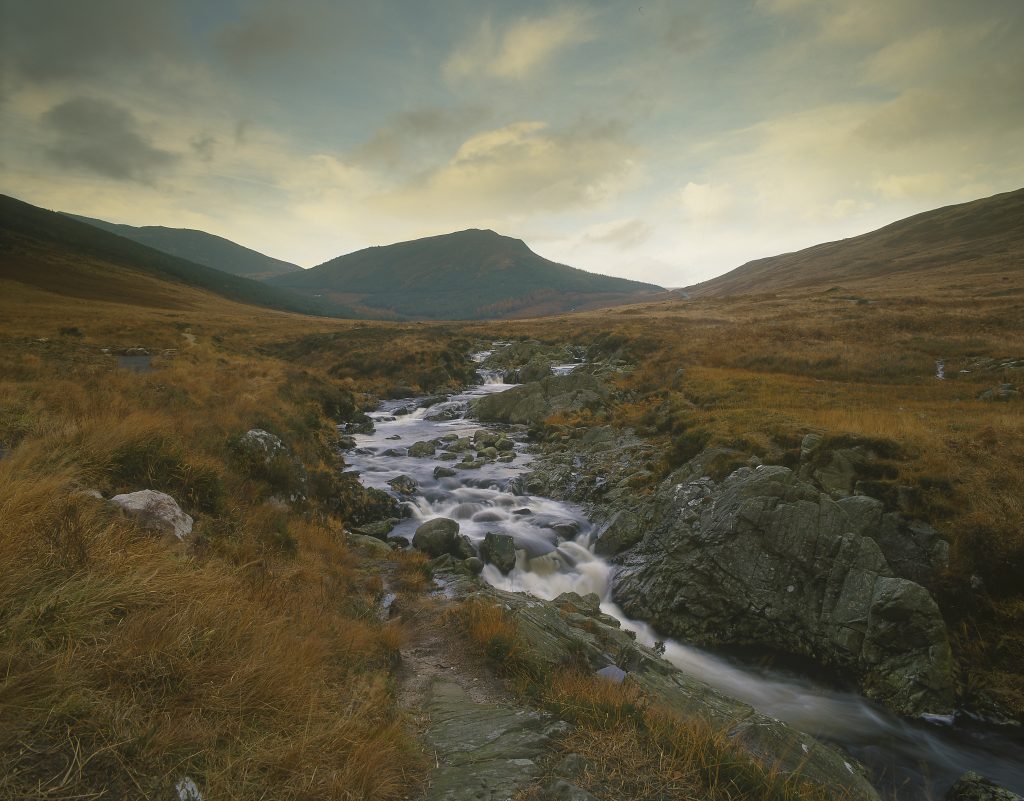
Glen Sannox (Image Credit: © VisitScotland / Paul Tomkins)
Preparation is everything: Whatever way you travel, a map makes things MUCH easier. The OS Landranger 69 yellow cycle map for Arainn (1:50,000) displays all the sites above plus many more, folds up small and is waterproof. This IS Scotland and all four seasons really can occur in one day. Dress appropriately and remember the midges! They make up in numbers what they lack in size.
If you’re looking for more west coast island inspiration (for when it’s safe to travel), dig into the archaeology of Tiriodh (Tiree).
By Megan Fyfe, formerly of the Arran Heritage Museum, and Sally Pentecost, Dig It! Communications and Events Officer
Featured Image: Glen Rosa (© VisitScotland / Kenny Lam)
This article was produced in support of Scotland’s Year of Coasts and Waters 2020-21.
Need help planning your next trip to Arran? Find all you need at Visit Arran and join the conversation on social media at #WeAreArran.