Outstanding Lesser-known Archaeological Sites in Orkney
You’re probably familiar with some of the titans of Orkney’s archaeological landscape such as the Ring of Brodgar and Skara Brae, but what about the less famous gems?
Historic Environment Scotland (HES) takes care of many historic sites in Orkney – about 35, depending on how you count them. They include two brochs, two castles, three palaces, two souterrains (underground chambers or passages), and a host of Neolithic monuments, some of which make up the Heart of Neolithic Orkney World Heritage Site.
In this article, dig into five fantastic lesser-known sites which can be found close to some of the more popular spots on the islands.
Fascinated by the Ring of Brodgar, Standing Stones of Stenness or Maeshowe? Check out Cuween Hill Chambered Cairn
Over 5,000 years ago in the Neolithic period, Orkney had emerged as an influential centre of power and culture, a highly organised society with the skill and resources to build great ceremonial monuments, like chambered cairns.
Due to Orkney’s relative scarcity of trees, prehistoric Orcadians didn’t have much timber to work with but found they could split the local sandstone into flat slabs, so they built with those instead. Because stone tends to survive for much longer than organic materials like wood, we still have lots of evidence of Orkney’s prehistoric achievements.
(© Rab Lawrence via Flickr, CC BY 2.0)
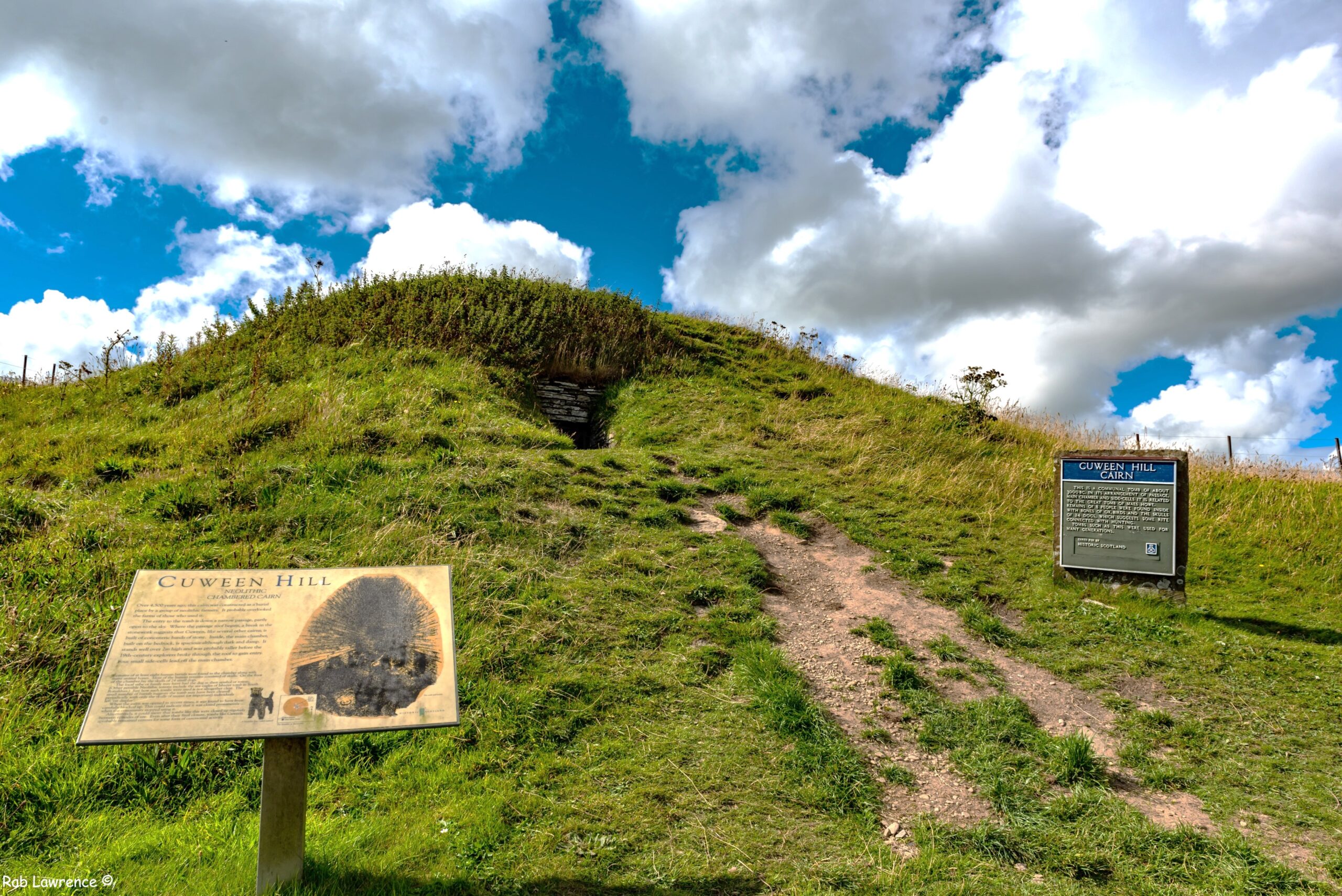
Built between 3,000 and 2,400 BC (some 4,400 to 5,000 years ago), Cuween Hill Chambered Cairn on Mainland Orkney is an excellent example of a Neolithic chambered tomb. It’s largely unlit and has four cells opening off a central chamber, which is accessed down a passage. Entrance into the tomb today is through the original passage.
Cuween contains rare examples of Neolithic scratch art, which importantly reinforce the relationship between settlements which contained large amounts of Grooved Ware pottery (such as Skara Brae some 11 miles away) and these elaborate tombs. The markings at Cuween are similar to those found on Grooved Ware.
In 1901, the remains of at least eight humans and the skulls of 24 dogs were found in the cairn. The canine remains suggest that the local tribe or family perhaps had a dog as their symbol or totem, or that there may have been a belief in an afterlife for animals. The site is evidence for complex burial rites within tombs that have been used over many years.
Stunned by Skara Brae? Don’t Forget the Brough of Birsay
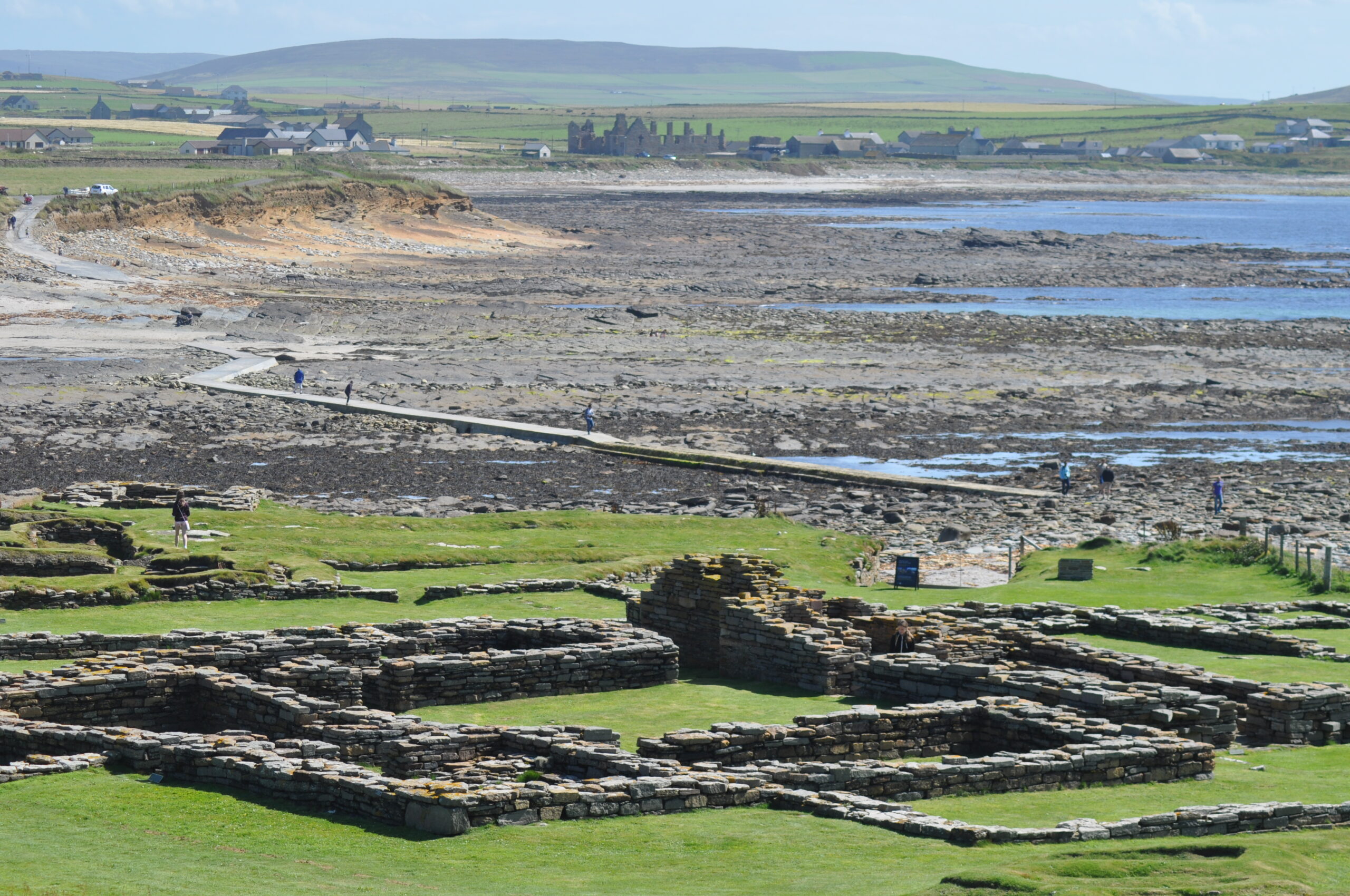
The Brough of Birsay is a small tidal island off the mainland which was settled by the Picts and Norse between the AD 600s and 1200s (between 800 and 1,400 years ago).
High-quality artefacts such as brooches, rings, bone combs and dress pins tell us that the site was once a high-status settlement. Birsay was probably a power centre for the Picts, who lived here in the late 7th century AD. Although traces of their buildings aren’t visible today, you can see a cast of one of their carved stones inside the graveyard which bears four Pictish symbols above an unusual scene featuring three armed men.
(© stevekeiretsu via Flickr, CC BY-NC 2.0)
Norse people settled on the brough in the early 9th century AD, and you can still see the remains of the individual rooms of their 10th-century houses (some with underfloor heating!), the possible remains of a 10th– or 11th-century blacksmith’s workshop, a barn and even an early medieval sauna.
A small church and what appears to be a monastery were built in the final phase of settlement on the brough, the latter being one of the most sophisticated medieval religious buildings to survive in the Northern Isles. But Birsay’s importance as a religious centre declined from the 1100s. The monastery was probably short-lived and may never have been completed.
The site may help us to understand how Pictish and Norse societies in Orkney interacted, particularly as some Pictish artefacts were found in Norse houses. Are they evidence of peaceful coexistence? Or were they taken by force?
Bowled over by the Broch of Gurness? Don’t Miss Midhowe Broch
Orkney’s status as a centre of expertise in stone construction was developed over many generations. Indeed, some experts believe that the islands witnessed the birth of the broch, a highly sophisticated, uniquely Scottish round tower that appeared in the final centuries BC, around 3,000 years after Orkney’s Neolithic monuments were constructed.
Midhowe Broch on Rousay was built on a narrow headland beside Eynhallow Sound more than 2,000 years ago. Today, the tower stands 4.3m high, but it could have been double this height when fully built. Its narrow entrance faces out to sea and a thick stone barrier and ditch across the neck of the headland defend it from the landward side. The remainder of the settlement, part of which has sadly been lost to coastal erosion, is surrounded by the sea, meaning that it was an expertly defended site.

(© MichaelMaggs via Wikimedia Commons, CC BY-SA 4.0)
Inside the broch, stone partitions, a spring-fed water tank, and a hearth with sockets which may have held a roasting spit, can still clearly be seen. The remains of other, smaller buildings which were later used as workshops surround the broch tower itself – an iron-smelting hearth is still visible in one.
Midhowe is one of several broch sites identified on both coasts of Eynhallow Sound, there are up to a dozen in all which may have been the main strongholds on each side of this important seaway between Mainland Orkney and the island of Rousay.
Archaeologists digging here in the 1930s found a remarkable array of everyday artefacts, including stone and bone tools, spinning and weaving pieces and crucibles and moulds which indicating bronze-working, plus a fragment from a Roman bronze vessel. The last item is of special interest to archaeologists because it could be linked to the claim of Roman historian Eutropius in the AD 300s that the king of Orkney had submitted to Emperor Claudius in AD 43. If this was the case, it would add to our understanding of the extent of Roman influence in Scotland over 2,000 years ago.
Enthralled by the Bishop’s and Earl’s Palaces? Check out The Earl’s Bu and Church in Orphir
The Earl’s Bu and Church are strongly associated with the Orkneyinga Saga, an account of the history of Orkney from its capture by a Norwegian king in the 800s until about 1200 AD. It tells of a Yule feast given by Earl Paul at his bu, or residence, at Orphir in 1136:
‘There was a large drinking-hall; the door was near the east gable on the southern wall, and a magnificent church stood before the hall door, and one had to go down to the church from the hall.’
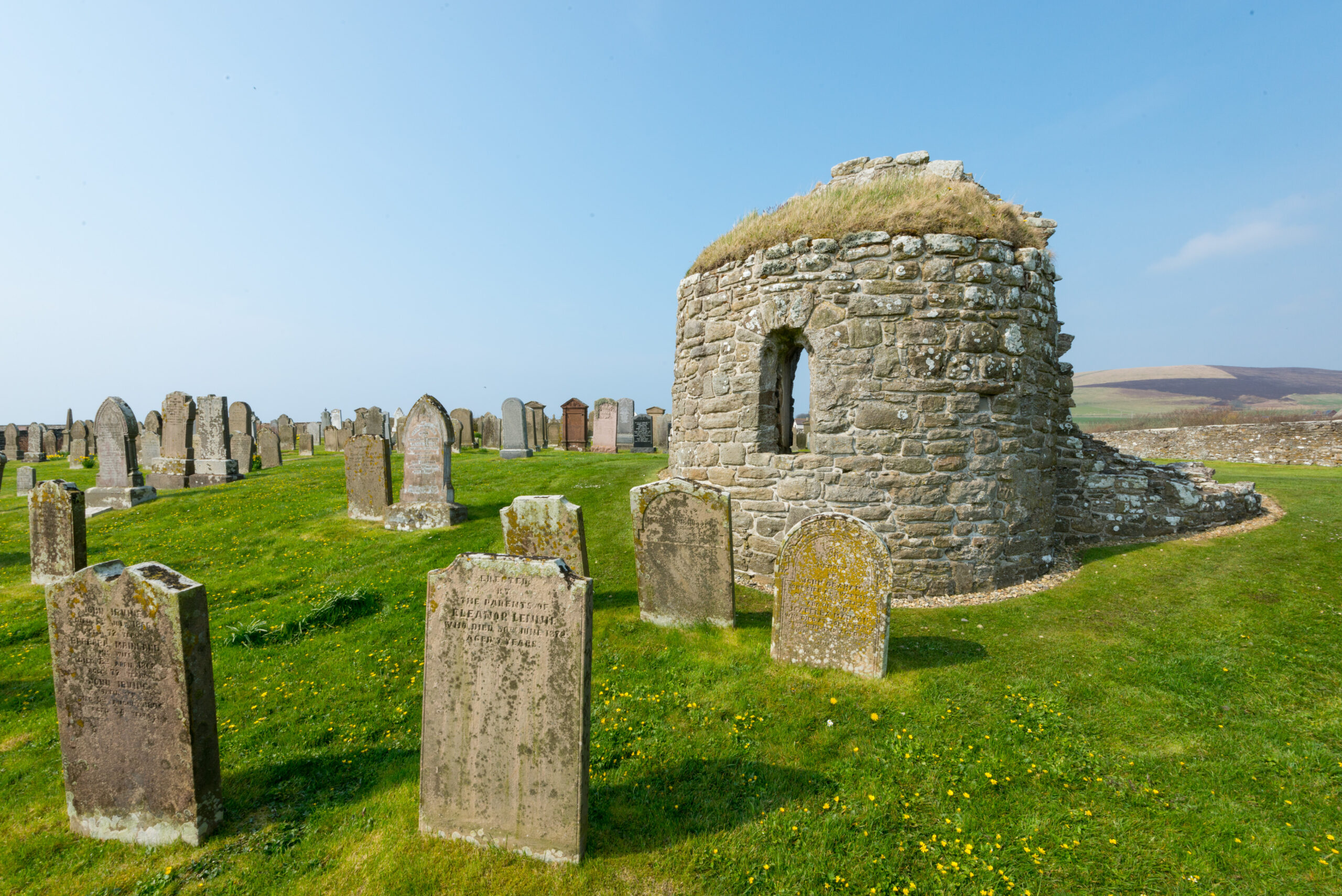
The remains of this church survive in Orphir to this day, and it is possible that the footings of large, ruined buildings once formed part of the drinking hall or residence.
Earl’s Bu and Church, Orphir (© Crown Copyright HES)
Orphir Church is circular, which is unusual: the only other round medieval church in Scotland is in the Scottish Borders. Circular churches were inspired by the rotunda of the Church of the Holy Sepulchre in Jerusalem and since Earl Haakon Paulsson of Orkney travelled to Jerusalem after the First Crusade of 1099, he probably built the church here (dedicated to St Nicholas) soon after his return.
In the next field to the East are the foundations of a Norse horizontal mill, more recently excavated and completely infilled by feasting debris from the Earl’s halls. The mill would have been used to process grain given as tribute or rent to the Norse Earls.
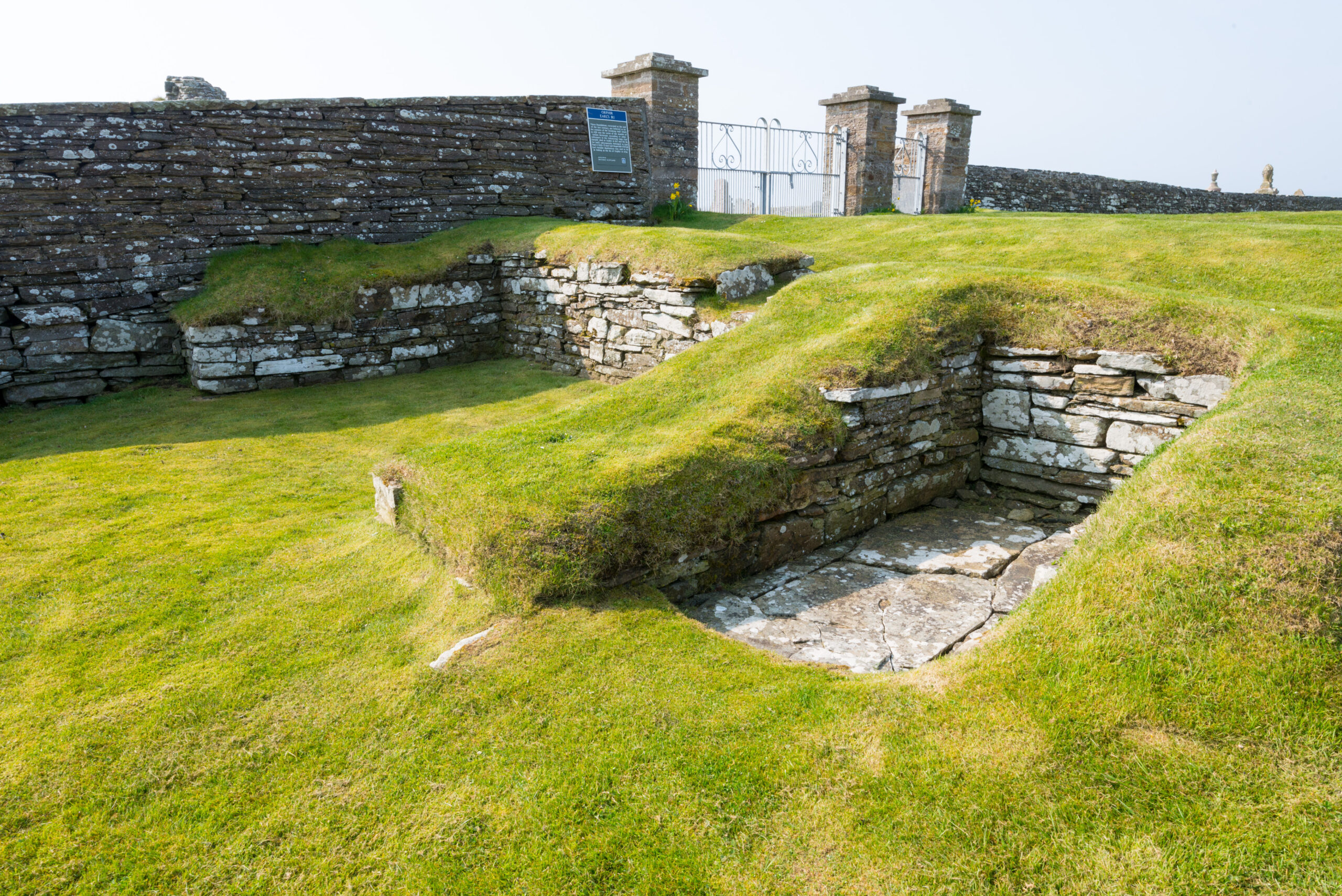
Earl’s Bu, Orphir (© Crown Copyright HES)
What we see today would have been part of a far larger settlement complex. One Pictish symbol stone and a substantial Early Bronze Age carved stone were discovered on the site during excavations in the 1930s, but are both now lost. It is possible that when the Norse settled here, they were taking over a high-status Pictish estate.
Enchanted by Noltland Castle? Seek Out the Knap of Howar
The Knap of Howar on Papa Westray is the most complete example of an Early Neolithic stone settlement yet discovered in Scotland.
The site is made up of two side-by-side Neolithic buildings with intact entrances which were constructed and occupied over 5,000 years ago, at some point between about 3,500 and 3,000 BC. The houses are both oblong-shaped, stand just over 1.6m tall, and are linked by a short passage. Both have stone-built cupboards, but one may have been used as a workshop or for storage, rather than as a dwelling.
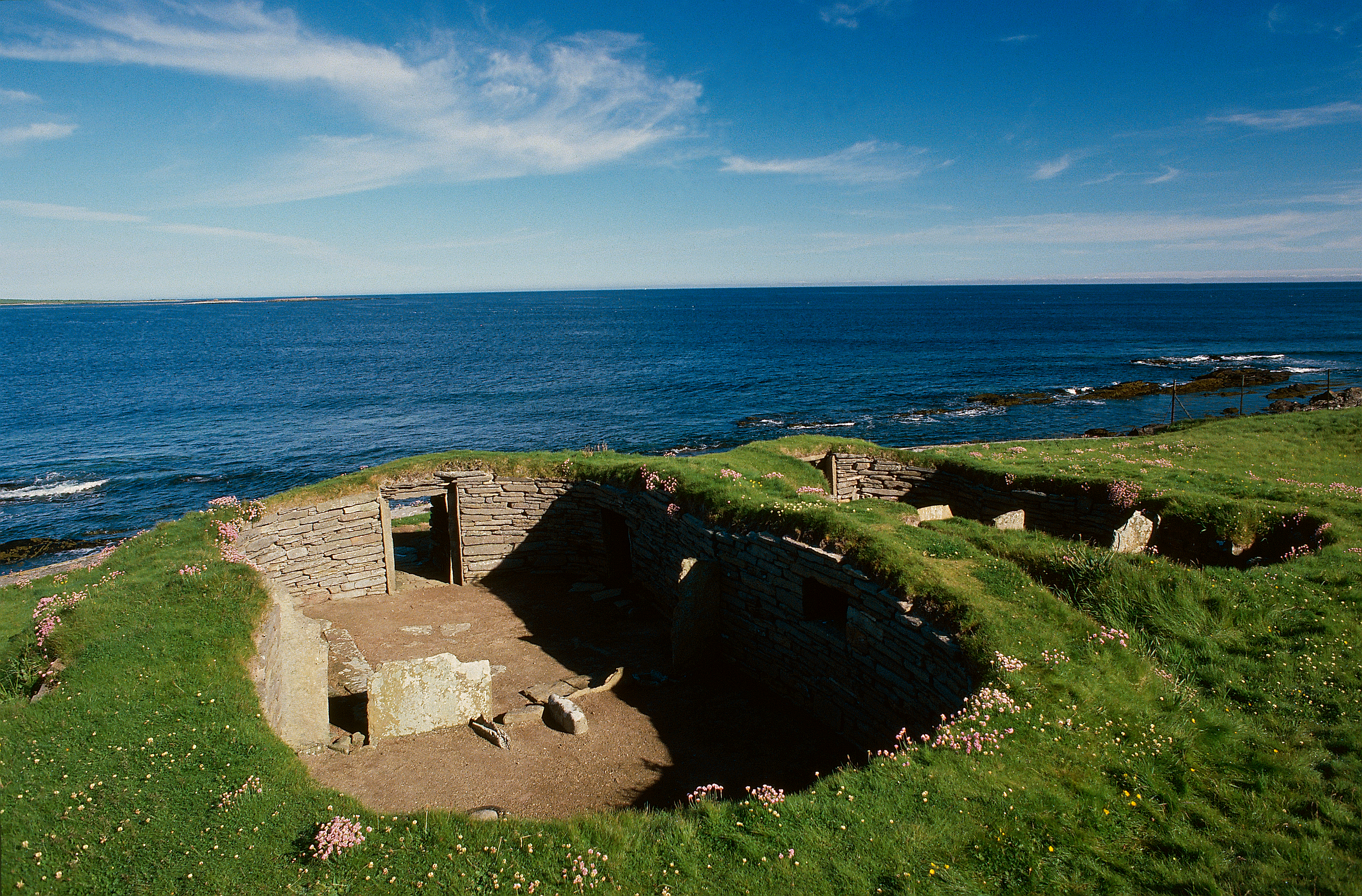
Knap of Howar (© Crown Copyright HES)
Excavation in the 1970s uncovered a wealth of information about Early Neolithic settlement, farming, beliefs and society. There’s evidence that the inhabitants kept cattle, sheep and pigs, cultivated barley and possibly wheat and utilised wild resources, including fish, sea birds and shellfish. Artefacts unearthed at the site all appear to have been made locally and include a range of bone and stone tools as well as round-based pottery such as Unstan Ware. Antler and whalebone maceheads are also evidence that domestic spaces like these were used for ceremonial and ritual activities.
The site has not yet been completely explored and the two houses are certainly part of a larger settlement. Will future excavations reveal more about life here over 5,000 years ago?
Where Can I Find out More?
HES’s new digital guide for Orkney reimagines dozens of the islands’ most spectacular archaeological sites, with commentary from stewards, rangers and monument managers as well as some of the leading experts on Orkney’s archaeology and history.
These experts include current and recent Fellows of the Society of Antiquaries of Scotland (who coordinate Dig It!). Dr Alison Sheridan, for example, discusses Maeshowe, Dr Hugo Anderson-Whymark covers the Holm of Papa Westray Chambered Tomb, Nick Card talks about the Ness of Brodgar, Julie Gibson focuses on the story of Walter Grant (who owned Highland Park distillery and sponsored at least four major archaeological digs on Rousay), and the late Caroline Wickham-Jones chats about Unstan Chambered Cairn.
Through the app, users can enjoy audio recordings (such as interviews and literary sources) and video content (including drone footage and 3D scans) even in areas where mobile signal is weak or non-existent, helping visitors learn more about life in Orkney over the last 6,000 years.
Orkney: A Guide to Our Sites is available with online admissions to HES staffed sites, or over the counter at the Bishop’s and Earl’s Palace in Kirkwall.
By Andrew Burnet, Interpretation Manager at Historic Environment Scotland
Header Image: Maeshowe Chambered Cairn (© Crown Copyright HES)
