Did the Romans Conquer Scotland?

2,000 years ago, the Romans thought of Scotland (or Caledonia, as they called the region) as a wild and unruly place lying beyond the most northerly limits of their empire – indeed to them, Scotland must have seemed like the very edge of the world. Many assume that the army stopped their conquest of Britain at Hadrian’s Wall in present-day Northumberland – but that’s not true!
In fact, the Romans did push north into the land we now call Scotland. Whether or not they ‘conquered’ this land is more a question of interpretation and you can make up your own mind by considering the evidence we have available. Here’s what we know…
When Did the Romans Come to Scotland?
While the Roman army settled for only relatively short periods of time, traces of their movements and the lives they led here can still be seen today. The ghostly imprints of temporary marching camps, for example at Pennymuir in the Borders and Black Hill in Perthshire, show the routes the army took as it travelled north, while the massive earthworks of the Antonine Wall that they cut across the country can still be seen from the Forth to the Clyde.
However, despite several invasions, the Romans never managed to hold the land north of Hadrian’s Wall for long. Trouble elsewhere in the empire, the unforgiving landscape and native resistance meant that Scotland was never brought fully under the administration of the Roman province of Britannia.
There are three main periods of Roman activity in Scotland:
– The Flavian period (in the late 70s and 80s AD) – named after the Flavian dynasty of emperors: Vespasian, Titus and Domitian
– The Antonine period (in the 140s to 160s AD) – named after the emperor Antoninus Pius
– The Severan period (208 – 211 AD) – named after the emperor Septimius Severus
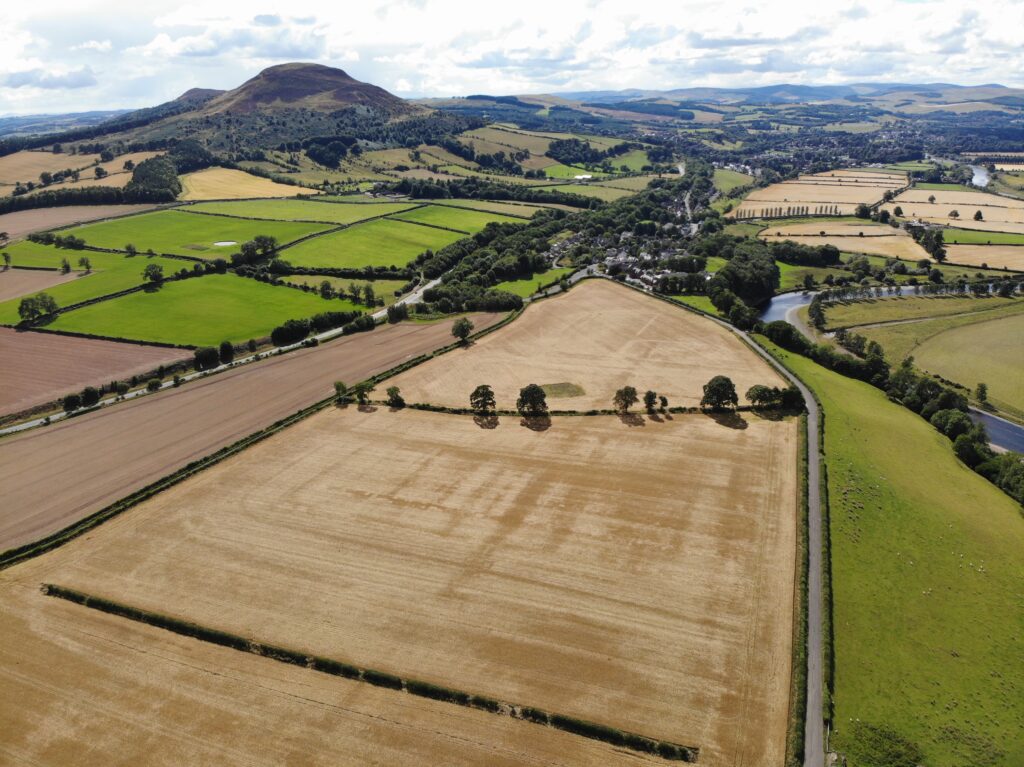
The remains of Trimontium fort are still visible today from the air as cropmarks (© Trimontium Museum)
Why Did the Romans Come and Go from Scotland?
The first Roman movement into Scotland was part of the conquest of Britain. The army had arrived in the south in 43 AD, but they didn’t make it to Scotland for another 35 years. When they did, they set up lines of forts that would potentially have seen them control the whole of mainland Britain.
However, trouble back on the Continent meant that soldiers in Britain were needed abroad, and so the Romans withdrew to the Tyne-Solway line between modern-day Newcastle and Carlisle, where they later built Hadrian’s Wall.
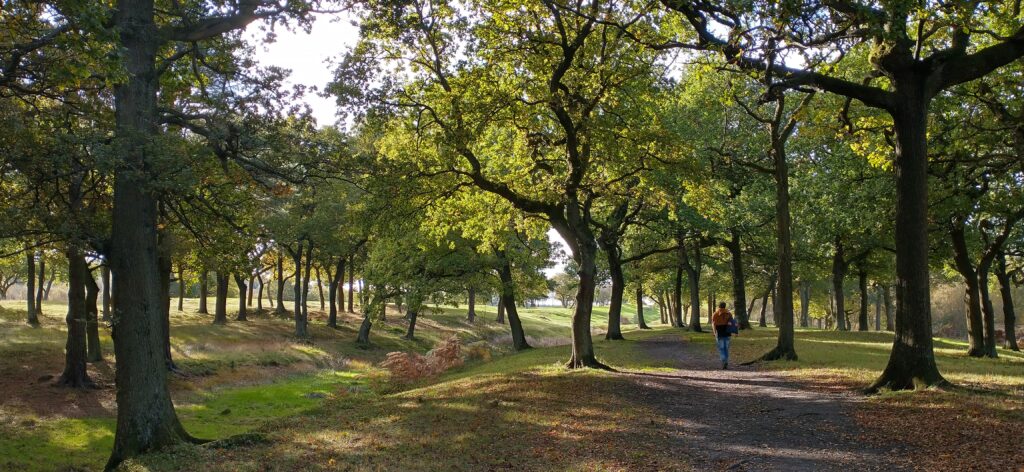
Some of the earthwork remains of the Antonine Wall (Image: Amy Baker)
In the 140s AD, a new emperor, Antoninus Pius, needed a military victory that would give him kudos in Rome – and it seems retaking some of the land abandoned in Scotland and building a mighty new wall across the Forth-Clyde line offered a way to achieve this (see more on the Antonine Wall below). However, this lasted only twenty years before his successor withdrew the armies back to Hadrian’s Wall.
In the early third century AD, the emperor Septimius Severus decided to try to quell resistance from the Iron Age tribes in the north once and for all. This was a massive undertaking, and seems to have seen some success, but three years into the campaign Severus became ill and died in York in 211 AD. His son returned to Rome to consolidate his power, the armies withdrew, and Hadrian’s Wall again became the border of the province.

A native Iron Age armlet, made of bronze, found at Trimontium fort (© Trimontium Museum)
After Severus, Scotland remained beyond the empire, unconquered. Unrest likely continued, however, this doesn’t mean that the Romans had no influence further north – an important part of maintaining their power in the south depended on a stable border, and links with tribes in Scotland remained through trade and diplomacy.
The Traprain Law silver hoard, uncovered in 1919 from an ancient hill fort in East Lothian, shows the Romans possibly trading valuable objects (or bribing!) to maintain peaceful relationships towards the end of Roman rule in Britain. Many smaller Roman artefacts have been found in Iron Age settlements, including this Roman coin found over 300 miles away from Traprain Law in the Orkney islands.
How Far Did the Romans Advance into Scotland?
Archaeological evidence of early Roman temporary marching camps have been found as far north as the Moray Firth, including a line of Flavian defensive forts and watchtowers called to Stracathro, and faint traces can still be seen at Kaims Castle.
Also linked to this period is the fortress at Inchtuthil – a massive military structure in Perthshire built to house over 5,000 legionaries. It’s one of the best preserved in the empire and shows the scale of the planned assault in Scotland. Close to one million iron nails were discovered during excavation, thought to have been buried by the Romans to prevent locals from getting their hands on them when they left (or because they were too heavy to carry back!).
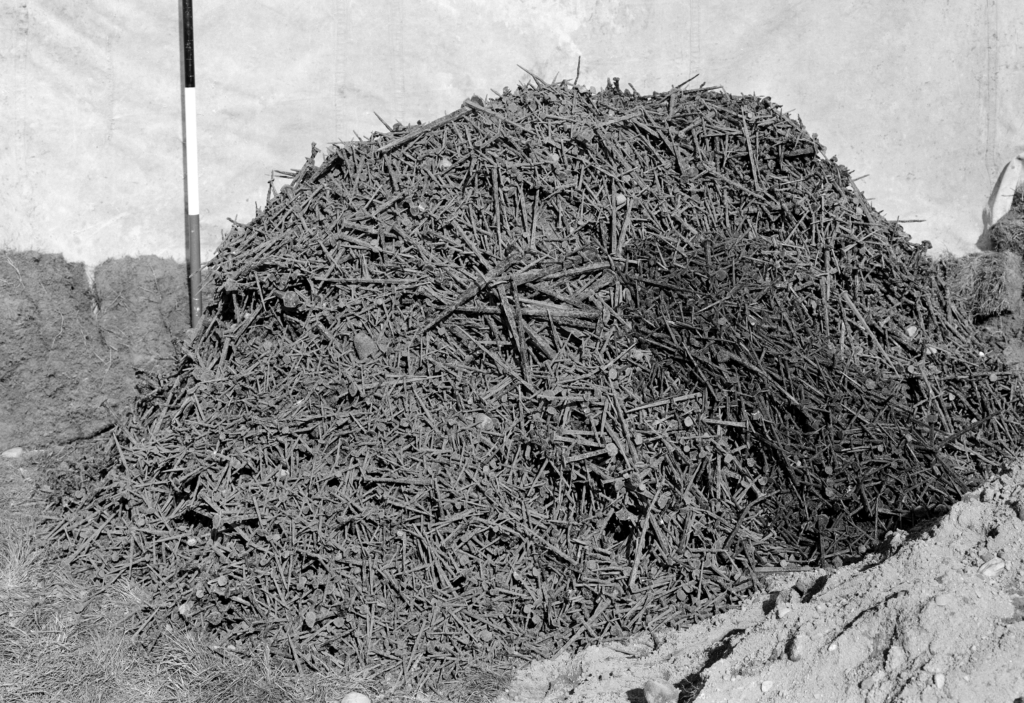
An image of some of the hundreds of thousands of iron nails found buried during 20th-century excavations at Inchtuthil fort (© Courtesy of HES)
In later periods, the Romans did not go this far into modern-day Scotland. Some forts in the Borders, such as Newstead (Trimontium) and Birrens (Blatobulgium), were garrisoned even while Hadrian’s Wall was the limit of the province of Britain, and would have provided a vital presence in potentially unstable territory.
Building the Antonine Wall
The most famous Roman remains in Scotland today are part of the Antonine Wall, a 37-mile-long earth rampart, with a massive ditch to the north, that spans the country from Carriden on the Firth of Forth to Old Kilpatrick on the Clyde.
There are at least 17 forts along its line. Rough Castle fort near Falkirk shows evidence of some of the nasty surprises the Romans used to protect themselves – the pits below are called lilia and would have been filled with sharp stakes to stop enemies getting close.
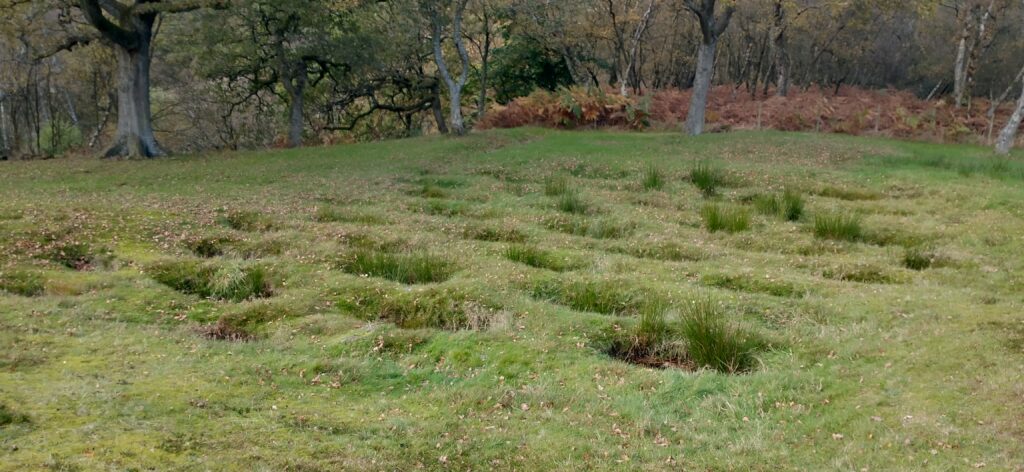
(Image: Amy Baker)
Massive carved stone dedications known as distance slabs (such as this one from Bridgeness) showed which legions built different sections of the wall. They would have been brightly painted and decorated with military imagery such as legionaries conquering Scottish native people – showing the role of propaganda in the Roman’s subduing of local populations.
A modern distance slab has been erected in Falkirk, with scenes from the point of view of local people instead (more on this project below).

One of the newly-carved replica distance slabs installed along the Antonine Wall in 2021 (© Rediscovering the Antonine Wall)
Were all the Romans in Scotland Soldiers?
It’s important to remember that the Romans were not just soldiers; supporting the military were also enslaved people, traders, craftspeople and families. These people would travel behind the army and settle in camps around the forts.
More excavation is needed to build up a better picture of where and how these people lived, but we do know some of these individuals by their tombstones.
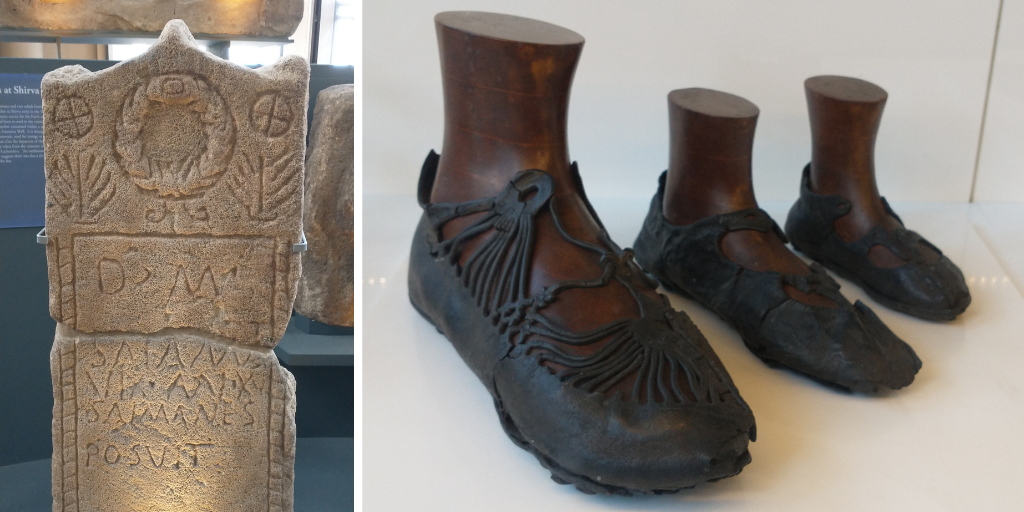
The gravestone of Salmanes, and common Roman leather sandals, both in the Hunterian Museum, Glasgow (Images: Amy Baker)
For example, the enslaved girl Verecunda, and Salmanes, possibly the son of an eastern trader. These tombstones were found in the 1720s and had been incorporated in a structure or ‘earth-house’ on the site of the Antonine Wall ditch sometime after the Romans left. The tombstones are thought to have originally been part of the cemetery associated with either Bar Hill or Auchendavy fort.
Where Did the Romans Come From?
This might seem like a silly question, but the Romans who came to Scotland were drawn from across the whole Roman Empire, not just Rome itself.
We have archaeological evidence which tells us that there were units occupying the forts which included archers from Syria, cavalry from Belgium and legionaries from Africa. Their names and identities are immortalised on altars and tombstones, including the Centurion Ammonius of the First Cohort of Spaniards. Evidence also comes from styles of cooking pottery found along the Antonine Wall that suggest North African links.
Where Can I See the Remains of the Romans in Scotland Today?
There are many exciting sites across Scotland that you can visit today. The Antonine Wall runs through Glasgow and the remains of an impressive bath house can be seen at Bearsden close to the city centre. There are also major forts to visit at Bar Hill and Rough Castle, as well as many sections of the Wall in between, for example at Croy Hill and Seabegs Wood.
The best sites at the eastern end, around Falkirk, can be found here. For further information, the Antonine Wall and Historic Environment Scotland websites list important sites and how to access them. The Rediscovering the Antonine Wall project has also installed new sculptures inspired by the Romans in Scotland, including giant metal heads and replica distance stones.

The towering Roman head sculpture, named Silvanus meaning “Roman god of the woods”, alongside a replica of a distance stone, on display at Nethercroy in North Lanarkshire (© Rediscovering the Antonine Wall)
The original distance slabs have their own special gallery in The Hunterian museum in Glasgow, and many Roman finds from the Antonine Wall and elsewhere in Scotland can be found in the National Museum of Scotland in Edinburgh.
Here you can see many highlights like the Newstead cavalry helmet (below) and the Cramond Lioness, but you can also learn about everyday Roman activities like cooking and farming and what they wore, including iron tools which look barely any different to those you might find in a garage today.
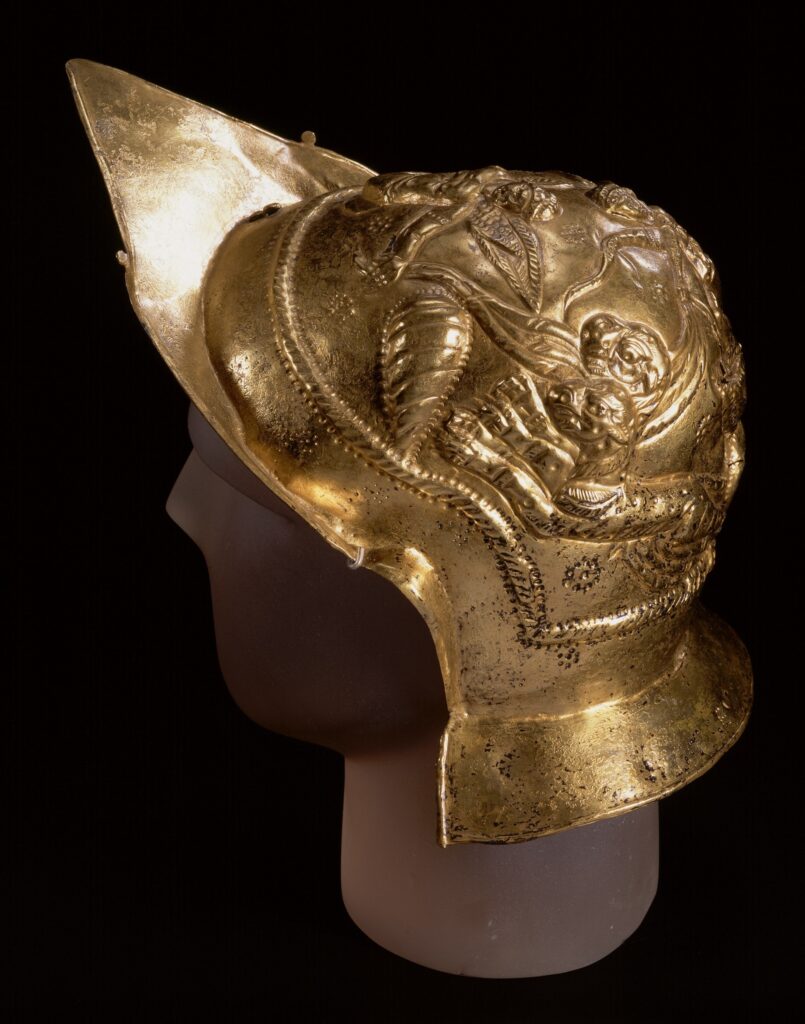
A bronze helmet with no visor-mask found at Trimontium, showing a naked winged figure of Cupid driving a chariot (© Trimontium Museum and National Museums Scotland)
In the Borders, the fort of Trimontium near Newstead boasts a museum and a walk through the fort site (now under fields) which tell an important story of Roman continuity and native contact in southern Scotland throughout the occupation of Britain.
Trimontium is also where some of the most impressive artefacts from Roman Scotland have been found, including beautiful jewellery and fine tableware. Ardoch near Stirling also has huge earthworks across a large area, representing the remains of multiple forts and marching camps from all periods of Roman presence in Scotland.
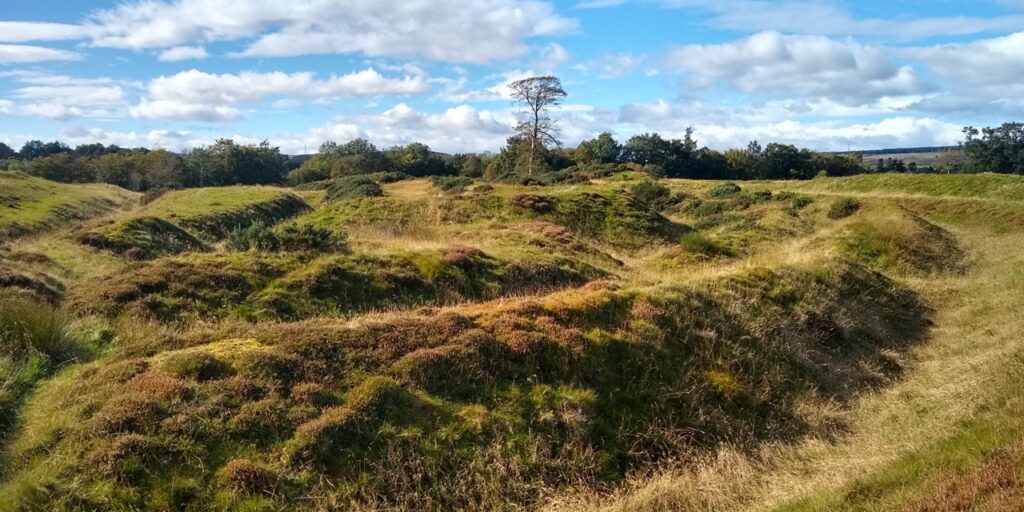
The remains of the fort at Ardoch in West Dumbartonshire, “one of the best preserved in the Roman Empire” (Image: Amy Baker)
On a roll with the Romans? Find out why experts consider the Romans to be part of Scottish history in our article by Dr Rebecca Jones.
By Amy Baker. Amy is currently studying for a Northern Bridge-funded collaborative PhD between Newcastle University and Historic Environment Scotland, researching craft activity on the Antonine Wall.
Header Image: © Trimontium Museum and National Museums Scotland
Further Reading
‘The Legacy of Rome: Scotland’s Roman Remains’ by Lawrence Keppie (2004) – an overview of the Romans in Scotland and their impact
‘The Antonine Wall: A Guide to the Surviving Remains’ by Anne S. Robertson (Revised and Edited by Lawrence Keppie) (2001) – the classic guide to visiting and walking along the Antonine Wall
‘Hunterian Treasures: The Antonine Wall, an Illustrated Guide’ by Sally-Anne Coupar and Donal Bateson (2011) – a guide to the carved stones and artefacts found along the Antonine Wall, with lots of pictures
‘Bearsden: The Story of a Roman Fort’ by David J Breeze (2016) – an overview of the excavations at Bearsden with lots of detail about life in a Roman fort on the Antonine Wall
