Top Five Archaeological Sites and Discoveries in South Lanarkshire
Home to museums, country parks, and even a UNESCO World Heritage Site, there’s plenty of archaeological stories to explore in South Lanarkshire.
Prehistoric Burials and Grave Goods in Chatelherault Country Park
In 1936 and 1939, sand-quarrying operations in the former deer park of Chatelherault (pronounced: chatel – her – oh) in Hamilton uncovered the site of a small Bronze Age cemetery which was in use over 2,800 years ago.
Also known as Ferniegair, finds at the site included several burials, some where the body was laid to rest in a stone-lined box (known as a cist inhumation), and some where burnt human remains had been deposited in a vessel and then buried (known as a cremation burial). You can read more about the finds in the Proceedings of the Society of Antiquaries of Scotland, which is published by the charity that coordinates Dig It!.
Some of these burials contained fascinating and unusual grave goods. One of the cist burials reportedly contained a “pillow stone”, a rounded stone chosen to support the head of the deceased individual. Another cist was covered by huge slabs covered by mysterious carvings (shown below outlined in white paint).
In addition, at least one of the cist burials appeared to contain the remains of a “moss-cloth shroud”. This organic material was made of wiry strands of moss stripped from the main stem which had been twisted, plaited and knotted together to create a kind of fabric, which had then been draped over the individual when they were laid to rest.
Two large cinerary urns (containers for keeping human ashes) were also discovered at the site, one containing an unburnt bracer (a type of wrist guard used in archery), made from stone. Bracers like this are usually found as part of “funerary kits” that often accompanied beaker burials – such as the one found at Culduthel Mains in the Highlands in 1975 – but is a rare find for a cinerary urn.* The finds are now in Glasgow Museums’ collections.
What’s more, the presence of both cist burials (which were common in the very early Bronze Age, around 4,200 years ago) and cinerary urns (which are normally dated later, around 3,500 years ago) suggest that this site was in use over several centuries.
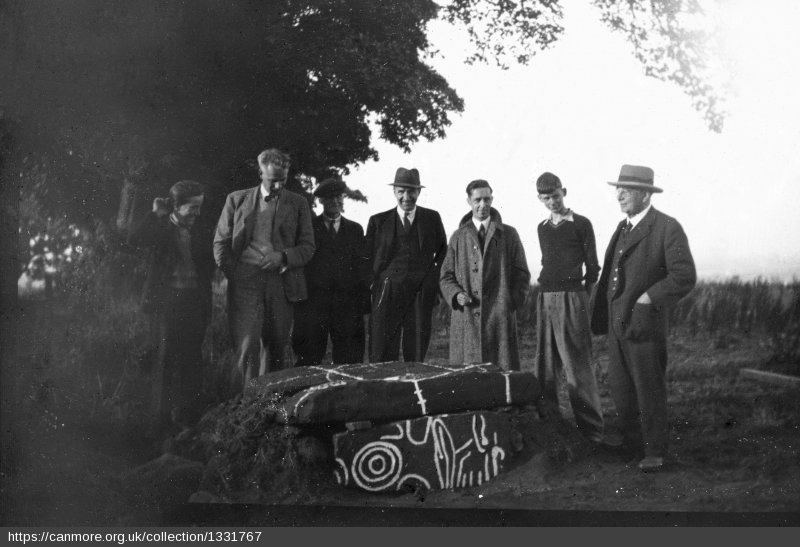
Cist 4 at Ferniegair, 1939 (from the Papers of Joseph Harrison Maxwell via Canmore)
Peelhill Bronze Age Hoard
In 1961, a hoard of burnt and broken bronze artefacts was recovered from boggy land near Drumclog after being discovered during drainage works. Now held by Glasgow Museums, the items are from the Late Bronze Age and date to 1000-810 cal BC (around 3,000 to 2810 years ago).
The hoard is made up of at least 31 complete and fragmented objects, including at least 25 spearheads, one tubular ferrule (or spearbutt), one socketed axehead, one Ewart Park type sword (referring to a specific shape of Bronze Age sword), three rings (which may have been used as scabbard belt-loops), and fragments of other bronze objects and burnt and unburnt wood which represent the remains of some of the spearhead hafts. Two of these hafts have been radiocarbon dated, which allows us to date the hoard.
Most of the items have been damaged by bending, breaking, or burning (or a combination of all three), and some of the objects are partially melted in several pieces. The deliberate damage makes it hard to know how many objects were once part of the hoard. This type of treatment, and similar object types, are also seen in the Duddingston Loch Hoard from Edinburgh which was the very first donation to the Society of Antiquaries of Scotland, and is now on display in the National Museum of Scotland.
It was previously thought that the Peelhill Farm Hoard was a collection of scrap metal deposited for safe-keeping and which was never recovered, but others have interpreted this deposit as a deliberate sacrifice of weapons, perhaps following a warlike event.
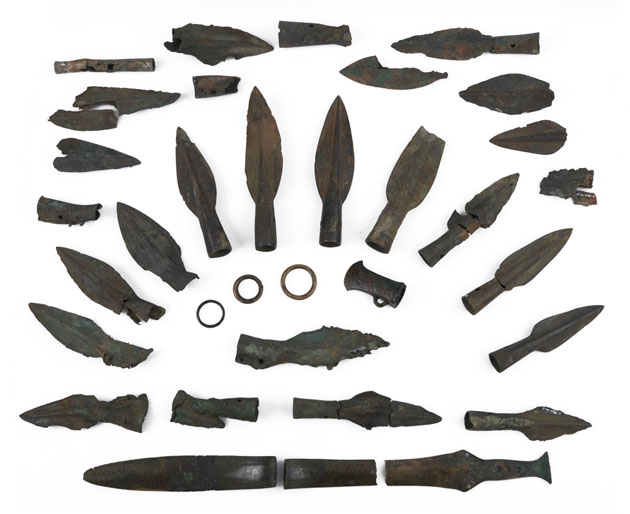
Sword, Spearheads, Socketed axe heads, Socket and Rings from the Peelhill Hoard (via Glasgow Museums, CC BY-NC 4.0)
Hyndford Quarry Iron Age Roundhouses
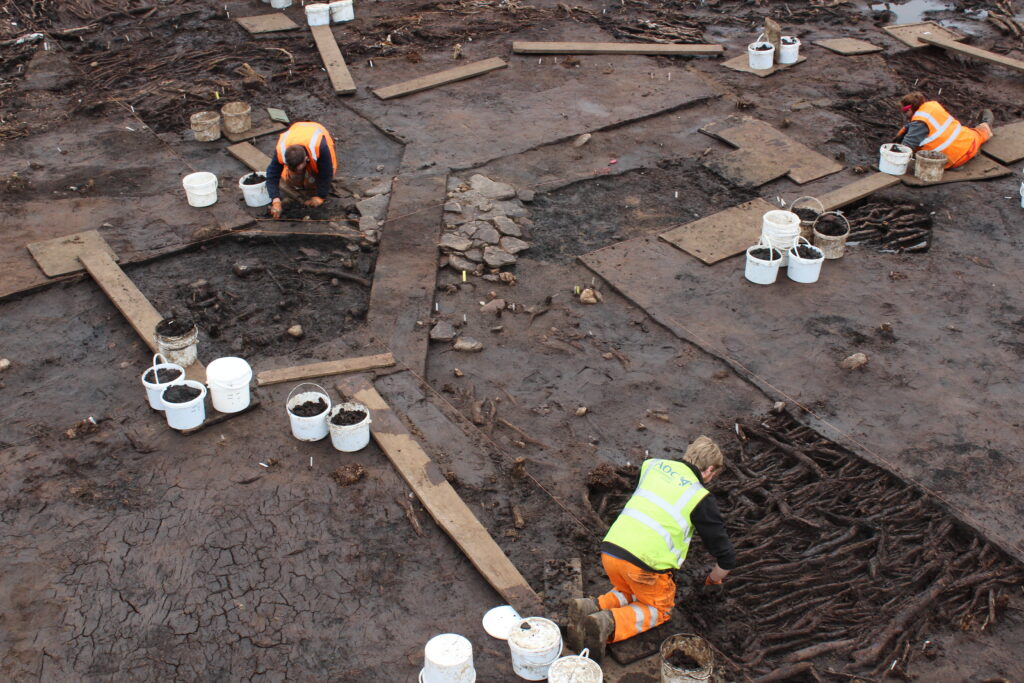
In 2020, AOC Archaeology discovered the remarkably well-preserved remains of three wooden roundhouses during monitoring works in a quarry two miles southeast of Lanark. They were uncovered as part of monitoring works, which are carried out by archaeologists to see if any remains of past human activity are uncovered when development is in progress – in this case, the removal of an area of peat bog to extend the quarry.
The houses were set within a sub-oval enclosure and would’ve been part of a Later Iron Age wetland settlement, with wooden walkways laid out between them. Archaeologists uncovered a range of exciting finds from the site, including an amber bead and a blue glass ring bead, a pair of copper alloy tweezers, a shale bracelet, stone tools such as a loom weight, and a polished stone axe. The waterlogged environment had even preserved rare perishable objects, such as wooden vessels, a woven basket and two wooden wheels.
A radiocarbon date from the one of the wheels placed the object in the 3rd century AD (around 1,700 to 1,800 years ago), but this doesn’t necessarily date the entire settlement. As of 2023, post-excavation processing of the artefacts from this site continues and has the potential to answer some burning questions about the construction, occupation and abandonment of the settlement.
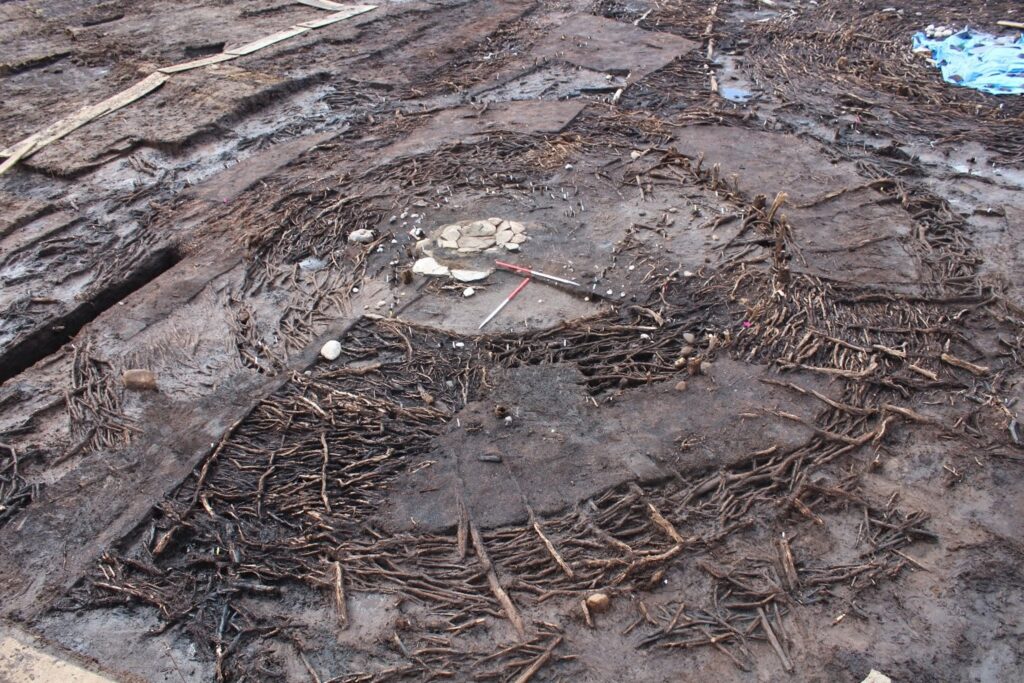
One of the Hyndford Quarry roundhouses (© AOC Archaeology)
Covington Medieval Tower
This late-medieval fortress was built sometime in the 15th century AD (around 600 to 700 years ago) as the manor house of the Lindsays of Covington. A pre-artillery castle, it relied on hugely thick (3.25m) walls for defence, and was most likely designed for use with bows and arrows.
There is no record of any warlike activity at the castle, and it most likely fell into disrepair when it was abandoned, with the stone then being taken from the site for use in buildings elsewhere.
In 1982, excavation was undertaken which unearthed early window and bottle glass, pottery, tin-plated pins, bone, a stone cannon ball weighing 11lb and a decorated lead caste whorl (used for spinning thread).
The finds are normally held in Biggar Museum, but you can currently see some of them in Moffat Museum as part of their temporary exhibition The 10 Towers of Moffat until the end of October 2024.

Covington Tower (cc-by-sa/2.0 – © Mary and Angus Hogg – geograph.org.uk/p/4904208)
New Lanark 18th-Century Mill Village
Built around 1785 around 30 miles southeast of Glasgow, New Lanark was once the biggest cotton mill in Scotland and one of the largest factory sites in the world with over 2,000 people living or working in the village. In 2001, it was inscribed as a UNESCO World Heritage Site, as it was deemed that the site had Outstanding Universal Value as an exceptional example of a purpose-built 18th century mill village.
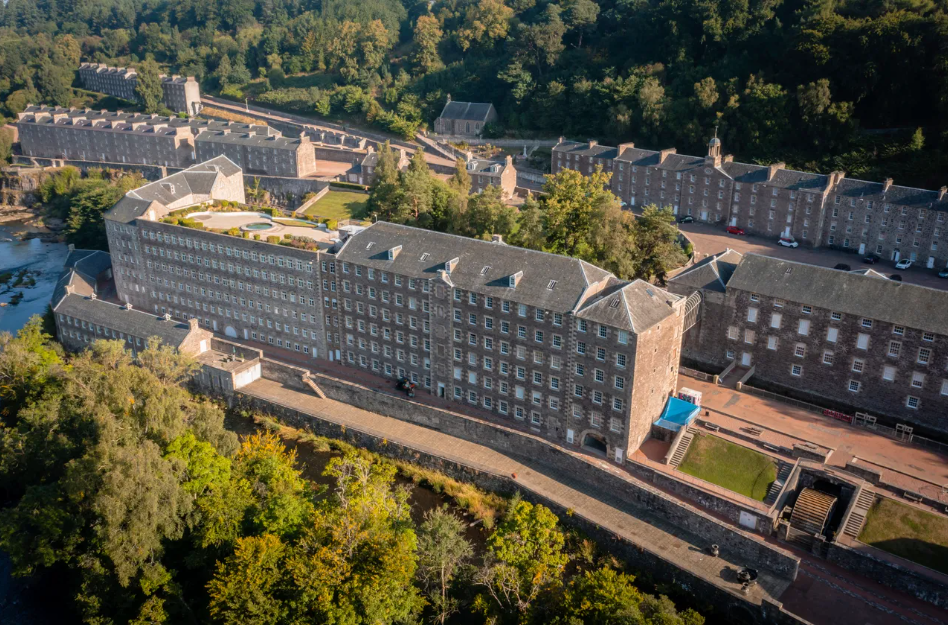
New Lanark World Heritage Site (© VisitScotland / Kenny Lam)
New Lanark’s collections offer us a glimpse into the lives of the people who lived there over the centuries. According to Lydia Housley, Heritage Officer at New Lanark Trust, “quite a lot of [the] collection items were found through excavation of the site, most of which took place in the 1970s and 80s during the [site’s] restoration period.”
Highlights include a silver letter opener found in the Mill Lade, parts of clay pipes found engraved with the words “Hogan 47 Kerr” (possibly connected to a Mary Hogan registered as a pipe maker at 47 Kerr St, Glasgow via the Post Office Directory – an alphabetical list of a location’s inhabitants and information on their profession and address), and a glass paperweight which possibly belonged to Mrs Owen, wife of Robert Owen who owned the mills between 1800 and 1825 and whom is New Lanark’s most famous figure.
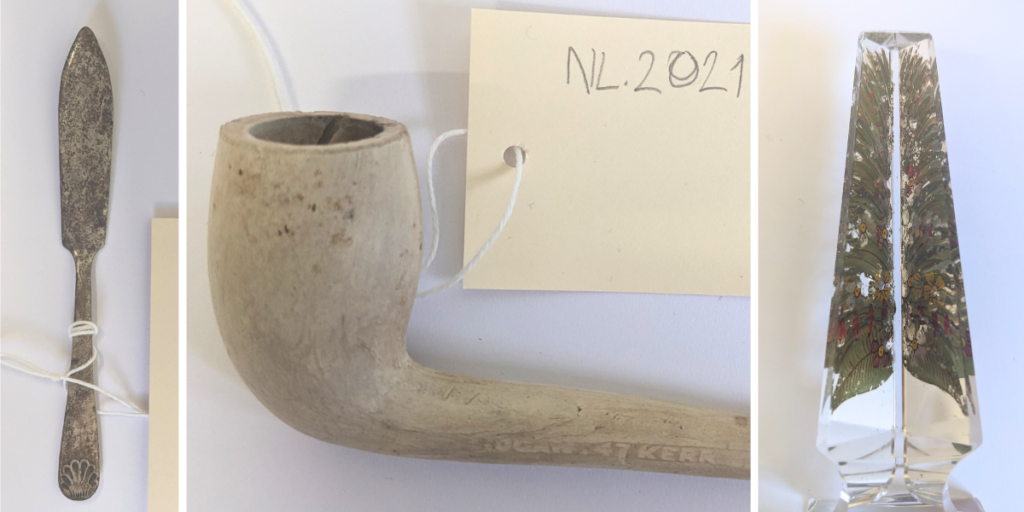
The letter opener, pipe and paperweight found at New Lanark (© New Lanark Trust)
If you want to know more, visit the site or explore their collections from home using their online database.
Tweet
Want to dig deeper into South Lanarkshire’s history? Check out Biggar Archaeology Group’s excellent guides (Part 1, Part 2, Part 3 and Part 4).
South Lanarkshire is one of the areas being studied as part of the wider Clyde Valley Archaeological Research Framework project – if you would like to keep up to date with projects and opportunities happening across the area, check out their website.
*‘Beaker pottery’ and Beakers were primarily used for food – they are often found in burials as grave goods but in the main do not contain ashes of burnt bodies (cremations) but are normally placed by the side of bodies in inhumation burials. Cinerary urns contain the ashes of a cremation burial.
Header Image: Excavation of one of the roundhouses (© AOC Archaeology Group)
