Top Five Metal Detecting Finds in Scotland You May Not Have Heard Of
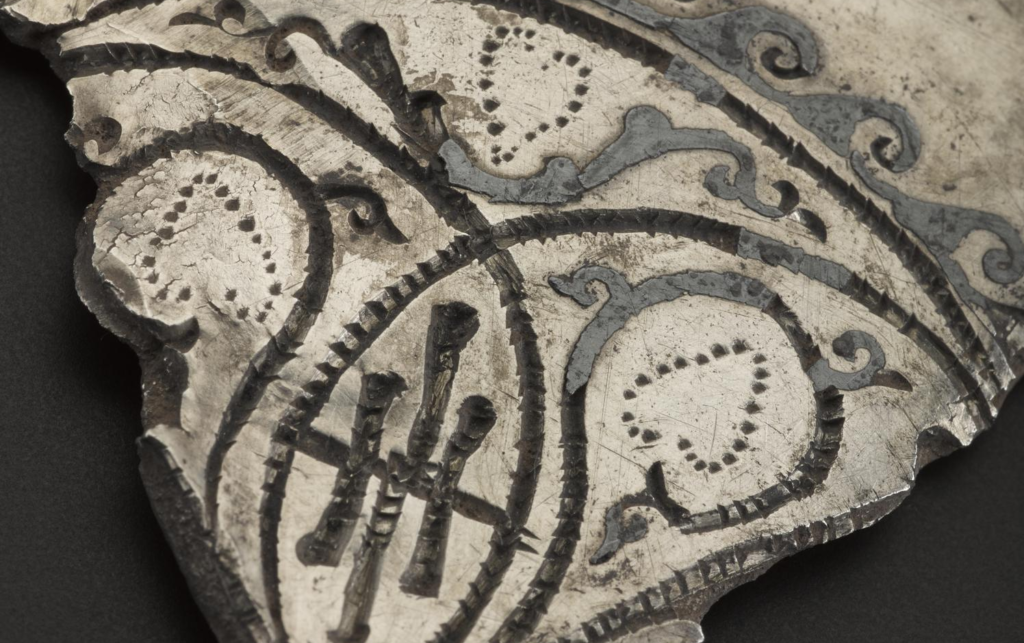
Metal detecting is becoming increasingly popular in Scotland, with spectacular finds such as the Galloway Hoard and Peebles Hoard inspiring more of the public to take up the practice.
When carried out responsibly, metal detecting as a recreational activity has the potential to make a positive contribution to our understanding of Scotland’s past.
“Where Can I Metal Detect in Scotland?”
In Scotland, you can go on most land to enjoy the outdoors thanks to access rights, as long as you follow the Scottish Outdoor Access Code. However, according to the Treasure Trove Unit, you must ensure you have landowner permission before metal detecting anywhere in Scotland, even in public parks.
It’s also against the law to detect on scheduled sites without permission from Historic Environment Scotland, and wherever you want to go you must check the status of the land before detecting on it.
You can do this by talking to the landowner about land designations, checking the Historic Environment Scotland website and visiting Past Map. If in doubt, contact either the Treasure Trove Unit or Historic Environment Scotland before you get started.
“Can I Keep Objects I Find in Scotland Through Metal Detecting?”
According to Scots Law and highlighted by both Treasure Trove Scotland and the National Council for Metal Detecting, any find made by a person, regardless of its age or what it’s made from, is subject to a claim by the Crown (the state) as Treasure Trove. Therefore, you must report any ownerless, human-made objects of significance so that they can be protected and preserved for the nation.
Not sure if you’d know if the object was significant? Not to worry. Nearly all finds in Scotland are subject to Treasure Trove – they don’t have to be made of precious metals. According to Historic Environment Scotland, “even the most unassuming object could be something important, so do not hesitate to send Treasure Trove images and a findspot.”
If an object is claimed by the Crown, the Scottish Archaeological Finds Allocation Panel will then review the find and may allocate it to a museum, who will receive and care for it and make it accessible forever. In that case, the finder will be offered a reward based on the artefact’s market value in recognition of the exercise of responsibility and good practice. The finder may choose to share this reward with the landowner or waive it entirely to help the museum who’ll receive it, as they’re the ones who pay for the reward.
But if the item is deemed to not be of significance, it’s disclaimed, and the finder can keep it. It’s important to emphasise that even in these cases, the reporting of the find and the record of its discovery still contributes to our understanding of Scotland’s past.
If you were to keep an artefact without reporting it, this could lead to a loss of potentially hugely important historical information or context about Scotland’s past forever. It’s also an offence potentially punishable by a fine or even imprisonment. Any object that isn’t reported can’t be owned by anyone else if the Crown hasn’t been given the opportunity to claim it.
Looking for inspiration? Here are some of the best finds which have been responsibly reported to the Treasure Trove Unit and preserved for the nation.
Birnie Coin Hoard
In 1996, metal detectorist Hamish Stuart uncovered a collection of 2,000-year-old Roman coins at Dykeside Farm near Birnie in Moray.
The find sparked years of fieldwork to further investigate the site. The rest of the hoard was discovered in 2000 within a ‘native Iron Age’ pottery vessel which had been broken by ploughing. Totalling 315 coins, the hoard turned out to be buried just outside the wall of a large Iron Age roundhouse.
In 2001, a second hoard made up of 310 coins in two small leather bags – also packed in a native Iron Age pottery vessel – was discovered just ten meters from the burial place of the first. The discovery of two hoards (or two parts of one hoard) on one site is unparalleled in Scotland.
Dr Fraser Hunter FSAScot, Principal Curator of Prehistoric and Roman Archaeology at National Museums Scotland, who led the excavations, said that the site “may have been the residence of a powerful local chieftain who had contacts with the Romans” and that “the inhabitants of Birnie were [probably] people of some importance, as they had connections with the Roman world on several occasions.”
The initial discovery of 18 coins were claimed as Treasure Trove and allocated to Elgin Museum and the rest of the two hoards reside in the National Museums Scotland collections.
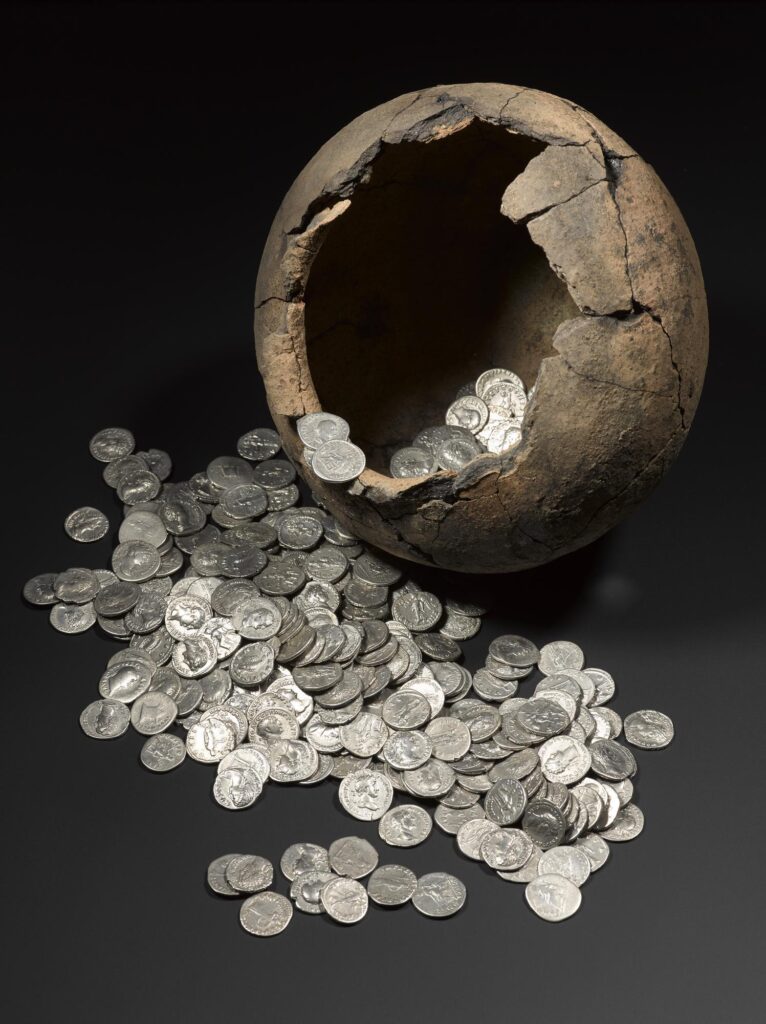
One of the Birnie coin hoards (© National Museums Scotland)
Blair Drummond Gold Torcs
David Booth had owned a metal detector for just five days when he discovered four 2,000-year-old torcs (neck rings) in 2009. The hoard was uncovered in a field near Blair Drummond in Stirlingshire and dates to between 300 and 100 BC (some 2,100 years to 2,300 years ago).
These fine works of art are found in several cultures in the European Iron Age, and they seem to have been a key object which identified the wearer as a person of high rank in Britain and Ireland.
At the time, this hoard was described as “the most significant discovery of Iron Age metalwork in Scotland” and was said to be of “international significance”. After a public appeal, they were acquired for the National Museum of Scotland in 2011 and are now on display in Edinburgh.

One of four gold torcs found by David Booth (© National Museums Scotland)
Dail ne Caraidh Hoard
In the 1980s, a hoard of complete and fragmentary axeheads and daggers was unearthed at Dail na Caraidh, north of Fort William in the Highlands. Initially discovered by metal detectorists and then recovered fully through excavation, 21 pieces were found from at least 13 axes.
In addition, nine fragments of rare flat daggers were uncovered at a time when only three others were known in Scotland (in 1999).
The types of axehead found in the hoard suggests that they were made of at least two separate deposits (buried at different times), and the excavators suggested that the site where the metalwork was buried was carefully chosen. Indeed, the site appears to have been used for ritual deposition over an unknown period of time. Its location on the Great Glen may be significant as part of an east-west transport route across the country.
Now in Inverness Museum, this is the largest group of Early Bronze Age flat axeheads recovered in Scotland.
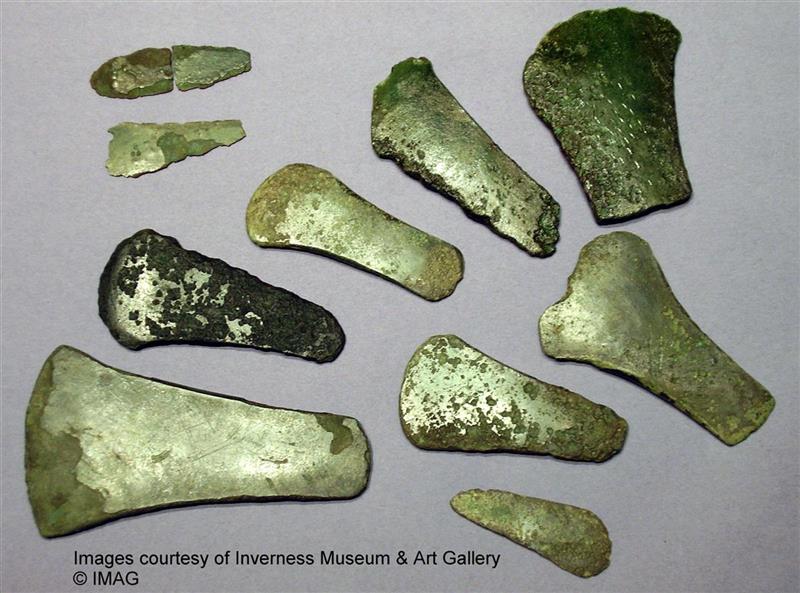
The Dail na Caraidh hoard of axeheads and daggers (© Inverness Museum & Art Gallery)
Dairsie Hoard
This hoard of 1,700-year-old Roman hacksilver was found near Dairsie in Fife in 2014 by teenager David Hall at a metal-detecting rally. The hoard is made up of over 300 pieces of silver, including fragments of at least four vessels.
Hacksilver is bent or cut bits of silver objects which were used as bullion or as currency by weight in ancient times. Dr Hunter has suggested that the hacksilver may have been a gift or payment to local Pictish tribes by the Roman army.
Dated to around AD 300 (some 2,300 years ago), this is the earliest hacksilver hoard ever found beyond the edge of the Roman Empire, making it even older than the Traprain Law hoard discovered in East Lothian in 1919.
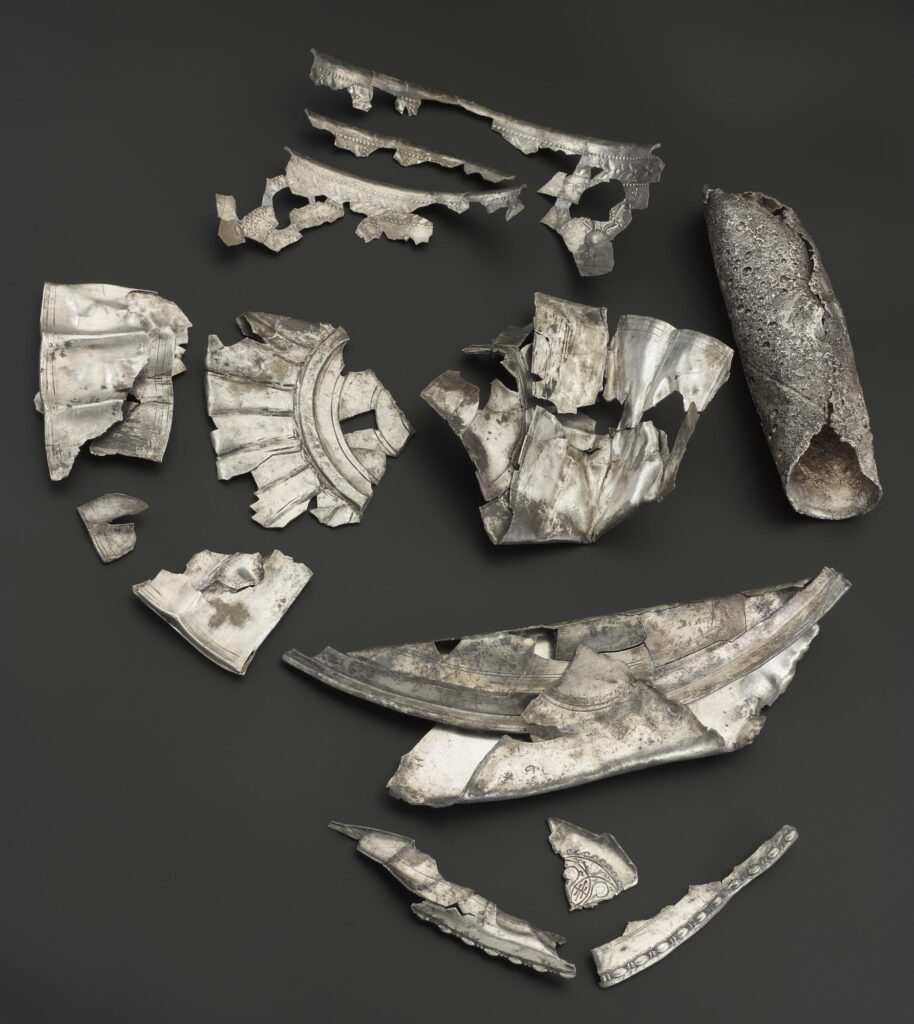
A beaded-rim platter, from the Roman hacksilver hoard found at Dairsie (© National Museums Scotland)
Dunstaffanage Silver Cross Pendant
This silver cross-shaped pendant with engravings on both sides was uncovered in Dunstaffanage in Argyll and allocated to Kilmartin Museum around 2010.
This was once an unusual class of medieval jewellery, but the popularity of metal detecting has meant that an increasing number of these have been recovered throughout the British Isles. And as a result of people reporting their finds, experts now know more about them.
This artefact is interesting because it’s an example of a style more generally found in Europe, but this particular pendant was discovered in what was a very culturally and politically distinct area of Scotland known as the Lordship of the Isles. As such, this tiny find is evidence of wide European connections during the medieval period (some 500 to 1,600 years ago) and of recognition of European fashion in Western mainland Scotland at this time.
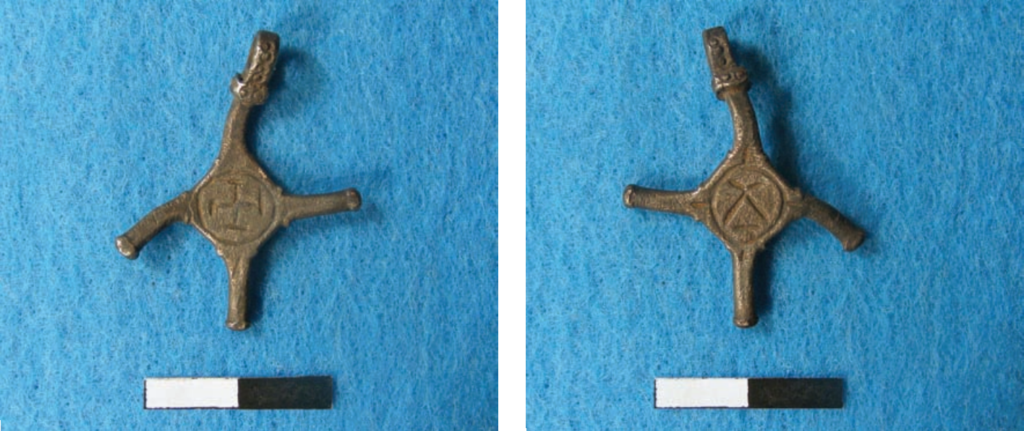
A Medieval silver cross pendant from Dunstaffanage, Argyll and Bute (© Treasure Trove Unit)
Want to explore more fascinating finds? Dig into the annual Treasure Trove Reports and our top picks of famous Scottish hoards.
You can also find out how to get started with metal detecting on the Historic Environment Scotland website, the National Council for Metal Detecting website and the Scottish Detector’s Club website.
In addition, the King and Lord Treasurer’s Remembrancer (KLTR) published an independent report on the Treasure Trove system in Scotland in September 2024, with recommendations for improvement which are wholeheartedly supported by the Society of Antiquaries of Scotland (who coordinate Dig It!).
Header Image: Fluted dish, from Roman hacksilver hoard, Dairsie, Fife (Image © National Museums Scotland)
