Top Six Archaeological Sites and Artefacts from Perth & Kinross

Did you know that Perth and Kinross is home to some of Scotland’s best archaeological sites and is where countless amazing artefacts have been found?
The Highland Boundary Fault runs through the county which separates the Highlands from the Lowlands, meaning that the north boasts mountainous and rugged uplands, while the south has fertile, arable lands. Both areas have provided homes for people over millennia who have left many traces of their lives behind for us to discover.
To understand more about the archaeology of the region, Perth and Kinross Heritage Trust and a team of experts have spent four years creating the Perth and Kinross Archaeological Framework (PKARF). As the latest addition to the Scottish Archaeological Research Framework (ScARF), it’s where you can find everything you ever wanted to know about the archaeology and heritage of this area.
Here are just some of the sites you can explore through this resource:
Carnelian Flints from Freeland Farm
Over 700 lithics (small stone tools) were found near Forgandenny during a community fieldwalking project. Most of the finds dated from the Late Mesolithic period (around 6,000 to 10,400 years ago) and many of these small blades, scrapers and knives were made from local carnelian which is also known as jasper.
Hunter-gatherer-fishers who were living in the region were choosing to use this distinctive orange/brown local material rather than the more usual flint that was used to make most lithic tools in the rest of Scotland at this time.
This is the largest find of Mesolithic tools in the region and the dense scatter of the lithics suggests that people were visiting and re-visiting this area over a long period of time. There may have been small temporary settlements as well as ‘knapping floors’ where people made the stone tools.
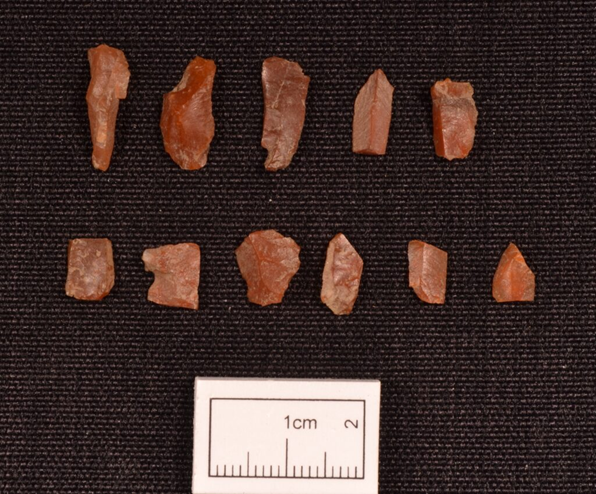
Jasper/carnelian microblades from Freeland Farm (©️ Lithic Research)
Carpow Log Boat
This 10m-long boat made from the trunk of an oak tree was discovered in 2006 at the head of the River Tay. It was likely crafted around 1,000 BC (some 3,000 years ago) and survived by becoming waterlogged in the mud of the estuary.
The late Bronze Age boat was so well preserved that even the cut marks from the axes, gouges and chisels used to make and repair the vessel could be seen.

The logboat exposed (© Courtesy Perth Museum & Art Gallery/Culture Perth & Kinross)
Moredun and Moncreiffe Hill forts
Many Iron Age hillforts can be found in Perth and Kinross, some of which were excavated as part of the Hillforts of the Tay project.
Moncreiffe Hill near Perth is home to two of them, including Moredun Top, which is as big as two football pitches and can be seen along the local sculpture trail. People built three successive forts and a monumental roundhouse at this site and lived there between 500 BC to 50 BC (around 2,070 to 2,500 years ago). Evidence that they were making objects from iron have also been found at this location, as well as this amazing bird-headed pin.
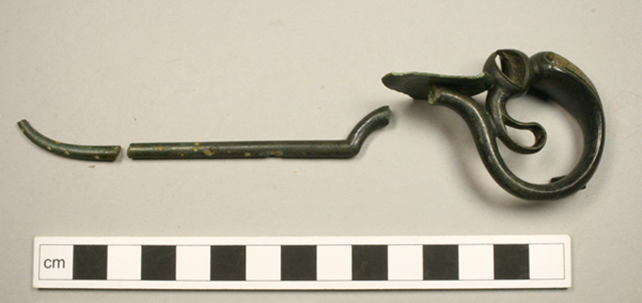
Copper alloy pin (© AOC Archaeology)
Ardoch Fort
Did you know that the Romans ventured even further north than the Antonine Wall? Roman roads, forts and towers can be found across Perth and Kinross, dating between the 1st and 4th centuries AD (some 1,600 to 2,000 years ago).
Ardoch Fort has some of the best-preserved Roman earthwork defences in Britain, including impressive banks and ditches. An imposing timber fort would have also sat in the middle where soldiers (many thought to be from Spain and North Africa) would have kept watch over the surrounding area.

Aerial view of Ardoch Roman Fort (© Historic Environment Scotland)
Forteviot
Forteviot was one of the most extensive early prehistoric ritual centres in mainland Scotland.
The site was also reused in the early medieval period as a palace and a place of royal inauguration (a place to crown kings). King Kenneth MacAlpin, traditionally known as the first ‘king of Scots’, died in AD 858 at Forteviot, which had become the capitol of his kingdom. It was one of several high-status early medieval sites in Perth and Kinross which were royal strongholds in the 7th to 9th centuries AD (around 1,300 to 1,100 years ago).
Forteviot church is now home to eight fragments from at least three Pictish symbol stones found in the area which can be viewed in 3D on SketchFab.
A new ‘Pictish’-style stone carving inspired by the original sculptures found in the area was unveiled in 2018 and can also be seen in the village.

Reconstruction of henges and other prehistoric monuments at Forteviot (from Brophy and Noble 2020; painting by David Simon)
Ben Lawers Settlements
After more than a decade of investigation, the Ben Lawers Historic Landscape Project found evidence that people have been living around Loch Tay for nearly 10,000 years.
The project also uncovered a more recent post-medieval settlement from the 15th to 19th centuries AD (around 120 to 600 years ago). The project identified and surveyed a number of small buildings on high ground known as shieling sites which would have been used when looking after grazing animals in the summer and excavated larger buildings such as the ruined farmstead at Balnasuim.
While few objects were recovered, two curious ‘shaped stone discs’ were found at the site. One interpretation was that they were used as weights for pressing cheese.
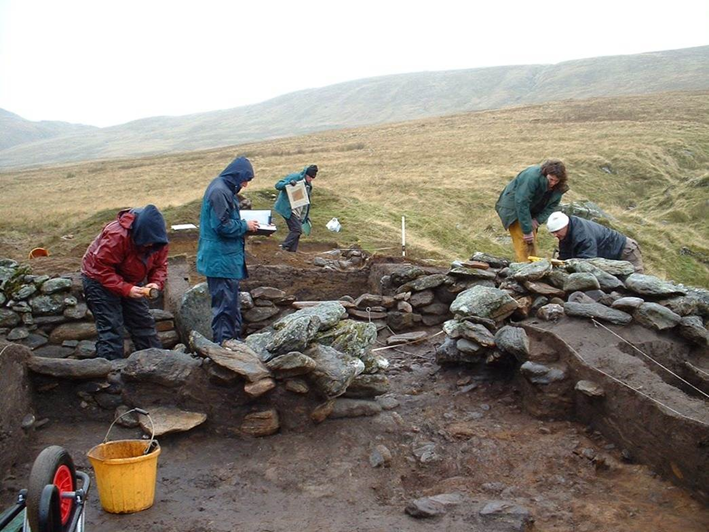
Digging the shielings (huts) at Meall Greigh (part of the Beinn Labhair range) (© National Trust for Scotland)
KEEP EXPLORING
If you want to find out more, head over to the PKARF website, ScARF website or check out our Top Ten Highlights from the Scottish Archaeological Research Framework. You can also get involved with Perth and Kinross Heritage Trust and see what other events are being held in the region.
BY Dr HELEN SPENCER, SCARF PROJECT MANAGER AT THE SOCIETY OF ANTIQUARIES OF SCOTLAND
The Perth and Kinross Archaeological Research Framework and ScARF project are primarily funded by Historic Environment Scotland and supported by the Society of Antiquaries of Scotland (who also co-ordinates Dig It!).
Header Image: © ScARF
