Top Six Iron Age Sites and Discoveries in Scotland
Named for the period when we first see the use of iron tools, the Iron Age was a time of great change in Scotland.
Beginning some 2,800 years ago and ending around 1,600 years ago, it was an era when materials, goods and ideas travelled over wide areas. The Iron Age communities of Scotland developed complex relationships with each other, other tribes in Britain, and later with the Roman army and the wider Roman Empire. Iron Age peoples were far from isolated.
People also began dealing with death in a very different way – we stop seeing obvious large stone or earth cairns and tombs and start to see more emphasis on the construction of buildings associated with the living (such as brochs, duns and the development of hillforts and roundhouses) which Iron Age peoples built to show their status.
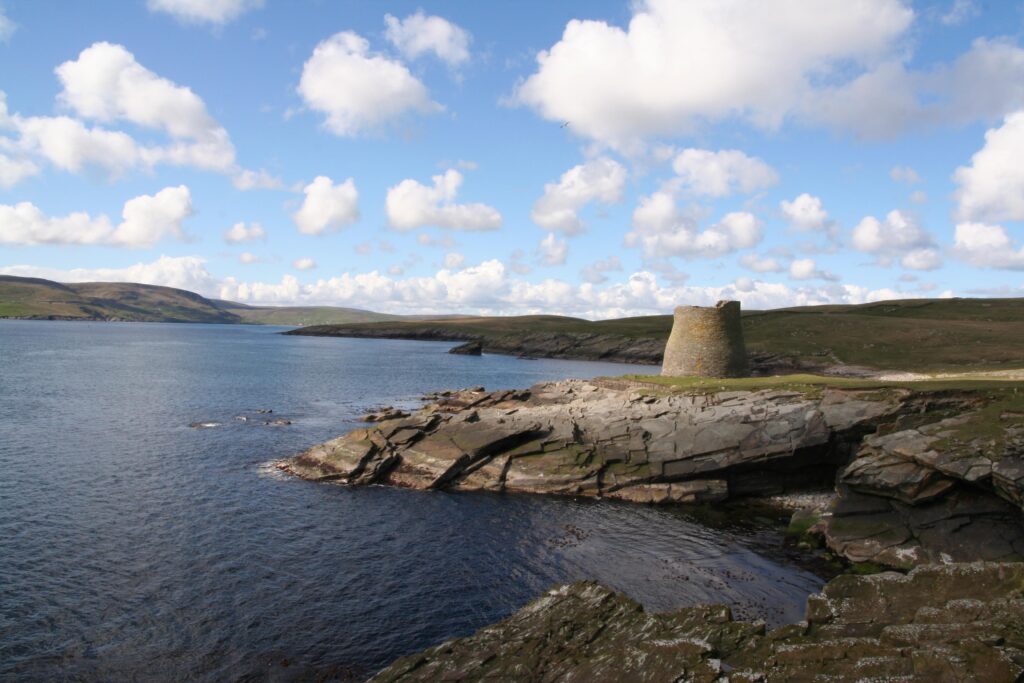
Mousa Broch, Shetland
Mousa broch is the tallest Iron Age drystone tower still standing in Scotland and is one of the best-preserved prehistoric buildings in Europe.
There are about 500 surviving examples of brochs in Scotland, found mostly in the north and west of the mainland and in the islands. Of these, about five stand close to their original height, Mousa being the tallest among them.
But Mousa is unlike most brochs in that it has one of the smallest internal diameter of any, and its walls are far thicker than in others. Its massive build probably explains its excellent state of preservation and suggests that this has always been an exceptionally tall broch.
The great structure is also mentioned in two historical documents: Egil’s Saga tells how an eloping couple from Norway found themselves shipwrecked in Shetland and sought refuge in ‘Morseyarborg’ in AD 900, and the Orkneyinga Saga recounts how Earl Harold besieged the broch in AD 1153, but found it ‘an unhandy place to get at for attack’.

Broch of Mousa (© Markus Schroeder via Flickr, CC BY-NC-ND 2.0)
Probably built somewhere around 300 BC (2,300 years ago), it was originally constructed with two additional wooden floors accessed by a staircase within the walls.
Mousa was cleared of debris in 1861 and great quantities of animal bones, especially of otters, were found; presumably the otters inhabited the deserted ruin. The remains visible today indicate that the site was used and reused a lot, and even the current entrance appears to have been reformed several times in the past. The few finds, now in the National Museum of Scotland in Edinburgh, include pieces of a clay pot and flat stone pot lids.
If you’d like to explore a reconstructed broch one day, the Caithness Broch Project are working to build one in the Highlands using traditional techniques.
Oakbank Crannog, Perth and Kinross
Crannogs are artificial islands where people lived and can be found across Scotland. They’re an iconic Iron Age structure, though they were also built in the Late Bronze Age and used throughout the medieval period. In addition, Research in recent years has revealed how the origins of these dwellings stretch further back into the Neolithic period (over 4,500 years ago).
The 2,600-year-old underwater remains of Oakbank crannog on Loch Tay – as well as the 1995 reconstruction it inspired – have told us much about life on the water in the Early Iron Age.
Underwater excavations of the original crannog have been carried out several times from the late 1970s to the late 2010s. These investigations have identified that the site was inhabited for perhaps more than 200 years, with people repairing and adding to the structure over time.
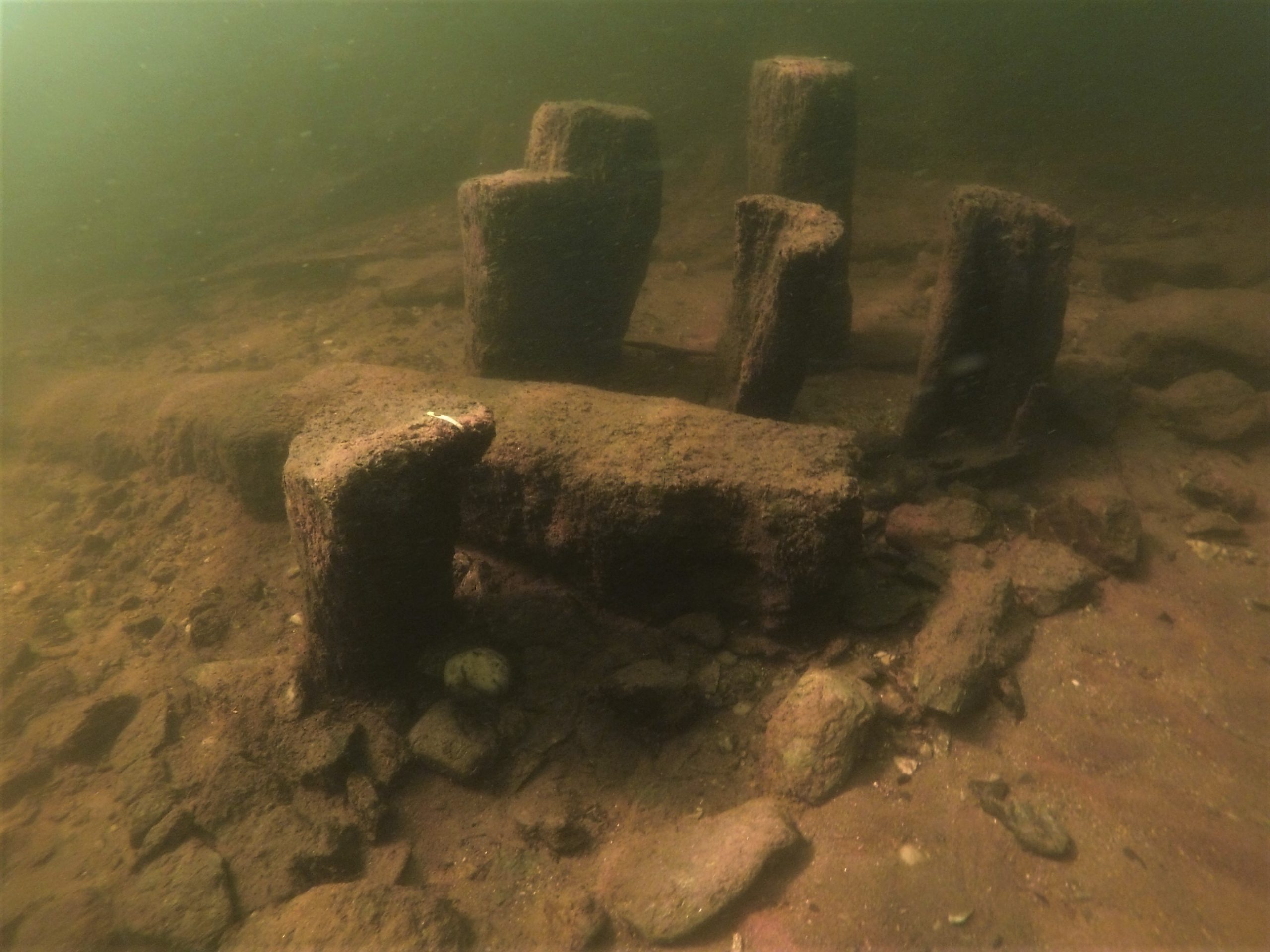
These timbers are located where a walkway met the main crannog structure at Oakbank crannog, Loch Tay (Image Credit: Michael Stratigos)
The discovery of several jointed timbers provided further insight into construction techniques used by ancient crannog builders. They also found the remains of a substantial timber floor with evidence of the hearth – in the form of burnt timbers and many pieces of charcoal – that had sat on the floor before its collapse. Beneath the floor were the remains of things which would have fallen through the gaps, including seeds, nuts, and fragments of bone.
A large number of other finds from the excavation are now on display in the Scottish Crannog Centre museum, including oars, a plough, a dish with traces of Iron Age butter still attached, and remains of a 2,500-year-old stringed instrument – one of the earliest musical instruments ever found in Western Europe.
Newbridge Chariot Burial, Edinburgh
In 2001, excavations by Headland Archaeology ahead of new developments at Newbridge near Edinburgh Airport uncovered a surprising find – an Iron Age chariot burial.
It was the first and only of its kind uncovered in Scotland and the oldest ever found in Britain.
In an unusual-looking ‘figure-of-eight’-shaped pit, the archaeologists first unearthed traces of what looked like iron bars at one end and small iron rings at the other. Joined by experts from National Museums Scotland, they found that the chariot had been buried intact with horse harnesses. No horses were buried with the chariot, but there were two bridle bits and four iron rings which fitted to the yoke (a wooden beam connected to the horses) to guide the reins.
Detailed post-excavation analysis has revealed the chariot’s history of repair and reuse. Experts can even tell that it would have had a slight ‘limp’, given that its non-matching wheels were of slightly different diameters.

Newbridge chariot reconstruction (© National Museums Scotland)
The wood was radiocarbon dated to 475 to 380 BC (around 2,500 to 2,400 years ago) and would have been for a wealthy and important individual. The dating also suggests that the chariot was part of an emerging British tradition of chariot construction by this time, inspired by styles and technology developed on the Continent but still distinctively different.
In the years since, a reconstruction has been made of the Newbridge chariot which is now part of the National Museums Scotland collections and the site of the discovery has been commemorated with the street name ‘Chariot Drive’.
The Newbridge chariot burial is one of several horse-related finds from prehistoric Scotland (such as the Peebles Hoard and the Torrs Pony Cap) and is part of a bigger picture of equitation (horsemanship) in Iron Age Scotland.
The Burn of Swartigill, Highlands
21st-century excavations at the Burn of Swartigill in Caithness have provided a glimpse of everyday life in Iron Age Scotland which is separate from the monumental architecture of brochs.
Over the years, experts, students and volunteers from the University of the Highlands and Islands Archaeology Institute and the Yarrows Heritage Trust have uncovered the remains of at least four buildings that were in use between 350 to 50 BC, some 2,070 to 2,370 years ago.
One of these buildings takes the form of a long, paved passage. This structure is almost certainly a souterrain, a type of underground structure which we associate with Iron Age settlements in Scotland.

The Swartigill Dig site (© Yarrow Heritage Trust)
There is a great deal of debate between scholars about what these structures were used for, such as rituals, storage of foodstuffs and materials, and refuges against attackers.
Finds from the Swartigill site include Iron Age pottery and stone tools used for various tasks including grinding food and shaping and sharpening metal-bladed tools.
The team have also unearthed items of adornment, including tiny blue glass beads and part of a bracelet.
The site regularly welcomes visitors while excavation is underway in the summer months.
Fragments of Roman Pottery at the Broch of Gurness, Orkney
The Iron Age broch village at Gurness was uncovered in 1929 and, through a number of artefacts found there, has revealed much about the connections between Orkney and the rest of Scotland during the time of the Roman Empire.
Most notable are pieces of a Roman amphora (a type of jug) dating to over 2,000 years old. We know the date for these sherds because this amphora is of a style that had become disused by AD 60.
It’s been suggested that Iron Age ‘royalty’ or chieftains in Orkney had connections (either through marriage or military alliance) with tribes in the far south of Scotland, or even further south in England. There is even a historic record that a “King of Orkney” submitted to the Roman emperor Claudius at Colchester in AD 43.
Is it possible that the Roman army formed some kind of alliance with powerful families in Orkney that benefited them both?

The Broch of Gurness (© VisitScotland / Kenny Lam)
Others have suggested that the few Roman artefacts found in Orkney most likely show a relationship between the islands and mainland Scotland during the late Iron Age and Pictish periods, but do not necessarily suggest any ties between the Orcadians and the Romans themselves.
Whatever actually happened, these Roman pottery remains do show just how extensive Orcadian trade was in the Iron Age, and how this trade kept communities in Scotland connected. Other Scottish artefacts found at different sites that paint part of this picture include recycled Roman glass at an Iron Age craft site at Culduthel in the Highlands, and reused Roman silver at the Iron Age hillfort at Traprain Law in East Lothian.
What impact the Romans had on local communities, and in turn, what impact these peoples had on the rest of the Roman Empire, are important questions archaeologists are looking to answer.
Uamh An Ard-Achaidh (High Pasture Cave), An t-Eilean Sgitheanach (Isle of Skye)
In 2002, archaeologist and cave explorer Steven Birch was in Uamh an Ard Achadh when he discovered disturbed broken crockery and bones in an abandoned passage. Previous visitors had thrown this material aside in attempts to find new routes, but Steven recognized the value of the find as well as the importance of the site.
The cave system was originally excavated in 1972, but in 2003 investigations led by Steven and Martin Wildgoose unearthed a wide variety of artefacts which showed that people had been visiting the site on and off for thousands of years.
Arrowheads left behind by hunter-gatherers suggest that it was occupied during the Mesolithic period (about 6,000 to 7,000 years ago), while other artefacts suggested that it was only occasionally occupied during the Neolithic and the Bronze Age, until about 800 BC.
At this point, it appears that the site became heavily used by Iron Age peoples and a large fireplace was set up in front of its entrance. Hundreds of finds around the fire pit and the cave floor – including bronze, bone and antler needles, and glass and ivory beads – point to a place of intense activity which may have been used for ceremonies.
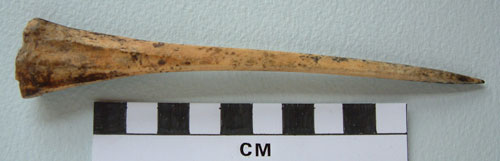
A fine dress fastener or hair pin, which has been manufactured from animal bone (© The High Pasture Cave Project)
Evidence relating to metalworking has also been found, while a large collection of well-preserved animal and fish bone provides evidence of the types of food that were being consumed here. Analysis of the animal bone suggests that unusual butchery practices were performed on some of the animals, especially on cattle and pigs, indicating that feasting may have been taking place at the site on some occasions.
During the Early Iron Age, a four-meter-long stairwell was also built to the natural limestone cave below. This lasted until about 40 BC, when the stairs were filled with boulders and earth. The skeletons of three humans, discovered in 2005, had then been placed on top of the blocked stairwell.
In 2012, a small burnt and broken piece of carved wood thought to be the bridge of a lyre was discovered. Dated to around 2,300 years ago, it was the earliest known example of a stringed musical instrument ever found in Western Europe (until another was found on Loch Tay in 2019 – see above), and may indicate contacts between locals and Mediterranean cultures in the Iron Age.
These varied and complex finds illustrate the importance of the site in the wider Iron Age landscape of An t-Eilean Sgitheanach and the cave’s possible use in ritual activities. The entrance to the cave may have provided access to the ‘Underworld’ or ‘Otherworld’, a liminal place (on the boundary or threshold between two places) in the landscape, where people from the surrounding settlements held special feasts, made offerings to deities and undertook the manufacture of metals.

Main stream passage to the cave (© High Pasture Cave Project)
Want to keep exploring? Dig into stories from other fascinating Iron Age sites published by the Society of Antiquaries of Scotland (who co-ordinate Dig It!): Cnip wheelhouse in Na h-Eileanan Siar (Outer Hebrides) and Two Iron Age duns at Barnluasgan and Balure, North Knapdale, Argyll.
Header Image: Mousa Broch (© swifant via Flickr, CC BY-SA 2.0)
