Top Lesser-Known Archaeological Sites in West Lothian
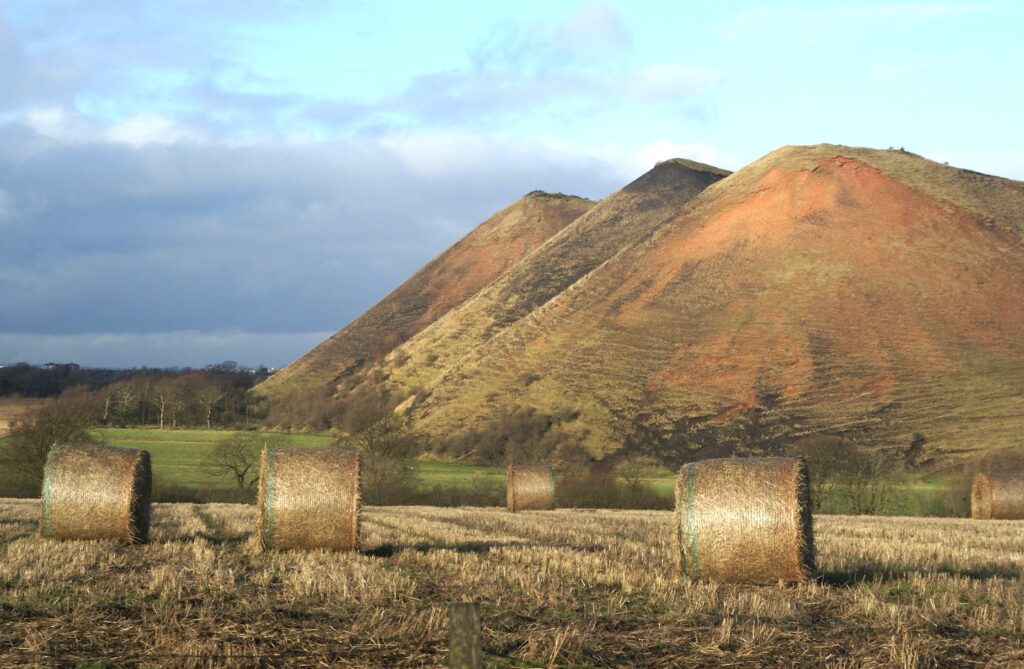
You may have heard of the famous historic West Lothian sites of Linlithgow Palace, Cairnpapple Hill and Blackness Castle, but did you know about these other archaeological gems in the area?
Winchburgh Enclosure
In 2013, CFA Archaeology Ltd set out to excavate features which had previously been recorded as cropmarks, ahead of a new housing development being built in Winchburgh. This kind of investigation is known as developer-led archaeology and is a vital part of the archaeological process. What began as a routine recording exercise turned into the excavation of the remains of a prehistoric enclosure surrounded by two ditches, built over 2,200 years ago.
The lack of artefacts at the site makes it difficult to be certain of the date and function of the enclosure, but radiocarbon dates from waterlogged wood and animal bone found within the ditch fills have been dated to 1,608–204 BC (around 3,600 to 2,200 years ago).
One of the most interesting finds from the site were horse teeth, which suggest that a symbolic horse burial was made at one of the entrances to the inner ditch.
The lack of evidence for people living in the enclosure long-term also led experts to suggest that the site was used periodically or seasonally.
All this combined has led experts to suggest that the site at Winchburgh could have served to bind West Lothian communities together in the Bronze Age and in the Iron Age through shared experiences, including the building of and spending time at the site.
CFA Archaeology Ltd’s Gary Savory explained how the stone recovered from the ditches is not local and had been purposely brought to site from further afield, and that the act of bringing this material together and “digging the ditches may have helped to reinforce tribal affiliations and identities.”
Although its exact purpose is uncertain, Savory noted that it’s tempting to view Winchburgh as an important meeting place where items were traded or exchanged, and tribal bonds were strengthened and reinforced.
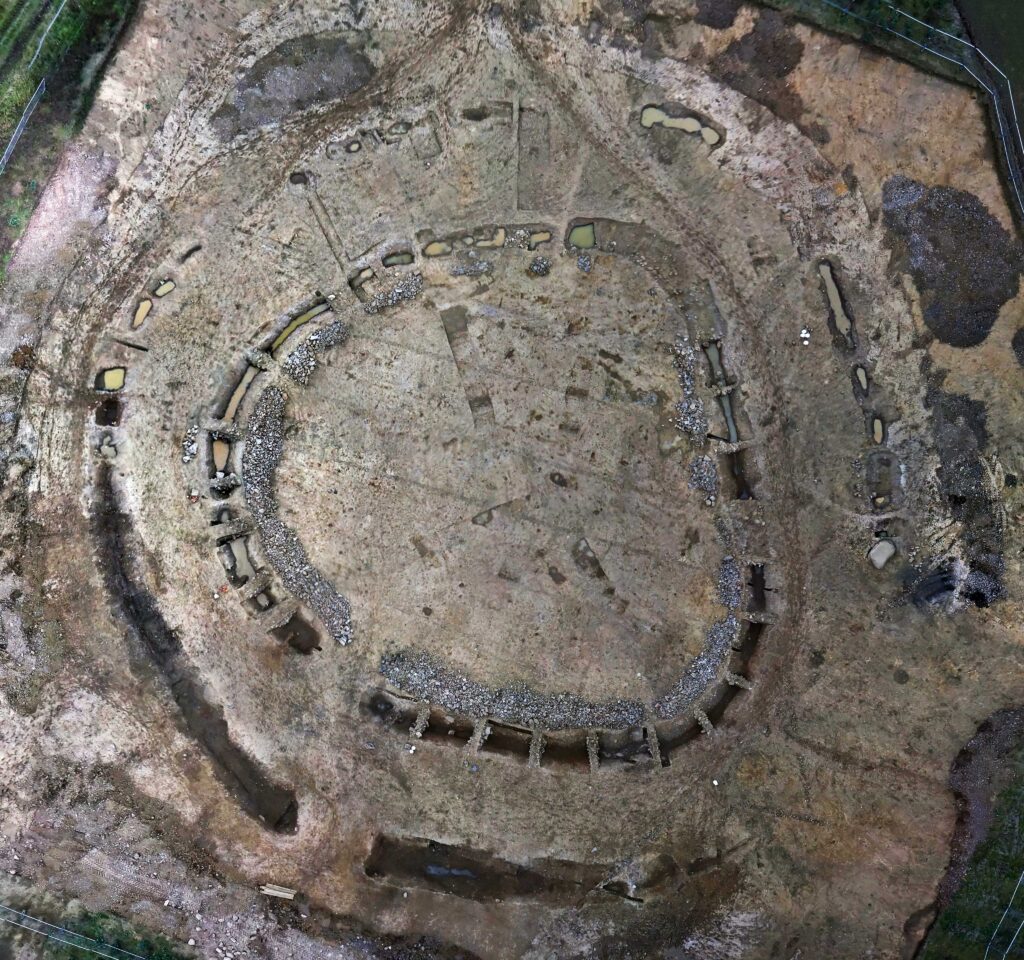
Winchburgh enclosure (© West Lothian Aerial Archaeology)
Castle Greg Roman Fortlet
The remains of this Roman fortlet can be found in Camilty Forest and have been dated to the 1st century AD (around 1,900 years ago). Rectangular with rounded corners and a well in the centre, the 180ft by 152ft structure housed soldiers during the Roman Empire’s occupation of what is now Scotland.
Many Roman artefacts have been uncovered at Castle Greg over the centuries. In 1830, for example, a large number of coins dating to around AD 170 were found under a large stone, and many more coins have been found close to the camp.
In 1852, Sir Daniel Wilson FSAScot also carried out excavations at the fort and discovered ‘numerous remains of Roman glass, mortaria (a type of kitchen vessel), amphorae (a tall jar or jug), fragments of iron weapons, and a portion of a lead vessel’.
In 2012, a ground resistance survey revealed some internal anomalies (something unusual or different from the norm), including internal roadways and high resistance ‘blobs’ which may be ovens, while a geophysical survey carried out in 2022 identified two possible buildings. These modern investigation techniques have revealed that there’s still much we can learn about Castle Greg fort and Roman occupation in Scotland in general.

Castle Greg Roman Fortlet, Camilty, West Lothian (© John Wells via Flickr, CC BY 2.0)
Niddry Castle
Built around AD 1500, Niddry Castle is a late-medieval tower house near Winchburgh with turreted barmkin (a type of defensive enclosure) and provision for early artillery. Mary, Queen of Scots stayed here in 1568 after her escape from captivity in Loch Leven Castle. Four years later, George, Lord Seton, garrisoned the castle in support of the Queen during the civil war in Scotland.
It was previously thought that Niddry Castle had always been a simple, one-period structure, but excavations in 1986-90 revealed that the site had developed over many centuries with timber and stone phases.
The digs also uncovered the remains of early gardens as well as significant finds including door and furniture fittings, spurs, exotic vessel glass, clay pipes, part of a pistol and beautifully decorated floor tile.
In addition, excavated horse bones suggest that there may have been periods of food shortage at Niddry, as horses were not commonly eaten at this time.
Dog skeletons also reveal a previously unrecorded and unexpected role of Niddry as a favoured hunting spot of the Seton family.
Another unusual find was a deposit of 94 whelk (sea snail) shells dug against the exterior of the south-east barmkin turret. Whelk shells are rarely found on medieval or post-medieval settlement sites and were sometimes considered unfit food for humans. Because of this, experts suggested that they could have been brought to the site to be used in the production of mortar (a cement-like substance) during the castle’s construction. Oyster shells were also used for this purpose, for example, at Inverkeithing Friary in Fife.
Unlike the horse bones and whelk shells, the discovery of traces of an oratory (a small chapel for private worship) at Niddry was not unexpected, as the Seton family were practicing Catholics at the time when the religion was being outlawed in Scotland during the Reformation. However, the destruction of all visible traces of the oratory could be evidence for the Setons eventually conforming to the Protestant church.
The Hope family became owners of the castle and its lands after AD 1676. Some excavated luxury artefacts from this period, including bottle glass, fine wine glasses, decorated tin-glazed earthenware and two corkscrews, appear to have been used when the Hopes made Niddry their principal residence.
Niddry Castle was eventually abandoned in the 19th century but still stands as a reminder of exceptionally turbulent times in Scotland’s past.
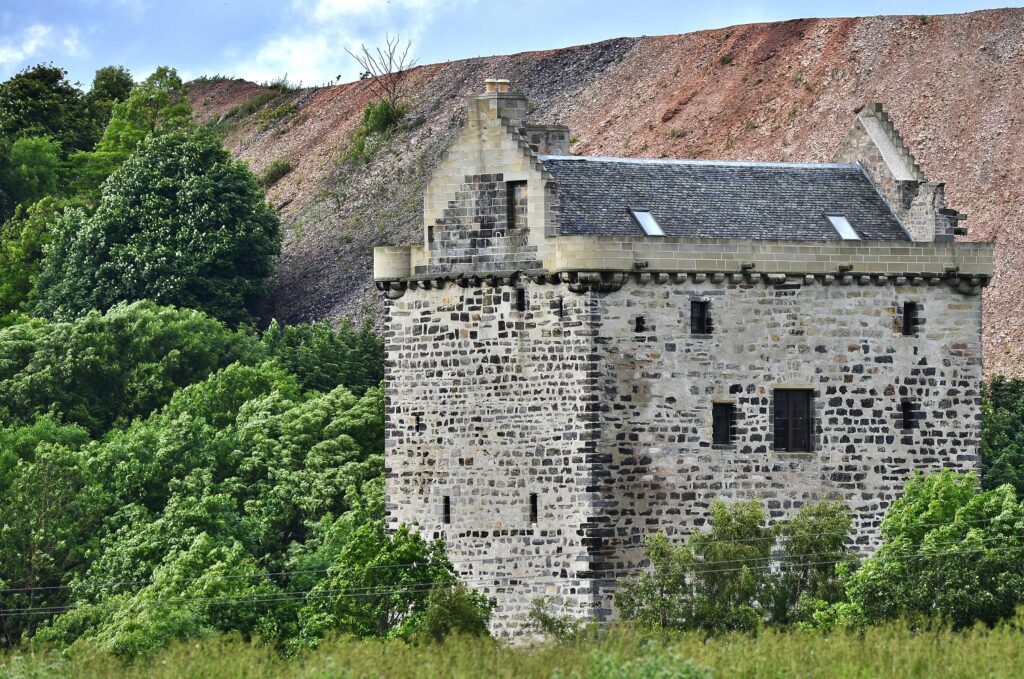
Niddry Castle (© Michael Garlick via WikiCommons, CC BY-SA 2.0)
The Shale Industry in Almond Valley
In AD 1847, chemist James Young, noticed oil dripping from the roof of a coal mine and began experimenting with ways of producing oil from coal. Oil was in high demand at the time for lighting, and increasingly to keep the machines of the Industrial Revolution running.
Young patented his method using a particular type of coal found in Bathgate: cannel coal, and the Bathgate Chemical Works became one of the first commercial oilworks in the world. When the supply of cannel coal ran out, Young moved to using shale and set up Addiewell Refinery in AD 1863.
From the mid-19th century, West Lothian became a hub for the shale oil industry, which shaped the region to what it is today. In less than half a century, “West Lothian was transformed from a small, rural, homogenous population to a growing multi-ethnic one” with workers coming from the Highlands, Ireland, and abroad to work in the mines.
A network of mines, railways and villages was built to house the employees and to move coal, oil-bearing shale and spent material, which was deposited in the shale bings (enormous piles formed of fragments of waste shale) that now characterise the landscape of West Lothian.
The industry closed completely in the 1960s, but the legacy of this movement is evident across West Lothian, for example, in the surviving housing built for shale workers such as the miners’ rows in Winchburgh and Broxburn.
A proposal for the redevelopment of the former shale-oil works at Westwood in Livingston led to an archaeological survey in 2003, where 20 features of industrial archaeological interest were recorded. These included the scheduled Five Sisters bing, as well as factory buildings including a laboratory, locomotive shed and stores, workshops and offices.
Today, you can take in many of these sites by walking or cycling the Shale Trail, a 16 mile route between West Calder and Winchburgh, via the Almond Valley Heritage Centre in Livingston and the Broxburn using the Union Canal. And you can read more about the industry and see more images on the fantastic Scottish Shale website.
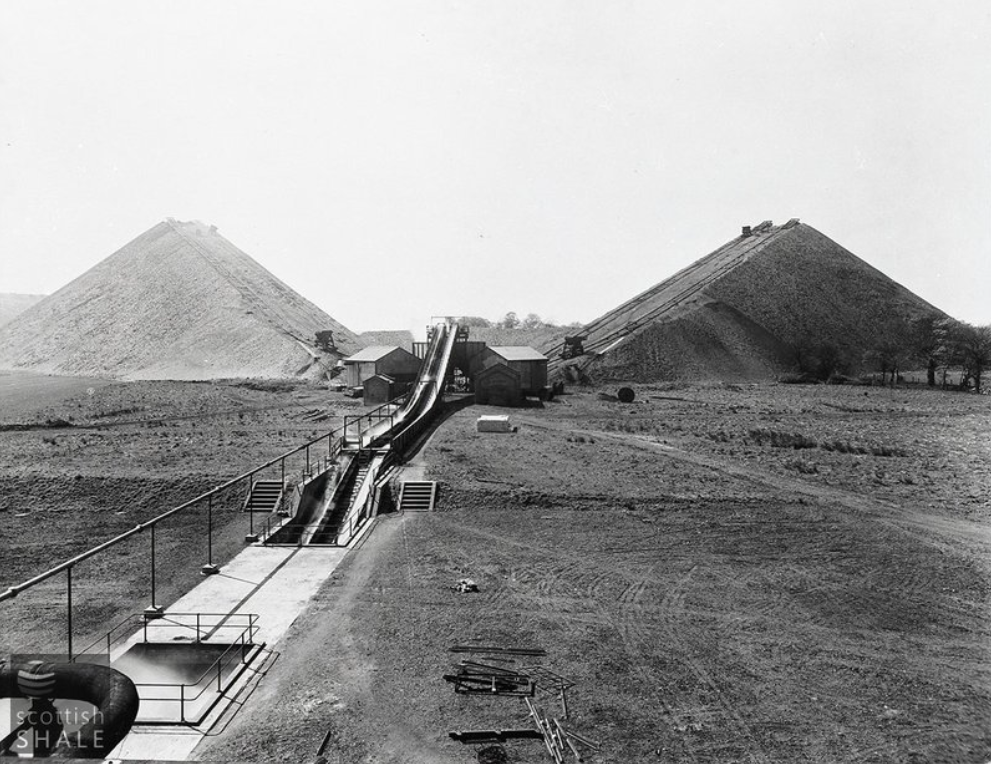
Spent shale bings around 1950 at Westwood works (via Scottish Shale at https://www.scottishshale.co.uk/files/41638/)
Ready to explore other archaeological hotspots in Scotland? Dig into our other regional guides to amazing Scottish archaeology.
Header Image Credit: Five Sisters Bings (© DNQA via Flickr, CC BY-NC-ND 2.0 DEED)
