What Do Hillforts Reveal About the Impact of the Roman Army and the Origins of the Picts?
Roman military presence in what is now Scotland began almost 2,000 years ago in the late 70s AD, when General Agricola extended the Roman conquest beyond the River Tay and up to Aberdeenshire in northeast Scotland.
In the second century (AD 101 to AD 200), the Romans again campaigned and extended the frontier to the Forth-Clyde line with the building of the Antonine Wall across what is now the Central Belt.
In the early third century (before AD 250), lands north of the Forth were once again invaded, this time under Emperor Severus, but the objective appears to have largely been to punish and decimate the rebellious local Iron Age groups rather than conquest.
After the campaigns of Severus, the frontier was re-established at Hadrian’s Wall in what is now England.
“THE PAINTED PEOPLE”: EVIDENCE OF NEW GROUP IDENTITIES?
One consequence of the Roman presence and military frontier may have been greater political consolidation (strengthening) of the groups that lived beyond.
According to historian Cassius Dio (c. AD 155 to c. AD 235), the local Maeatae and Caledones tribes who joined together to attack the Roman military in the late second and early third centuries AD were the outcome of the merging of multiple groups. Later references are more limited, but by AD 297, conflict in northern Britain is again documented and often involved fewer named groups – principally the Picts (Picti), “the painted people”.
While we could credit the use of nicknames such as “the painted people” to the Romans’ sketchy knowledge of the social and political composition of these northern groups, it might also point to the creation of new group identities in the face of Roman impact.
Collaboration and the geographical scale of cooperation amongst the barbarian groups of the north and the success of their attacks certainly seemed to increase in the fourth century (AD 301 to AD 400). The year-long state of war and disorder known as barbarica conspiratio (the “Barbarian Conspiracy”) of AD 367-8, for example, involved Picts, Scotti, Saxons and others working together to bring Roman Britain to its knees during a series of far-reaching raids.
WHERE ARE THE PICTISH SETTLEMENTS IN SCOTLAND?
One of the traditional problems of researching the Picts (the people who lived north of the Firth of Forth in the late Roman and early medieval period) has been the lack of identified settlements. As a result, the late Roman period and following centuries, has been seen as one of crisis with lots of movement and a lack of permanent structures rather than consolidation.
However, some recent discoveries have added weight to the idea of social and political consolidation and centralisation.
Elsewhere in Europe, hilltop settlements played a critical role in the cultural realignment of many European regions beyond the frontiers of the Roman Empire from the third century to the seventh century AD (AD 201 to AD 700). But the occurrence of hillforts north of the Forth has been poorly documented so far.
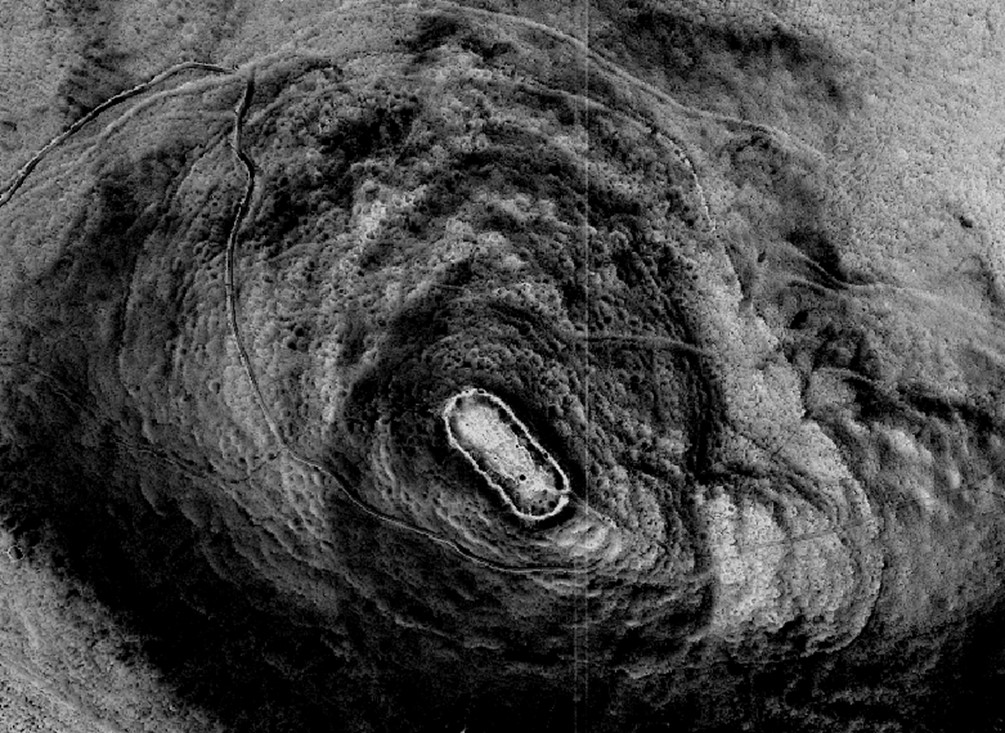
LiDAR-derived image of Tap o’ Noth in Aberdeenshire showing the hundreds of house platforms within the lower fort (Credit: University of Aberdeen)
TAP O’NOTH HILLFORT
New evidence of much larger settlement groups in this region has recently been uncovered through work at the complex hillfort of Tap o’ Noth in Aberdeenshire by the University of Aberdeen.
LiDAR and photogrammetry surveys – which use laser light and photography to create 3D representations – were used to identify over 800 house platforms within the lower fort, making Tap o’ Noth a hillfort with the densest concentrations of first millennium AD (AD 1 to AD 1000) settlement remains known in all of Scotland.
The houses inside date from the late Roman Iron Age (c. third century AD to the sixth century AD) and the hillfort and its extensive settlement remains would’ve overlooked the early royal centre at Rhynie, around 3.5km to the southeast.
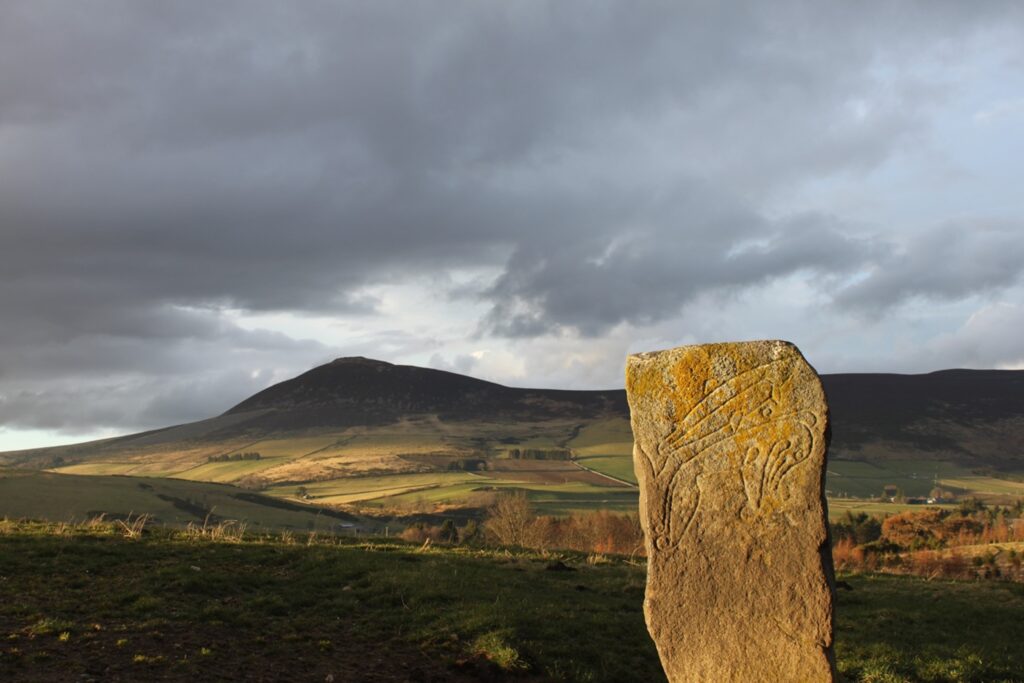
The Craw Stane at Rhynie with Tap o’ Noth in the background (© Cathy MacIver FSAScot)
EAST LOMOND HILLFORT
If that wasn’t enough, a newly identified site in central Scotland at East Lomond in Fife shows huge potential for providing another example of a major hilltop community that developed and flourished in the late Roman period and following centuries.
East Lomond Hill in Fife is crowned by a spectacular multi-phase fort with a series of lower defences. The upper fort is undated, but on its southern side is a large (1.5ha) annexe enclosure that has now been dated to the third to sixth centuries AD (AD 201 to AD 600).
The annexe settlement was first identified and explored in a 2014 Heritage Lottery funded project and then in 2017 and 2019 by community-led excavations by the Falkland Stewardship Trust and the late Dr Oliver O’Grady FSAScot.
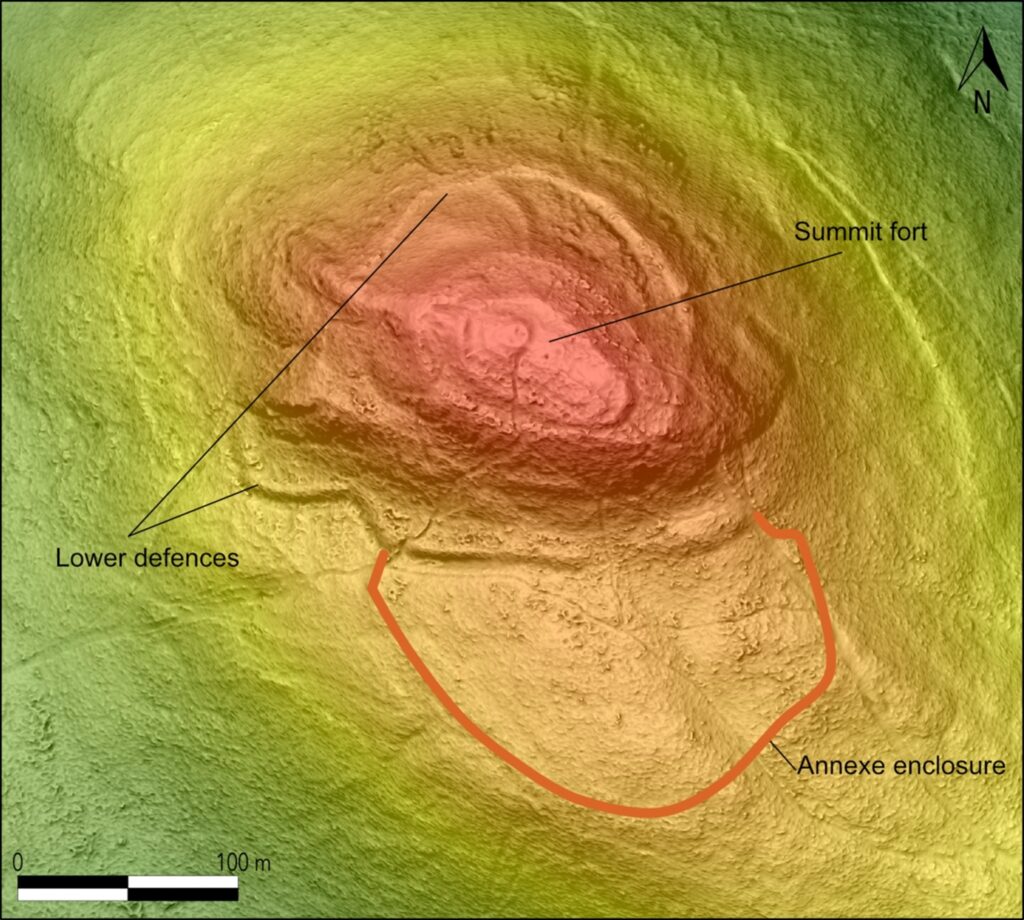
LiDAR-derived image of East Lomond hillfort showing the summit fort and annexe enclosure (Credit: University of Aberdeen)
Excavations by the University of Aberdeen and the Falkland Stewardship Trust from 2022 have continued the work at East Lomond, working with local volunteers and students from Aberdeen.
Some of the most exciting finds that have been uncovered in the excavations to date include incredibly rare sherds of Late Roman amphorae and a type of coarse pottery known as ‘E-ware’ that ultimately connected Pictland to trading networks originating from the eastern Mediterranean and western France. Late Roman amphorae and E-ware pottery is normally found on documented or suspected royal centres in western England, Wales, Ireland and western Scotland.
Equally exciting is the range of weaponry found on site. At least five spearbutts are known from the excavations at East Lomond and a spearhead has also been identified. Weaponry is again a very rare find in this region and time period.
Perhaps most importantly though is the settlement evidence. Apart from Tap o’ Noth, we have only a handful of documented buildings constructed during the third to seventh century AD (AD 201 to AD 700) in eastern Scotland, but at East Lomond we now have evidence for dozens of buildings which have been identified through multiple hearths (fireplaces) and occasionally walls, which suggest they were turf-built dwellings.
The remains at East Lomond suggest a similar complexity of settlement to that at Tap o’ Noth, and the radiocarbon dates (dating that determines the age of organic materials) suggest a similar period of occupation. Both sites at Tap o’ Noth and East Lomond have structural remains and a collection of rich finds similar to Traprain Law in East Lothian, a site that seems to have been the centre for a local king or chief and associated followers that was initially supported by the Romans, before becoming a power centre of the fifth and early sixth centuries AD (AD 400 to AD 600).
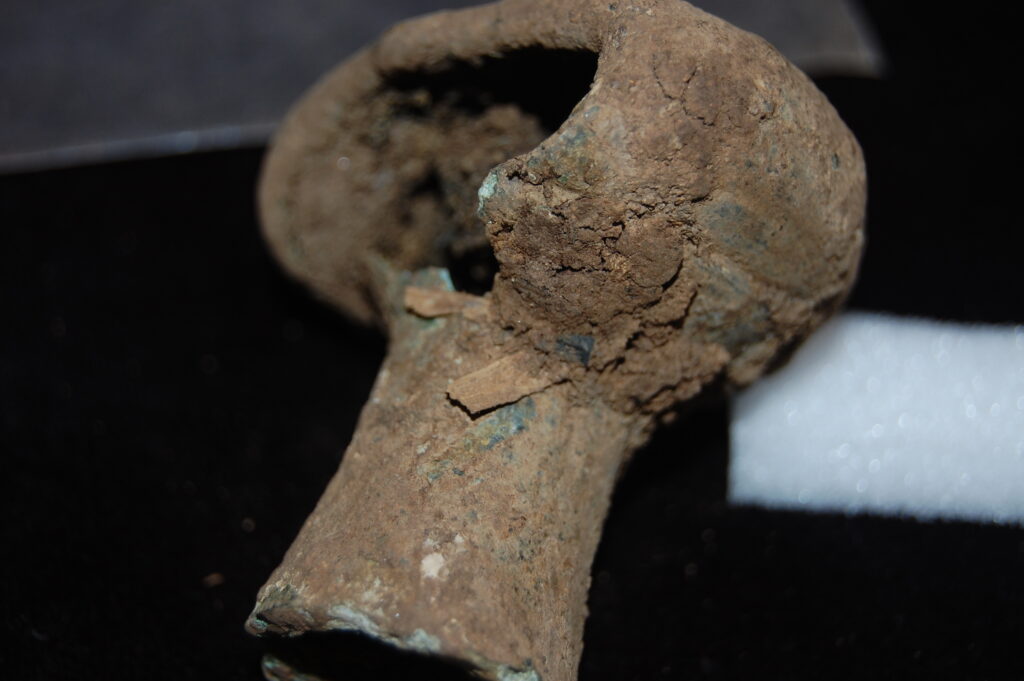
Pictish Spearbutt in Fife (Credit: Will Murray at the Scottish Conservation Studio)
Both of these sites are part of quite fascinating and growing evidence for major hilltop settlements having emerged at the edges of the Roman frontier zone in areas much further north than previously known and in the areas that became part of the core of the Pictish kingdoms in the centuries following the Roman withdrawal. Perhaps the Roman presence did create some form of centralisation and strengthening of local groups after all.
If you’d like to find out more, watch the recording of the Society of Antiquaries of Scotland’s free public lecture, Ethnogenesis and Kingship AD 300-900 below. Or read Professor Noble’s e-book published by the Society, Rhynie, A Powerful Place of Pictland.
By Professor Gordon Noble MA PhD FSAScot, who has undertaken award-winning landscape research and field projects working on projects from the Mesolithic to Medieval periods. He has two major current projects. Northern Picts, funded by the University of Aberdeen Development Trust and Historic Environment Scotland, is focused on the post-Roman societies of northern Britain. The second, Comparative Kingship, funded by the Leverhulme Trust, is examining the early royal landscapes of Ireland and Scotland. Gordon was appointed as lecturer to the department at Aberdeen in July 2008. In 2012 he became Senior Lecturer, Head of Department in 2015, Reader in 2017 and Professor in 2019. He is also an Honorary Curatorial Fellow to the University Museums.
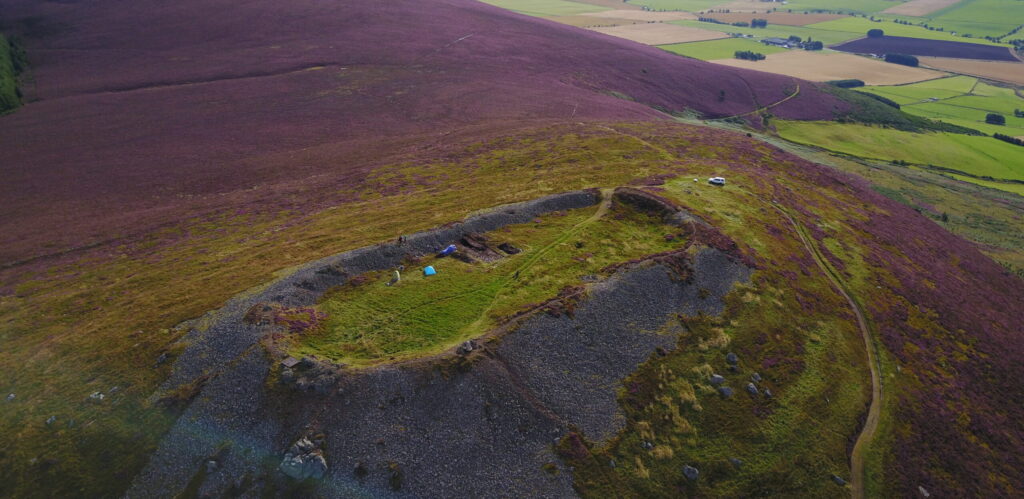
Header Image: Tap o’Noth hillfort (© University of Aberdeen)
