Boats, Brooches, and Swords: Five Viking Age Scandinavian Burials in Scotland

From Eilean Ì (Iona) to Shetland, Scotland has a spectacular Viking past.
The Scandinavian seafarers who gave their name to the Viking Age (c. AD 750-1050) arrived in what we today call Scotland around 1,230 years ago. Over the course of 300 years, they left plenty of marks which tell us about their lives in Scotland, including at least 140 grave sites where they were laid to rest.
[Note: this article contains references to child loss and images of human remains]
What Do We Mean by ‘Vikings’?
The term ‘Viking’ originally referred to the Scandinavians who raided across Europe.
From AD 793, groups of Scandinavian warriors (or ‘Vikings’) also started raiding the coastal areas of Britain and Ireland. In Scotland, their repeated attacks on the monastery on Eilean Ì, for example, are well-documented.
Eventually, however, these raiders began to permanently settle in Britain, with others sailing from Scandinavia to join them. The term ‘Viking’ may not be the best way to describe these groups, as they were not plunderers, but farmers and traders.
In Scotland, the settlers established themselves along the Western coast, in the Northern Isles (Orkney and Shetland), and in Na h-Eileanan Siar (the Outer Hebrides). There, where their presence was the strongest, archaeologists have also found the majority of Viking Age Scandinavian graves.
While these early medieval Scandinavians have long had a reputation as raiders, gained from their earliest short and bloody stays in Scotland, their graves tell a more complex story.

Items from a Viking burial at Ballinaby, Ìle (Islay) (© National Museums Scotland)
How Do We Know That They’re Viking Age Scandinavian Graves?
Viking Age Scandinavian graves in Scotland are usually identified by the presence of grave goods.
When the Scandinavians arrived, none of the communities in Scotland at the time buried their dead with grave goods, which conveniently helps us separate their burials from others.
Particularly spectacular examples that have been found include swords, horses, and — on rare occasions — boats, but everyday objects, such as household items, can also indicate a Scandinavian grave.
Why they deposited such objects with their dead is unclear. Researchers have suggested that the practice reflects pagan beliefs — in other words, religions common in Europe before Christianity was adopted — and were maybe placed there as they were thought to be useful in the afterlife.
By AD 1,000, the Scandinavians had adopted Christianity and Christian burial customs, and these objects disappeared. These graves are trickier to identify as Scandinavian, however, as they are more or less identical to other Christian ones. Christian graves were usually oriented a specific way, from east to west, and had no grave goods.
Each potential Viking Age grave tells a fascinating story. These five examples from Scotland that help us better understand these complex Scandinavian peoples who made Scotland their home.
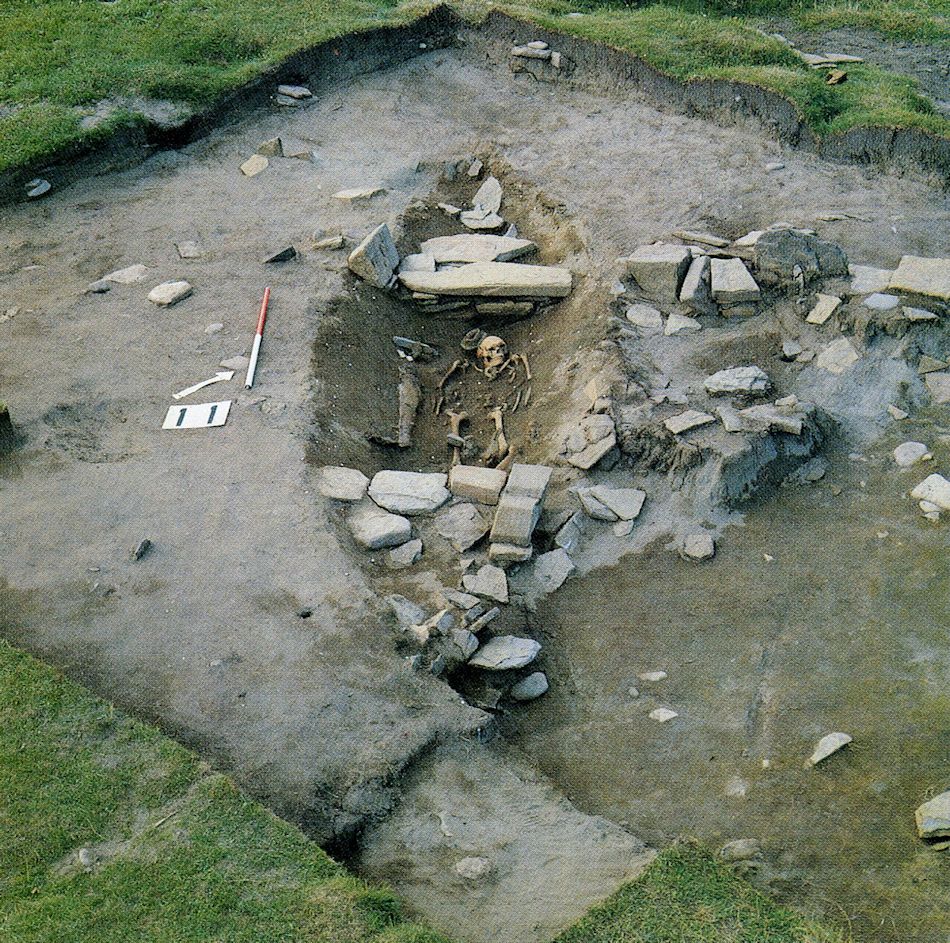
A warrior’s boat burial from Westness cemetery in Rousay, Orkney, which was excavated in 1968 and 1984 (via the Swandro-Orkney Coastal Archaeology Trust website)
The Ardnamurchan Warrior
In 2011, a rare Scottish boat burial – the only one thus far known on the UK mainland – was discovered on the Western Highland peninsula of Ardnamurchan.
Excavation revealed that the boat, around five meters long, would have been perfect to speedily navigate calmer waters. Numerous grave goods further suggested the occupant had perhaps been a Scandinavian warrior on the move. This includes traces of what was probably a saucepan, an unusual artefact with a handle over 50 cm long, and handy flint sherds for lighting fires.
Teeth were also recovered, and isotopic analysis performed on these has suggested that the individual had spent part of their childhood years in another location, potentially in Northern Ireland, Eastern Scotland, or Norway.
Everyday objects were not the only type of grave good found, however. Other items are considered to be more spectacular symbols of power, such as a sword decorated with silver and copper, a shield, and a spear — all signs that the deceased had been highly respected by their community, who ensured that they had a fine burial.
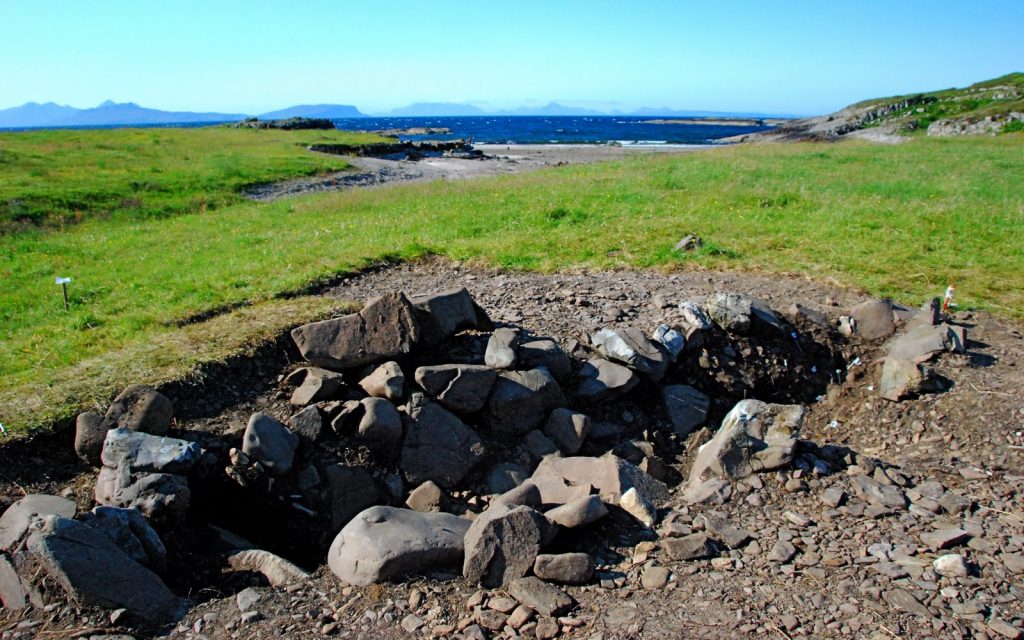
The Ardnamurchan Boat Burial (© John Haylett via Wikimedia Commons, CC BY 3.0)
Powerful Scandinavian Women? A Rich Grave from Westness Cemetery
Scandinavian graves in Scotland have also helped shed light on the lives of the women who came to settle in the country.
In 1963, a farmer from Westness on Rousay in Orkney was burying a dead cow when he found an ornate dress fastener made from silver, gold, amber, and glass poking out of the spoil heap. According to National Museums Scotland, when an archaeologist arrived to investigate “she discovered a disturbed grave in a stone chamber: an elite, Scandinavian-style female burial from the first generation of Viking migrants to Orkney.”
The grave, dated to around AD 850, belonged to a woman who was no more than 30 years old. Her bones were found alongside those of an unborn child, which were still in place in the pelvic region of the woman’s skeleton. The Westness brooch-pin, as it is now known, found with her is a spectacularly ornate object, which suggests that she may have wielded significant power around 1,170 years ago.
The brooch-pin itself was made around AD 750 and would already have been 100 years old – and probably a treasured family heirloom – when it was buried alongside the woman. It remains the richest female Viking-age burial yet discovered in Scotland, in terms of the amount of grave goods and the range of material (including items of gold, silver, bronze, glass, iron, antler and textile).
The site was further excavated in 1968 and 1984 by Sigrid Kaland of the University of Bergen, revealing a graveyard dating to between the 7th and 11th centuries, hosting the remains of 29 individuals, including two warrior boat burials.

The Westness brooch pin (© National Museums Scotland)
According to Dr Stephen Harrison FSAScot, lecturer in Viking Archaeology at the University of Glasgow, female graves — or graves that have been classified as female by archaeologists — are more common in Scotland than in England and Wales. He says that this points, if not to a higher proportion of Scandinavian women here, then certainly to an increased social role for women in the area that would eventually become Scotland.
The Scandinavian graves of the Westness Cemetery could also be interpreted as evidence that these settlers integrated with the existing local communities in Orkney.
The cemetery began as a Pictish and Christian cemetery but became even more multicultural as the Scandinavians arrived and buried their dead in the same space with their own burial rites, without disturbing the other graves.
The ornate brooch-pin may even reflect peaceful cultural mixing between locals and Scandinavians in Orkney during the Viking Age. It was long assumed to have been looted from an island in Britain or Ireland, based on the reputation of the Viking Age Scandinavians as fearsome plunderers. But experts have recently suggested that it “could have” been received as a tribute or marriage token — supporting a different interpretation of their lifestyle as traders and settlers rather than bloodthirsty raiders.
The “Spectacular” Scar Boat Burial
The most spectacular Viking Age boat burial from Scotland, dating to the 9th Century AD (around 1,100 years ago), also shows that some Scandinavian women enjoyed considerable status in their lifetime.
The coastal grave, found at Scar in Orkney in 1991 by a local farmer and confirmed by Regional Archaeologist Dr Raymond Lamb, was quickly excavated to rescue it from recurring winter storms.
Inside were the remnants of a boat and three skeletons, belonging to an elderly woman, an adult man, and a younger child. Who they were is a mystery, but analyses showed that the woman had lived to be over 70 years old and had contracted arthritis in her fingers, possibly from hours spent working on textiles during that time.

The plaque found at the Scar boat burial site on the isle of Sanday, Orkney – on display in the Orkney Museum (reproduced with permission from Orkney.com)
To find three people in one boat burial is unusual and the discovery has raised questions as to how they were connected with each other. Research has shown that they were genetically related, and were perhaps mother, son, and grandchild. The exact circumstances of their deaths also remain somewhat unclear, but it’s been suggested that they may have perished due to the same illness or accident.
Regardless of how they were connected, they were clearly considered to have been important people, as they were buried with a wealth of objects. The elderly woman, for example, was accompanied by several textile-related objects, including a rare whalebone plaque used for working linen. The plaque may have had special religious significance, which could mean that textile-working was regarded as important amongst the Scandinavian settlers and that she had been highly respected.
A Scandinavian Child from Balnakeil
In 1991, heavy storms revealed a solitary grave in Balnakeil Bay in the Highlands. It’s one of only a handful of Scandinavian child burials known in Scotland.
Analyses of the individual’s bones and teeth suggested that the skeleton was probably male and between 10 and 14 years old. In the grave were several full-size weapons, including a sword, knife, and spear. But there were also signs of a more everyday life, such as the presence of needles, a fishhook, an antler comb, amber beads, and a set of antler gaming pieces.
Though just a child to us, the fact that the boy was buried with grave goods fit for an adult have led researchers to suggest that his community may have considered him akin to a fully grown man.
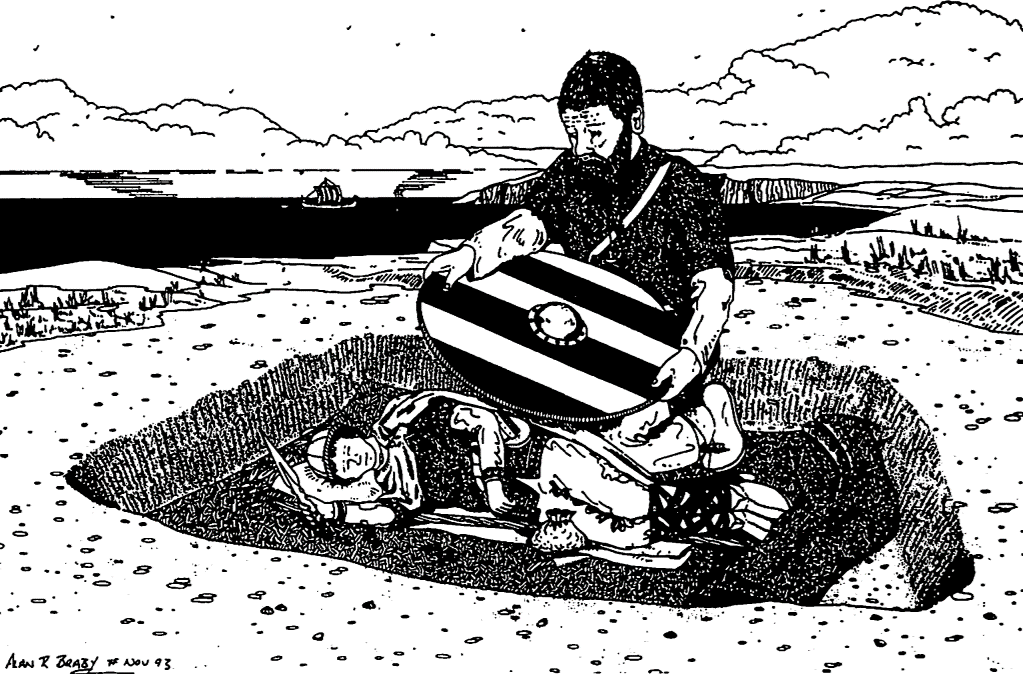
Reconstruction drawing of the Balnakeil child grave (Credit: Alan Braby FSAScot, 1993 as depicted in ‘A Viking burial at Balnakeil, Sutherland’ by Dr Colleen Batey HonFSAScot).
Christian Scandinavians at Loch Lomond?
Towards the end of the Viking Age, the Scandinavian settlers in Scotland began to slowly adopt Christian beliefs and grave customs, such as the burial being orientated with the head facing east, and a lack of grave goods.
We can find examples of this in a cemetery enclosed by an enormous ring ditch at Mid Ross by Loch Lomond. It was excavated by GUARD Archaeology ahead of a hotel being built near the site (as part of a process called developer-led archaeology) between 2003 and 2005.
There were few skeletal remains, but the graves had probably belonged to men and women who were part of a Scandinavian community with pagan burial traditions. This includes the use of grave goods such as knives, beads, and arm rings.
At some point, however, the nature of the cemetery seems to have changed, perhaps as a result of a Scandinavian transition to Christianity.
Other individuals thought to belong to the same community (because their graves had been oriented in the same way and yielded Viking Age radiocarbon dates), were buried inside the ring ditch without any objects aside from single iron nails. These probably held together modest wooden crosses – a clear marker for a Christian burial.
Such a change in burial customs – from grave goods to none at all – may mean that the Scandinavians around Loch Lomond had begun to abandon the older traditions, and probably any pagan beliefs, too. The archaeologists from GUARD also identified the foundations of a probable timber chapel, as well as later graves all oriented east-west in the Christian burial tradition, inside the ring ditch, which potentially adds more evidence to this narrative.
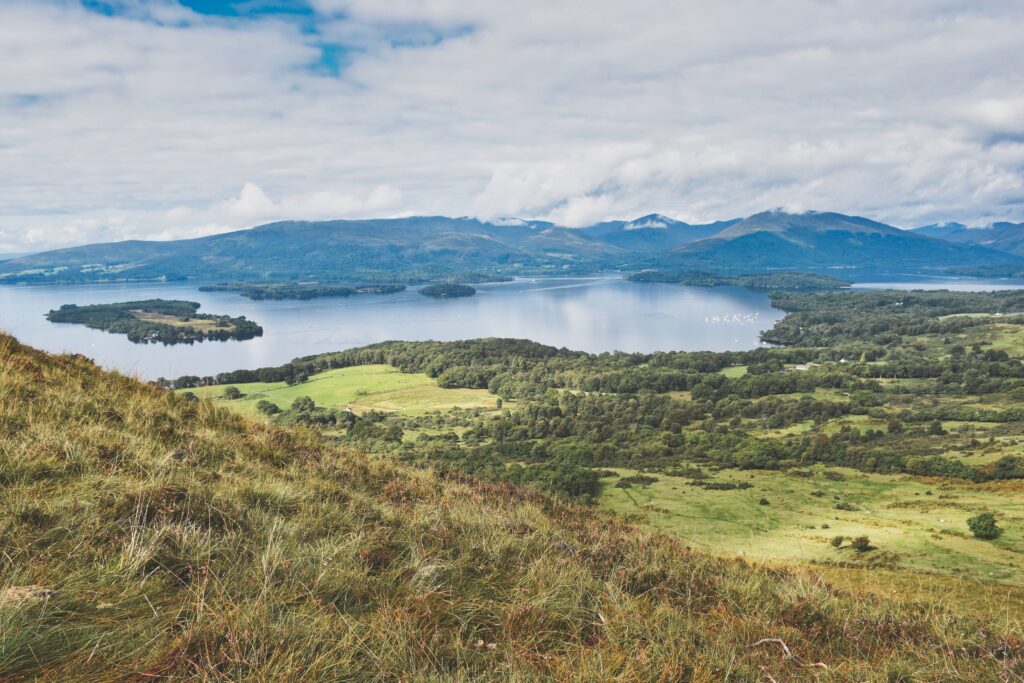
Loch Lomond (Photo by Robert Keane on Unsplash)
From Plunderers to Farmers
The Scandinavians who are often called ‘Vikings’ are usually depicted as people who came, plundered, and left, but the diverse Viking Age Scandinavian graves of Scotland show that there’s a lot more to their story.
According to Dr Harrison, the majority of Scandinavians who came to Scotland were in fact settlers with fascinating skills and traditions. They were shipwrights, farmers, and traders who helped shape the Scotland we know today.
Many current place names, such as Kirkwall in Orkney and Jura in Na h-Eileanan a-staigh (the Inner Hebrides), for example, are Scandinavian in origin. Scotland’s modern connection with its early Scandinavian settlers is nurtured today through events such as Up Helly Aa, a Viking Age-inspired festival that happens every year in Shetland.
These graves also show that, in turn, the seafaring Scandinavians were changed by the early Scotland they encountered. They absorbed local fashions – seen in, for example, the Westness brooch-pin – and adopted Christianity.
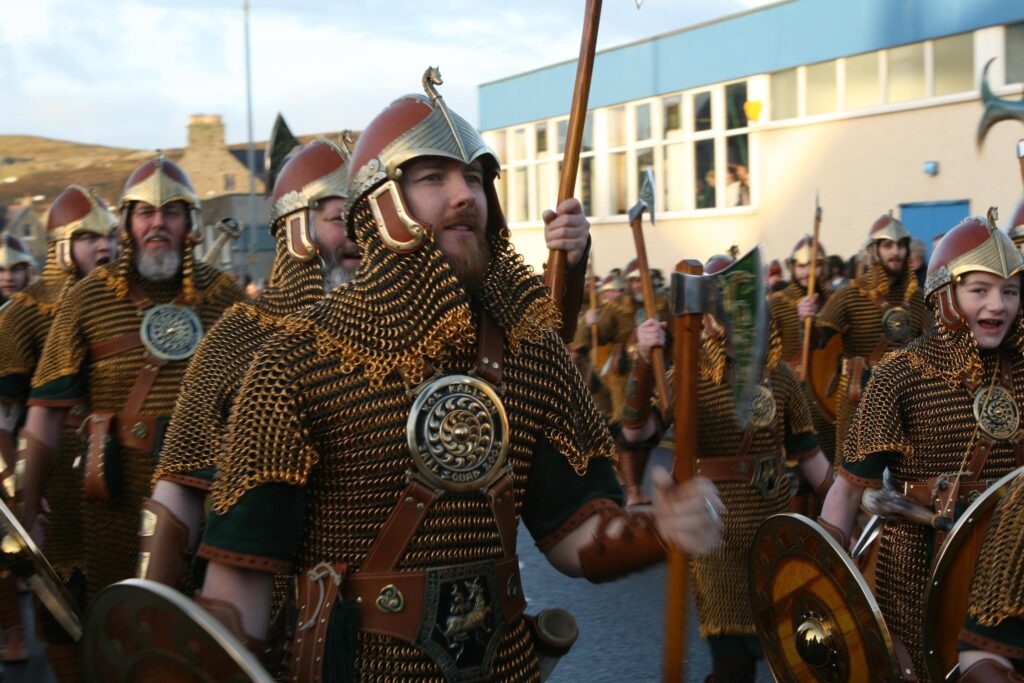
Up Helly Aa (© colemic2006 via Flickr, CC BY-NC 2.0 DEED)
The Future of Viking Age Graves in Scotland
As graves continue to be discovered, we may yet learn more about this fascinating period of Scotland’s history.
New scientific methods, in particular, have extraordinary potential to reveal more about Viking Age Scandinavians in Scotland. According to Dr Harrison, the ability to examine DNA, for example, can “tell us much more about the people buried in these graves — their sex, age, health, living conditions, and where they grew up. These add new dimensions to our understanding of these individuals.”
If you’re keen to find out more about Scottish Viking Age Scandinavian graves and the fascinating stories they tell, be sure to explore further by visiting museums and archaeological sites in Shetland, Orkney, and other Scandinavian-influenced locations across the country.
By Livia Dyring, a graduate of the Department of Archaeology at the University of Glasgow. Livia regularly writes about science, including archaeology, for Inspire the Mind and elsewhere.
Further Reading and Watching:
- The Viking Age in Scotland by Tom Horne, Elizabeth Pierce, and Rachel Barrowman
- The Children of Ash and Elm by Neil Price
- Vikings in Scotland by James Graham-Campbell and Colleen Batey
- The Viking boat-burial at Kiloran Bay, Colonsay, and its international context by Emeritus Professor James Graham-Campbell (free to watch on the Society of Antiquaries of Scotland YouTube channel)
Tweet
Header Image: A bronze scale and seven weights found in a grave at Kiloran Bay, Colbhasa (Colonsay) in Na h-Eileanan A-Staigh (the Inner Hebrides). The occupant was buried between AD 875 and 925 with a range of Scandinavian weapons, tools and a pin. He was probably a trader as well as a warrior (© National Museums Scotland)
