Top Eight Archaeological Sites and Discoveries from Neolithic Scotland

The way of life for people living in the land we now know as Scotland was completely transformed in the Neolithic period. Arguably the most important change came when communities began to farm animals and plants rather than existing solely as hunter-gatherer-fishers.
Beginning around 6,100 years ago and ending around 4,500 years ago, other vastly significant introductions in the Neolithic period (also known as the “New Stone Age”) were the use of pottery and the building of monumental stone, wooden and earthwork structures, such as standing stone circles or settlements, some of which we can still see today.
Recent and ongoing work on sites and artefacts from the Scottish Neolithic is constantly changing our understanding of this period, and there are dozens of amazing examples we could pick for our list. We’ve brought together eight sites and discoveries from this pivotal period, some you may know well and some that you may not have heard of.
The Rotten Bottom Bow – Scottish Borders
6,000 years ago, a broken flatbow was abandoned in wet ground at Rotten Bottom in the Scottish Borders. There it remained, preserved in the peat that grew up over it, until it was found by a hill walker, Dr Dan Jones, in 1990.
Bows surviving from Neolithic Britain and Ireland are extremely rare. This bow dates from the very early Neolithic, and is the oldest bow ever discovered in Britain. It’s now on display in the National Museum of Scotland in Edinburgh.
Skilfully made from a single piece of yew, it now measures 1.36 m but would originally have measured 1.74 m. It’s thought that it was broken while in use, at full draw, almost certainly during a deer hunt. It was found near the end of an upland valley in the hills above Moffat, in a position which would have been ideal for hunting deer. Once broken, this precious possession could not have been mended, although its string would probably have been removed for re-use.
The bow was likely imported since yew did not grow in Scotland at the time (except perhaps for one or two tiny areas in the south). It’s most likely to have come from Cumbria, across the Solway Firth, or perhaps Ireland. The early farming communities in Scotland were in contact with both of these areas. Even though the bow was found in a hunting context, it’s most likely to have been the possession of an early farmer who exploited the land’s wild resources.
Yew is the best wood for making bows, being strong yet supple. This object shows that the early Neolithic inhabitants of Britain had a sophisticated knowledge of the properties of different woods and used these to their best effect.
(Based on information published by Dr Alison Sheridan)
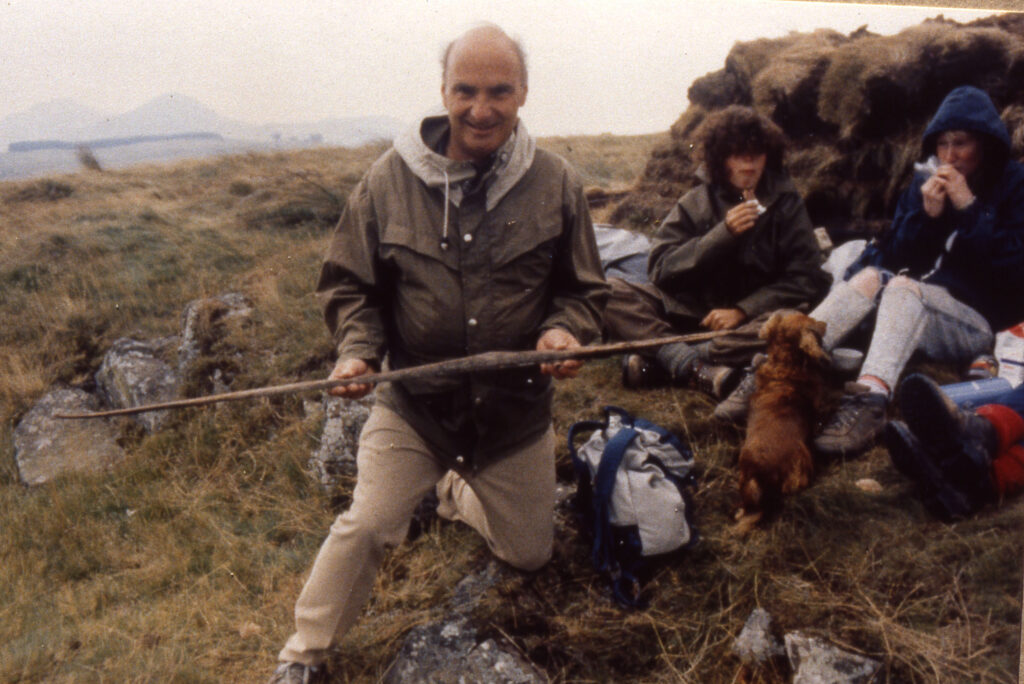
The finder, Dr Dan Jones, with the bow in 1990 (© Dr Dan Jones)
The Cleaven Dyke – Perth & Kinross
The Cleaven Dyke is the best surviving cursus monument in Britain. It’s a vast earthwork measuring some 2.6km long, averaging 9m wide and 1.8m high in places – you may have driven past it and not realised!
It was once thought to be a Roman defensive structure, possibly linked to the nearby Roman forts at Inchtuthil and Meikleour. However, excavations carried out at Cleaven Dyke in 1993 revealed it to be a Neolithic Cursus. These monuments usually consist of a long avenue defined by either parallel ditches and banks, or pits and posts, which would have taken decades to build. The purpose of a cursus is open to debate, but they were probably linked to moving through the landscape at special times, like a procession.
While there are more than 50 cursus monuments in Scotland, there is only a handful of upstanding bank barrows, helping the monument to make a striking impact on the modern landscape which may have been the builder’s intention. The Cleaven Dyke is set in a landscape rich in other Neolithic ceremonial and burial features and lies amidst a dense concentration of Neolithic flint scatters (worked stone). The nearby Herald Hill long barrow appears to point at the south-east terminal of Cleaven Dyke. If this was intentional, what did it mean?
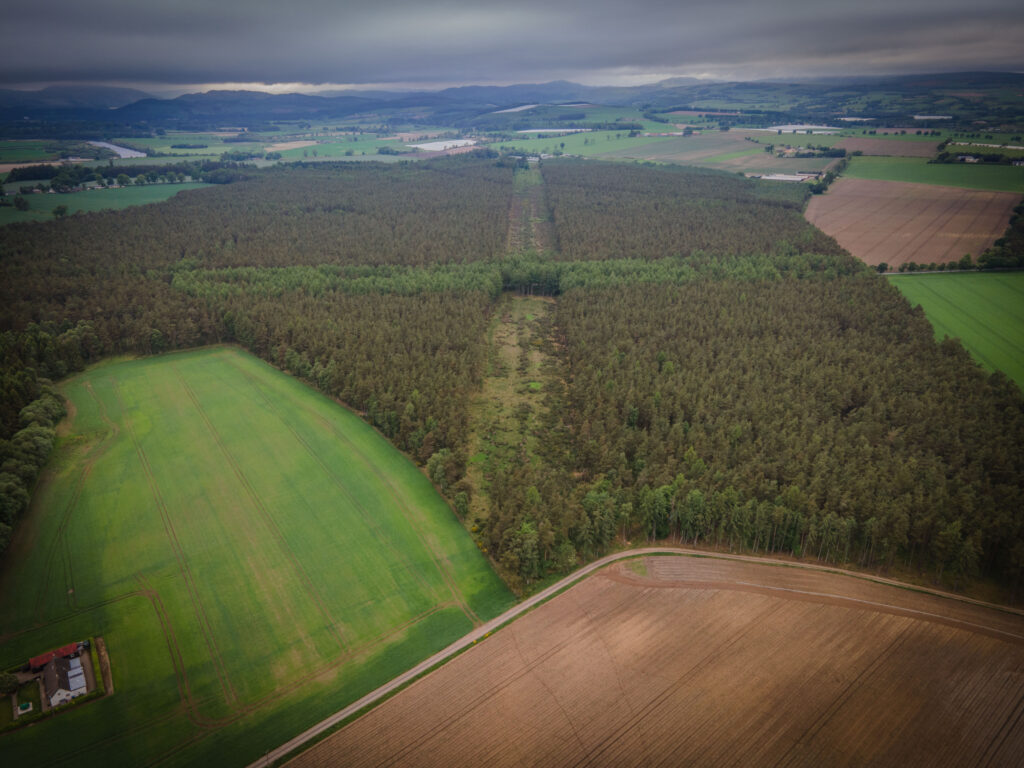
Cleaven Dyke (© Our Heritage Blairgowrie & Rattray/Isla Aerial)
Jadetite Axeheads – Various Locations
Found across Scotland, these exquisite axeheads were made over 6,000 years ago from stone high in the Italian Alps.
They were brought over from northern France by immigrant farmers shortly after 4,000 BC. At the time, most would have been at least 100 years old. They would have been treasured heirlooms, each with its own story.
These axeheads were not everyday tools for felling trees and chopping wood – they were sacred and precious ceremonial objects, made of rare jadeitite (a form of jade) and other special rocks. These tough Alpine rocks are difficult to work and it took over 1,000 hours to make a highly polished axehead.
It’s been suggested that Neolithic people may have associated mountains with the world of the gods. These hard-won pieces of the mountains could have been regarded as having divine powers to protect and heal. Perhaps polishing them to a glassy sheen was believed to enhance these powers and their luminous green colour may have symbolised immortality.
It seems that the Neolithic farmers of Scotland felt the need to return these sacred and powerful objects to the world of the gods. They deposited them in special places, often in or beside water. Sometimes they deliberately broke and/or burned axeheads, probably as a way of ceremonially ‘killing’ them, removing them from the world of the living. At Cairnholy, in Dumfries and Galloway, they buried a burnt fragment of a broken axehead in a stone monument built to house the dead.
These precious artefacts have been found in various locations across Scotland including Perth and Kinross, South Lanarkshire, Stirling, Midlothian and Dumfries & Galloway.
For #16 of #ScottishArchaeologyMonth we’ve got some ancient Stone Age Jade.
Found in Scotland, these exquisite axeheads were made over 6,000 years ago, high in the Italian Alps.
Now, thanks to a French-led project their fascinating story can be told: https://t.co/qcTKa0XwXf pic.twitter.com/kC0xXMQPuE
— National Museums Scotland (@NtlMuseumsScot) September 16, 2018
(Based on information published by Dr Alison Sheridan and Projet JADE)
The Towie Ball – Aberdeenshire
This carved stone ball was discovered around 1860 in Aberdeenshire when a drain was cut several feet underground on the slopes of Glaschul Hill in Towie.
More than 430 examples of similar objects are known in Scotland with the overwhelming majority being found in Aberdeenshire, but the Towie ball, created around 3,000 BC, is often considered the finest example.
The ball is around 70 mm in diameter and adorned with spirals and other designs that clearly reference passage tomb ‘art’, resembling the sacred symbols carved into the stones of prehistoric tombs in Orkney and at Newgrange in the Boyne Valley of eastern Ireland.
The makers of carved stone balls sought out stones that were visually and/or texturally striking, probably coming from glacial deposits and/or riverbeds. The shaping and decoration would have taken at least 50 hours, with the intricately decorated Towie ball likely taking well over 100 hours to complete.
Why they were made and what they were used for has been debated for over 150 years. The most popular theories include the balls representing symbols of power which showed off the status of their owner. Or, like maceheads, they have been used as ‘fancy’ weapons to be thrown or tied to handles. What do you think?
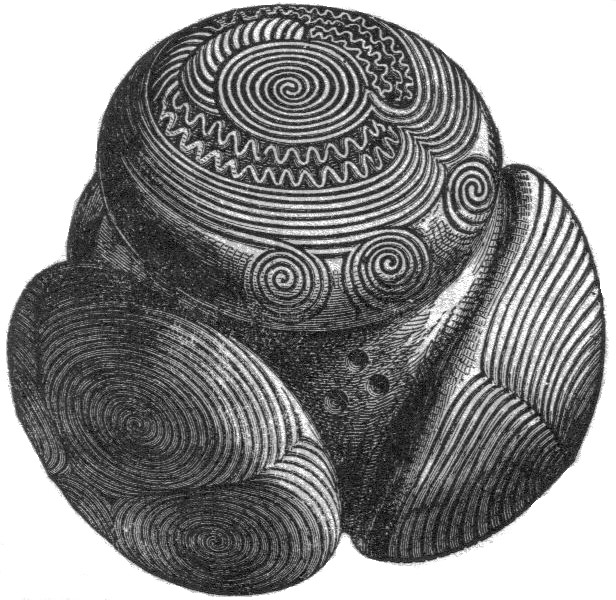
The Towie carved stone ball (Credit: Public domain via Wikimedia Commons)
The ‘Westray Wifie’ – Orkney
This small humanlike figurine (measuring just 41 x 31 x 12 mm) was unearthed during a Historic Scotland excavation in 2009 at the Late Neolithic settlement at the Links of Noltland on Westray in Orkney. It has since become internationally known as the ‘Orkney Venus’ or the ‘Westray Wifie’ and has even been replicated in biscuit form by local bakers.
Radiocarbon dating of the site suggests that the ‘Westray Wifie’ may well date to around 2900 to 2600 BC (some 4,600 to 4,900 years ago) making it one of the earliest representations of the human form ever found in Scotland.
Probably made from a beach cobble, it’s been carved in the shape of a figure – either human or divine – with a round head, rectangular nose and angular eyebrows. The eyebrows bear a marked resemblance to a decorated stone uncovered at the same site in 2008. They’re also identical to the “eyebrow motif” pecked carvings found in the southernmost chambered cairn on the nearby island of Holm of Papa Westray, and on the chalk ‘drums’ (a very rare set of cylindrical decorated chalk objects) from Folkton in Yorkshire, England.
This has led experts to suggest that this shape had a particular significance in the Late Neolithic belief system, and in turn, that the figure may depict a deity, perhaps an ancestor. How the object was used remains a mystery.

The “Westray Wifie” (© Crown Copyright HES)
Machrie Moor – Arran, North Ayrshire
The magnificent standing stone circles of Machrie Moor are part of a rich and ancient archaeological landscape which also boasts chambered cairns, hut-circles, field systems and a recently discovered cursus monument.
Erected around 4,000 years ago in the early Bronze Age, the six stone circles cared for by Historic Environment Scotland are the most prominent monuments on the moor today. The stone circle known as ‘Fingal’s Cauldron Seat’ is even connected to the story of a legendary Irish figure. However, archaeological excavation has demonstrated that they were part of a later phase in a long history of human activity on Machrie Moor.
The earliest known activity is the digging of pits and a gully at Circle 11 around 3,500 BC (some 5,500 years ago). Timber circles were erected around 4,500 years ago and the area was then cultivated, before the stone circles were built later on exactly the same sites as their timber predecessors.
Neolithic and Bronze Age farmers living on Machrie Moor performed religious and ceremonial activities here for millennia, perhaps asking the gods for good fortune and celebrating the changing of the seasons.

Machrie Moor (© Crown Copyright HES)
Kilmartin Glen – Argyll & Bute
Kilmartin Glen on the west of Scotland is rich with remnants of the country’s prehistoric inhabitants. In particular, the glen is considered to have one of the most important concentrations of Neolithic and Bronze Age remains in Scotland. The area spans 5,000 years with a multitude of cairns, standing stones, carved rock, stone circles, forts and castles.
Highlights from the Neolithic period include cup-and-ring markings at Achnabreck, one of the finest examples of prehistoric rock art in Scotland. Believed to be about 5,000 years old, spirals and massive multiple ring marks are spread over several outcrops, some reaching over 1m across.
Another gem is a 2km line of burial cairns (also called a “linear cemetery”) running north to south through Kilmartin Glen. All five are large, round cairns dating to the late Neolithic and Bronze Age periods. The oldest, Nether Largie South, was probably built over 5,000 years ago. The original chamber at its centre was divided into four compartments and probably held numerous burials.
Finally, Temple Wood Stone Circle was in use for some 2,000 years, from the Neolithic period through to the Bronze Age. The earliest remains on the site indicate it was first used in about 3500 to 3000 BC (some 5,000 to 5,500 years ago) when a timber circle was built which may have had an astronomical alignment. Work began on a stone circle to replace the timber one, but was never finished.
In about 3000 BC, an oval setting of 22 standing stones was built south-west of the timber circle. Later, the gaps between the individual stones were infilled with slabs. The slabs were designed to restrict access into the circle, but not the view from outside it, suggesting that only a select few took part in what went on inside while others in the community watched.

Nether Largie South Cairn, near Kilmartin, Argyll (© Historic Environment Scotland)
Submerged Crannogs and Pottery – Na h-Eileanan Siar (Outer Hebrides)
Artificial islets, also known as crannogs, are widespread across Scotland. Traditionally considered to date to no earlier than the Iron Age (which began around 2,800 years ago), recent research has now identified several much older crannogs from the Neolithic period in Na h-Eileanan Siar.
Survey and excavation of these sites has demonstrated—for the first time—that crannogs were actually a widespread feature of this period. The discovery of artefacts in the water surrounding the crannogs also suggests that the sites may have been considered special locations where offerings to the gods were made.
In recent years, former Royal Navy diver Chris Murray has found extensive new evidence of Neolithic loch-side life in Leòdhas (the Isle of Lewis). Within just a short time he’d amassed a hoard of evidence, including dozens of sherds of decorated pottery and an astonishingly complete undecorated pot, around 5,500 years old.
These astonishing findings challenge our current ideas of life and settlement in Neolithic Scotland, and suggest that other crannogs across Scotland and Ireland could potentially have Neolithic origins.
Here is a lovely cup recovered from a crannog, or artificial island, at Loch Arnish on the Isle of Lewis in 🏴
🔗 (🆓) https://t.co/4eMZse4YLB pic.twitter.com/vvtZoaQzUr
— 🅰ntiquity Journal (@AntiquityJ) May 22, 2021
Bonus: Rock carvings at Traprain Law – East Lothian
During the 1930s, four carved rock surfaces probably dating from the Neolithic period were discovered on the north-east slope of Traprain Law in East Lothian prior to quarrying.
Sadly the rock carvings were destroyed during the quarrying, but casts and some original fragments are preserved in the National Museum of Scotland collections and in 2014, another fragment was found in the quarry and allocated to the museum.
But in 2004, fieldwork on Traprain Law unexpectedly uncovered more rock carvings on the floor of what could be an Iron Age building on the southern edge of the summit. This new panel may also date to the Neolithic as, like on the Towie ball, the markings suggest similarities to passage grave art.
It’s rare for rock art to be discovered in place, surrounded by the remains of contemporary life. Although partly covered by the metalled floor of the later building, the most complex cup-and-ring motifs in the panel would have been ‘on display’ within the floor of the later building, close by the hearth. Although it’s tempting to see this as a deliberate act of incorporation of the earlier art within the new building, the exposed motifs were very faint and the re-use of this outcrop may have simply been a coincidence.
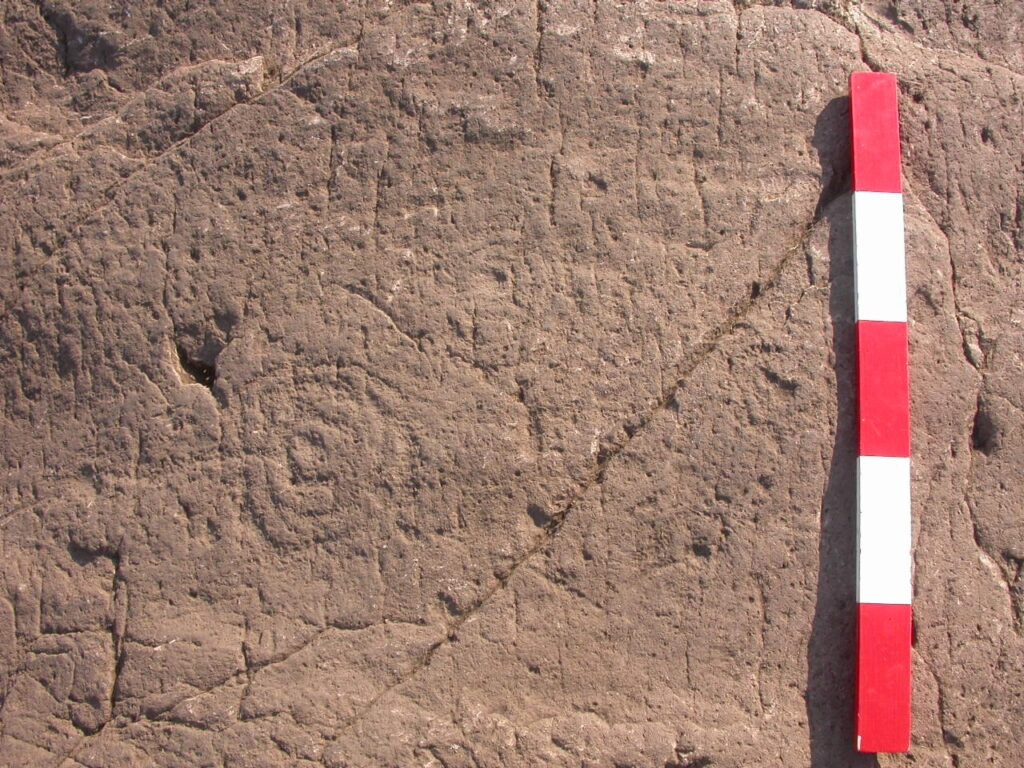
Traprain Law rock art discovered in 2004 (Credit: Ian Armit)
Want to go even further back in time? Check out our list of the Top Five Discoveries from the Mesolithic period.
Header Image: © Historic Environment Scotland
