Unearthing Scotland’s Musical Past Through Archaeology
Music has long been a thread woven into the fabric of Scottish culture, and archaeology offers a fascinating glimpse into the sounds that filled the air centuries ago.
Bone Whistle from Skara Brae
This bone whistle was found at the Neolithic settlement of Skara Brae in Orkney, which was a thriving village over 4,500 years ago. It features two holes which were made next to each other through the wall of the short tube of bone.
First uncovered by a storm in 1850, the site was investigated by the landowner’s family, antiquaries, and archaeologists such as Dr Anna Ritchie HonFSAScot, the first female president of the Society of Antiquaries of Scotland (who coordinate Dig It!). It’s now considered to be the best-preserved Neolithic settlement in Western Europe with prehistoric houses that still contain stone ‘dressers’ and box-beds.
Skara Brae was home to farmers and fishers, as well as hunters who may have used the instrument to make music to attract prey.
Lyre Bridge from Uamh An Ard-Achaidh (High Pasture Cave)
In 2012, experts revealed that they’d uncovered the remains of the earliest stringed instrument ever found in Western Europe – dating to approximately 300 BC (more than 2,300 years ago).
The Iron Age wooden bridge, with notches where strings would’ve been placed and potential wooden fragments from what was most likely a lyre, was found at Uamh An Ard-Achaidh on An t-Eilean Sgitheanach (the Isle of Skye) in na h-Eileanan a-staigh (the Inner Hebrides). Originally rediscovered by cavers in 1972, the underground passages and above ground remains were then excavated by Steven Birch and Martin Wildgoose with community involvement between 2004 and 2010.
According to Birch, writing for the Scottish Archaeological Research Framework, “the cave provided a major focus for a wide range of activities including metalworking, craft specialisation and the deposition of everyday objects, human remains and the debris from some major feasting events.”
To Birch, the artefact “conjures up a vivid image of the past, showing people gathering together for religious ceremonies, feasting on pig and cattle, and drinking to the accompaniment of music.”
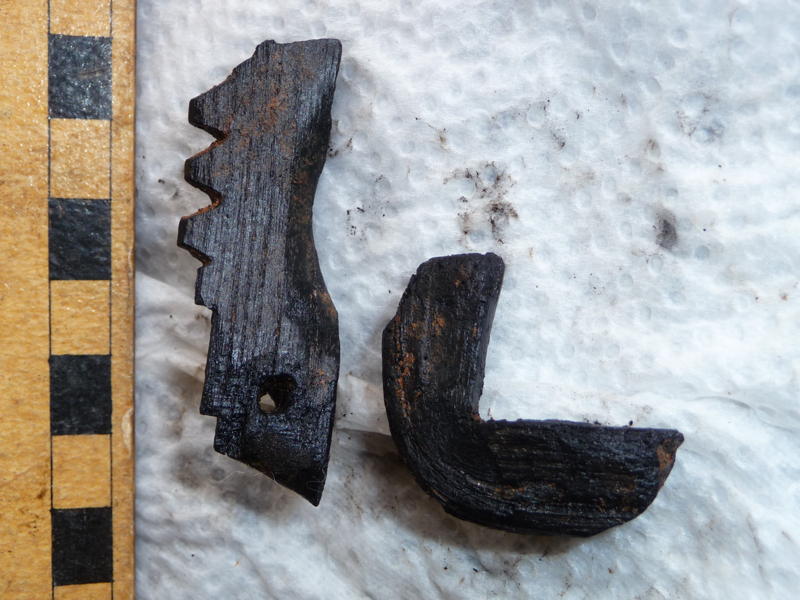
Lyre bridge (Image credit: Steven Birch)
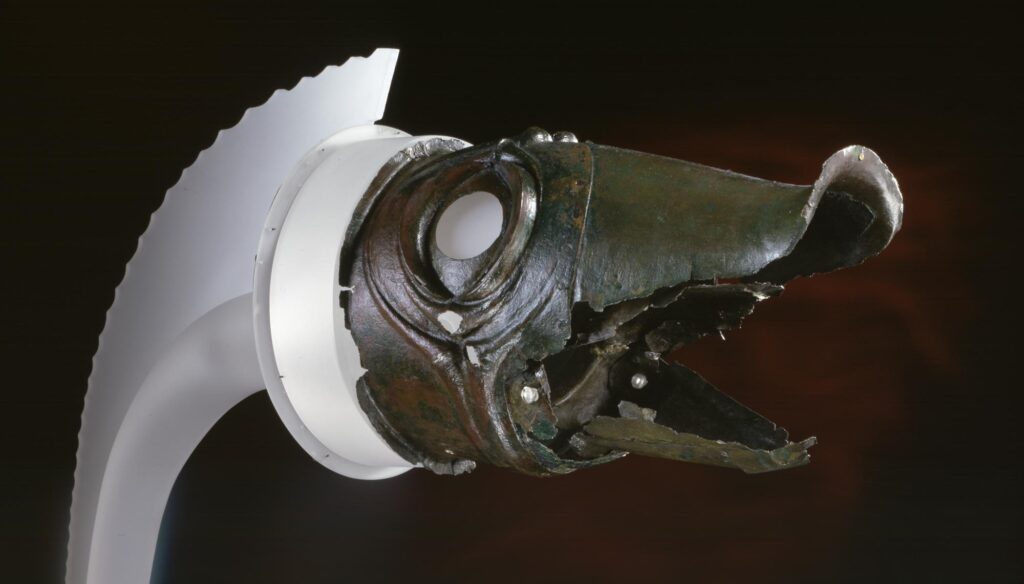
Deskford Carnyx
The Deskford carnyx is the head of an Iron Age war trumpet found in the bottom of peat moss in Deskford in Banffshire (which is now in the council area of Moray) around 1816. Shaped to resemble the face of a wild boar, it’s crafted from sheet bronze and brass. Because brass is not native to Scotland and instead represents recycled Roman metal, this means that the carnyx is likely somewhere between 1,770 and 1,900 years old (c.80-200 AD).
Excavations by National Museums Scotland in the 1990s examined the spot where the artefact was found, and experts concluded that the carnyx ended its life as a sacrificial offering to some unknown deity – possibly at a time of great danger or celebration. Archaeologists think that there was a widespread belief in the Iron Age that wet locations were sacred places where you could contact the gods.
In 1992, a replica was made by musicologist Dr John Purser and metalsmith John Creed which means we now know something of what it sounded like.
Harp carving on the Nigg Stone
Although harps can be spotted on other carved stones – such as St Martins Cross in na h-Eileanan a-staigh, Dupplin Cross in Perth & Kinross, and the Monifieth 4 Sculptured Stone from Angus – it’s believed that the earliest evidence of European triangular framed harps is found on the 1,200-year-old Nigg Stone cross-slab in Easter Ross in the Highlands.
This “magnificent” and “intricately carved” Pictish stone dating from the 8th century AD features a decorated cross on the front and an “extremely complicated” scene on the back which includes an eagle symbol, hunting scenes, an illustration of a Biblical story, and the harp (which would’ve had horsehair strings).
Known to have stood in the kirkyard until 1727, the stone is now housed in Nigg Old Church, which is in a location that has probably been a place of Christian worship for as long as the carved stone has existed.
According to the Highland Pictish Trail, “the Nigg Stone, along with the Shandwick Stone and the Hilton of Cadboll Stone, is evidence of the important role of the Tarbat peninsula in Pictish times, and the three stones may well be linked to the major Pictish religious site at Tarbat.”
Rediscovered by archaeologists in the 1980s, this site saw one of the country’s largest research excavations, which you can read about in the Society of Antiquaries of Scotland’s free Open Access E-book: “Portmahomack on Tarbat Ness: Changing Ideologies in North-East Scotland, Sixth to Sixteenth Century AD”.

The reverse or “secular” side of the stone in a 19th-century illustration, minus the top section (Image credit: Charles Carter Petley (1780-1830), Public domain, via Wikimedia Commons)
Polyphonic music slate from the Paisley Abbey drain
Several unique carved slates have been found in Paisley Abbey’s Great Drain in Renfrewshire, including the earliest example of polyphonic music (music with simultaneous notes) uncovered in Scotland.
Rediscovered in 1990, the 600-year-old medieval drain is a vaulted tunnel almost two metres tall and running for 100 metres just outside the perimeter of the abbey complex. According to John Pressly, the Science Curator at Paisley Museum, “archaeologists found the bottom of the drain covered in a thick layer of silt which revealed a remarkable array of artefacts.”
“This included amazingly preserved organic material such as worked leather, wood and plant seeds, over 14,000 sherds of pottery (the largest assemblage of medieval pottery found in the country at the time).”
The carved slates would’ve been used by the abbey scribes to practice writing skills and are just one of many artefacts which, according to Pressly, “unveiled a fascinating insight into life behind the cloister walls”.
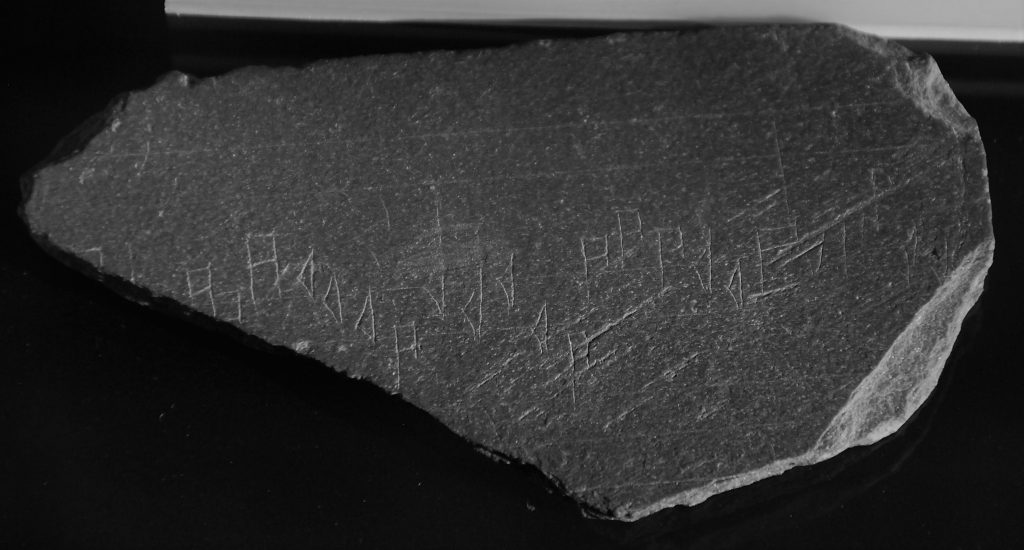
Musical notation carved onto a piece of slate. Found during the excavation of the Great Drain in 1991 (Image credit: John Pressly)
Want to keep reading? Dig into more sites in Orkney, cave discoveries, finds from peat bogs, the Picts or the archaeological collection at Paisley Museum.
Header Image: Deskford carnyx (© National Museums Scotland)
