Why the Romans are Part of Scottish History

“All right, but apart from the sanitation, the medicine, education, wine, public order, irrigation, roads, a freshwater system, and public health, what have the Romans ever done for us?” – Monty Python’s Life of Brian.
Archaeologists studying the ancient Romans in Scotland are still sometimes asked “did they ever march north of Hadrian’s Wall?”. We’re also sometimes asked if we should include the Romans at all when writing about Scotland’s past. The answer to both questions is a resounding yes!
Hadrian’s Wall in Northern England was the boundary of the Roman province known as Britannia for a few hundred years. But soldiers travelled north several times, building structures and depositing artefacts, interacting with local tribes and making a home for themselves and their families in this new land – all of which helped to shape Scotland’s story.
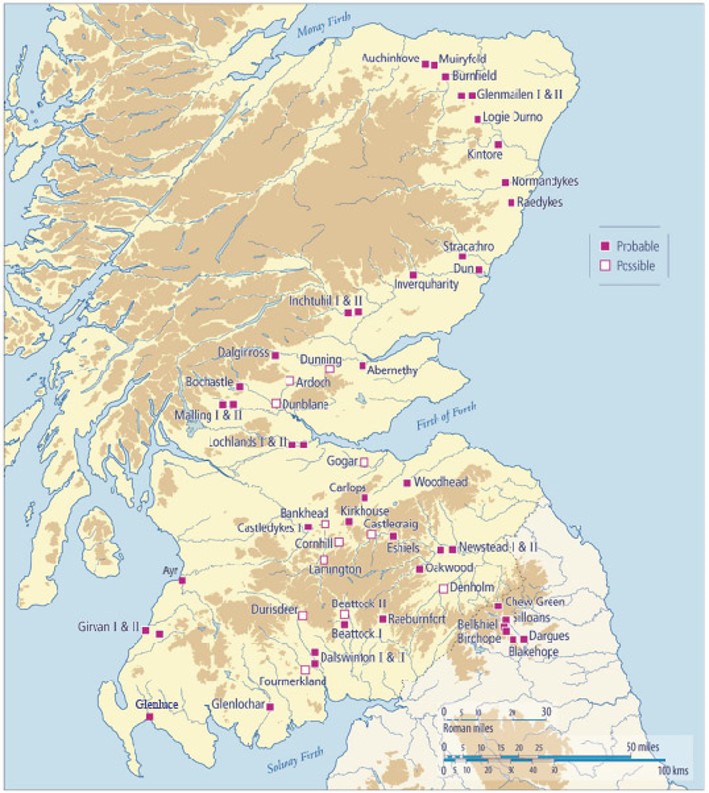
Map of Agricola’s army’s marching camps across Scotland (© GUARD Archaeology Ltd)
Making a Mark: Roman Camps and Campaigns
The legacy of the ancient Roman Empire in Scotland is that of a series of military campaigns and relatively short occupations. These military excursions may have been brief interludes in the Iron Age chapter of Scotland’s story, but the soldiers left a lasting mark on the land in the remains of military structures, roads and more.
When the Romans campaigned in Scotland, they camped in leather tents and marked their camp site using a rampart (bank) and ditch before later building what were intended to be more permanent fortifications (forts and fortlets). It is often the ditch that leaves traces for archaeologists to uncover centuries later.
Evidence for these temporary camps have been found as far north as Moray and as far west as Girvan in South Ayrshire and Glenluce in Dumfries & Galloway. New camps have also been found through the excavation of Roman ovens in recent years, for example, under the new Aberdeen western periphery route (Aberdeen bypass) and under the new Academy in Ayr.
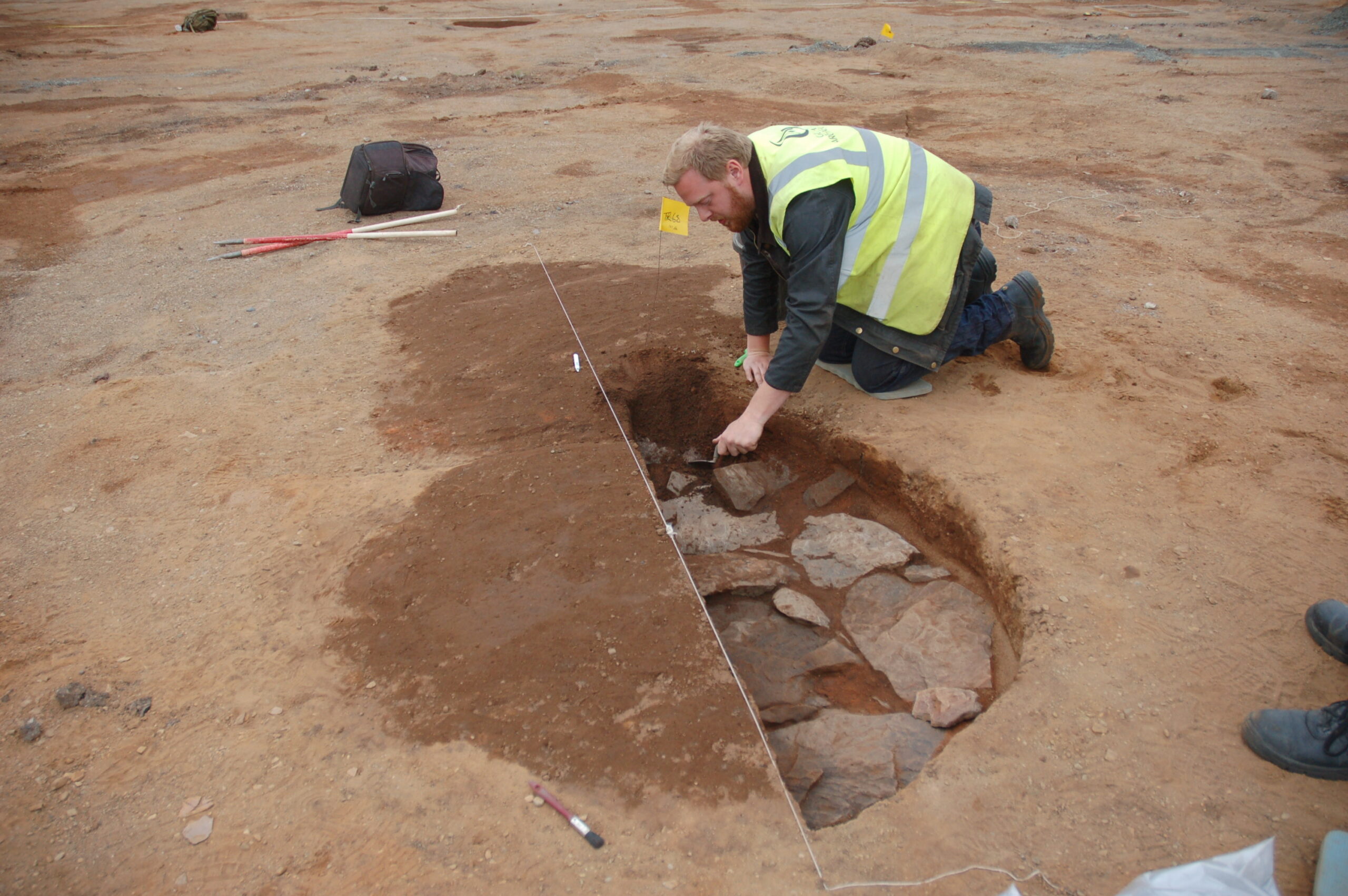
Excavation of one of the Roman ovens at Ayr Academy (© GUARD Archaeology Ltd)
In fact, just off the A68 in southern Scotland lie some of the largest Roman camps known in Europe, evidence from when the Roman Emperor Septimus Severus himself was campaigning here around AD 208.
In AD 142, the Roman army began building a great 41-mile-long defensive wall stretching from the Firth of Forth to the Clyde. In the end, this structure was only occupied for around 20 years, but today, the remains of the Antonine Wall – a turf rampart with a great ditch on its north side, and various forts and fortlets – are still visible in places. It is now a World Heritage Site, one of only six in Scotland.
Friend or Foe? Interacting with Local Tribes
But we shouldn’t think that Roman soldiers kept hidden behind the walls of their forts during their time in Scotland; they also spent some time interacting with the locals.
The impact of Rome on the Iron Age communities who already lived in Scotland 2,000 years ago varies across the country. Recent work at Burnswark near Lockerbie in Dumfries & Galloway for example, has suggested that this was the site of fighting between the invading Romans and the local Iron Age people.
Whereas at Birnie, two coin hoards could be an example of the Roman army buying off Moray’s local tribes to avoid conflict. We have similar evidence of this diplomatic bargaining with hoards of Roman hacksilver (fragments of cut and bent silver items that were used as currency by weight) found at Traprain Law in East Lothian and Norrie’s Law in Fife.
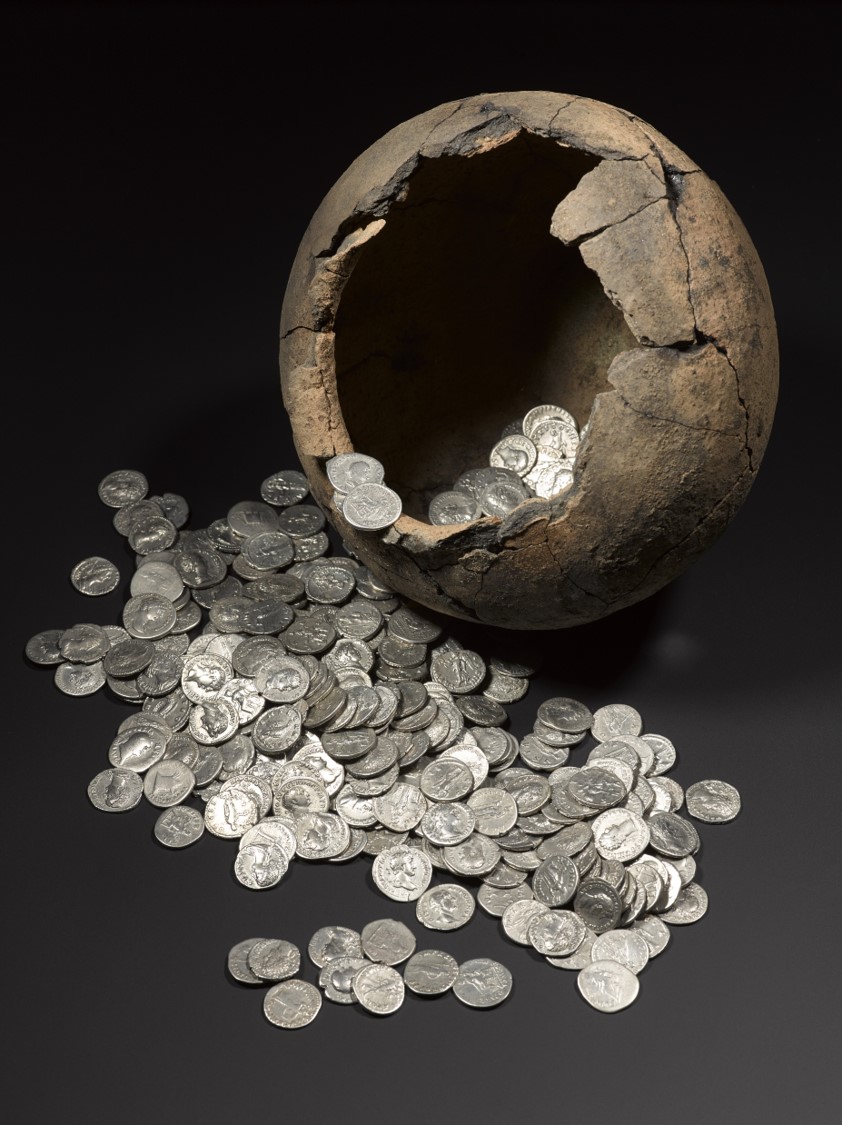
Birnie Coin Hoard (© National Museums Scotland)
Roman artefacts have even been discovered in the far north. A Roman coin recently discovered during excavations at Swandro in Orkney tells us that Roman goods found their way into Iron Age communities across the country.
This evidence helps to build a picture of a complicated and nuanced relationship between Roman soldiers and the peoples whose land they had entered. The presence of the Roman army in Scotland would have undoubtedly affected local communities – some would have exploited opportunities for trade, but others would have had their land and goods stolen from them. The interactions between these two groups, both the good and the bad, are all part of Scotland’s history.
Building a Life in a Roman Fort in Scotland
When we consider Roman forts in Scotland, we may think of soldiers clad in armour and hob-nail boots or sandals spending their time sharpening their swords and practicing fighting. But the reality of life for soldiers on the Antonine Wall and elsewhere was much more than that.
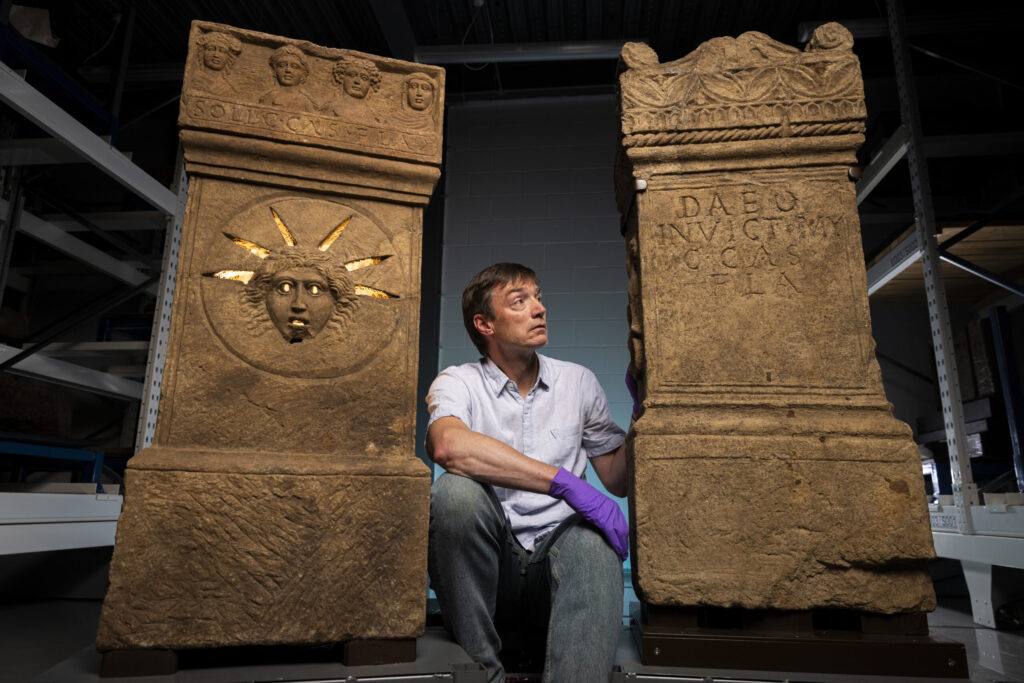
Curator Dr Fraser Hunter FSAScot examines the Lewisvale Roman altars (© Duncan McGlynn)
Gaming objects found on digs indicate leisure activities and altars tell of their religion. The soldiers were also accompanied by their wives, enslaved people and children and were followed by merchants who did their trade in the vicinity of the forts. While campaigning in the northernmost fringes of the Empire, this community essentially settled on a temporary basis, building a home for themselves near their forts.
The Roman army and the people who travelled with them brought many different cultural practices never before seen in Scotland, such as cooking styles (including pottery associated with a style of cooking from north Africa), other religions, different languages and presumably accents. It’s hard to tell how many of these stuck around after the army left, but for the few hundred years in which the Romans occupied Scotland, they were part of the fabric of the Scottish landscape.
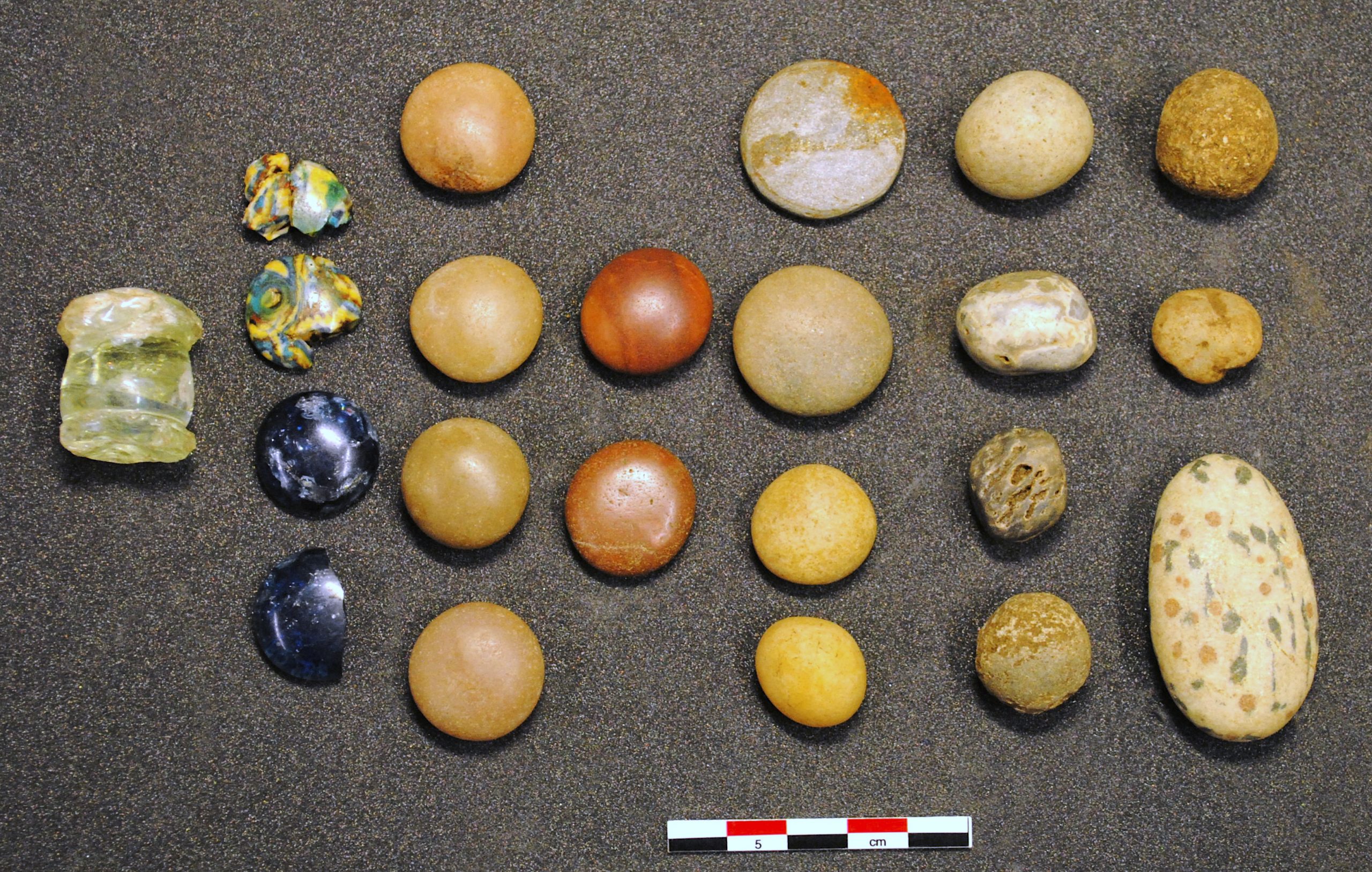
Glass gaming pieces from Tarland (Image Credit: Mark A Hall)
For the soldiers and their families living in Scotland at this time, this land became their home. The experiences they had here – of trading, fighting, foraging, building, praying, playing and raising children – make the Romans an essential part of Scotland’s story.
Ready for more Roman story from Scotland? Dig into Bearsden fort near Glasgow.
By Dr Rebecca Jones FSAScot, Former Head of Archaeology and World Heritage at Historic Environment Scotland and visiting Professor at Heriot-Watt University.
Rediscovering the Antonine Wall was a project funded by The National Heritage Lottery Fund and other partners which aimed to raise awareness of the Wall with its local communities. Alongside a series of projects and activities, the project saw exciting new pieces of artwork, new Roman themed playparks and replica distance stones being put into the landscape. Designed with local communities, these are helping to make the Wall fun and interesting.
Header Image: The Bridgeness Slab is a Roman distance slab created around 142 CE marking a portion of the Antonine Wall built by the Second Legion (© VisitScotland / Kenny Lam)
