Who Were the Vikings?
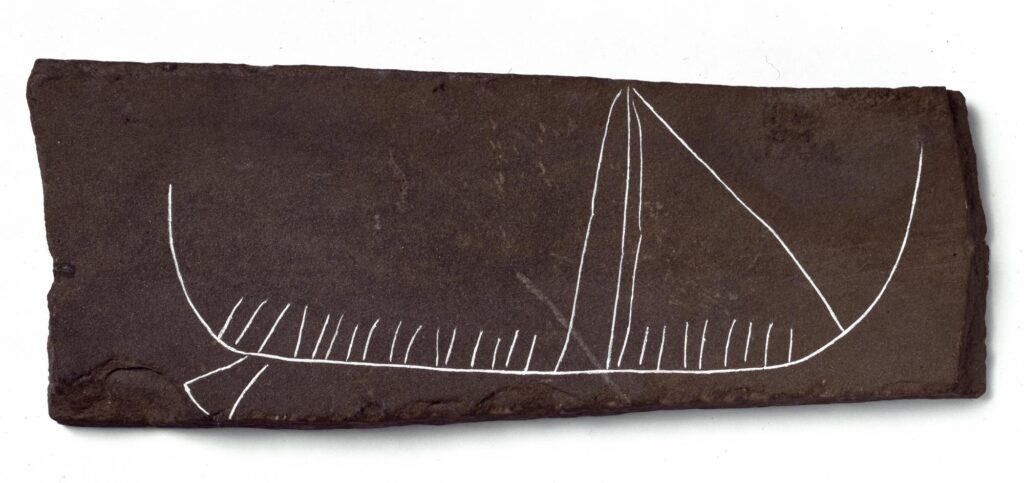
You may know that the Vikings weren’t all horned helmet-wearing warriors on dragon-headed longships – but you might be surprised to learn that archaeologists’ view of who they were is still “under construction”.
The simple answer to the question of “who were the Vikings?” is that they were people who left early medieval Scandinavia to trade, raid, and colonise other parts of Europe, the North Atlantic, and the Near East (around the East Mediterranean). In reality though, it’s a bit more complicated than that.
The people we refer to as the Vikings were never a single self-identifying group, but rather a diverse mix of people from hundreds of small tribes and kingdoms, predominantly from Scandinavia but also from peoples living along the Baltic and North Sea coasts. These tribes and kingdoms eventually formed larger Nordic kingdoms that we would recognise today as Norway, Denmark and Sweden.
It’s worth remembering that Scotland’s Viking Age lasted for nearly half a millennia (from around AD 750 to AD 1100, which was approximately 1,270 to 900 years ago) and a lot changed in Europe during this time. Kingdoms rose and fell, languages changed or disappeared, and there were big shifts in the religious landscape.
During this period, group identities were in flux – concepts like nationality hadn’t formed yet and people would’ve had several identities relating to their family, social class and political allegiance. In this age of long-distance trade and migration, many people would’ve also known at least the basics of several languages. In short, the past is messy and complicated, and chances are if you asked 1,000 ‘Vikings’ who they are, you would get 1,000 different answers!
It’s important to consider the depth of time covered by the Viking Age. Think about how different the world looked when Mary, Queen of Scots was on the throne compared to today, and how much our society and culture has changed – nearly as much time has passed between then and now as from the start of the Viking Age to the end of it.
So although we’ll try our best to answer common questions about the Vikings in this article, it’s worth keeping in mind that – like most of history – very few questions have simple answers. To apply statements to the period, or to a group of people as a whole, can be misleading at best and dangerous at worst.

Map showing two of the common definitions of “Scandinavia”; a cultural, historical and ethno-linguistic region in northern Europe (By DemonDays64 – This file was derived from: Blank map of Europe (without disputed regions).svgLegend from Map of Scandinavia.png, CC BY-SA 4.0, https://commons.wikimedia.org/w/index.php?curid=109745719)
Why do we call them ‘Vikings’?
The word ‘viking’ is actually an activity, rather than the name for a group of people. ‘To viking’ is a verb meaning a form of piracy or raiding, and all the early uses of the word are specifically referring to pirates. So if viking is an occupation rather than an ethnic group, why do we use that label to refer to an entire people?
The ‘Vikings’ as a singular concept are the creation of 19th-century scholars; an easy way for us to group together and study a complex phenomenon which occurred across multiple continents over several hundred years.
Ultimately the name stuck because early scholars focused on the dramatic and well-recorded raids on monasteries and towns which occurred in AD 800 and 900 (over 1,000 years ago). Thus the label of ‘pirate’ was effectively applied to all the people of early medieval Scandinavia regardless of their actual involvement in raiding.
Unfortunately, we don’t really know what they called themselves as a group of people. Most surviving names for ‘the Vikings’ are from an outside perspective – or were written down much later in history after the Nordic kingdoms of Denmark, Norway and Sweden had formed, which meant that they projected their ideas onto the past. These later sources, such as the Icelandic and Norse sagas, describe groups of people by their family connections (‘Njalls kin’), their leader (‘Olaf’s Men’) or where they live (‘Men of Møre’).
English historical sources such as the Anglo-Saxon Chronicle (created late in the AD 800s) refer to them as “danes”, “heathens”, and more rarely “wicinge” (viking). Irish sources like the Annála Uladh (with entries that span the years from AD 431 to AD 1540) use the terms “gaill” (foreigners) or “nordmanni” (northmen) and, later in history, start to speak of different political or kin groups using terms like “fingaill” (fair foreigners), “dubgaill” (dark foreigners), and “gall-goidil” (Gaelic-foreigners).
If anyone managed to stop and ask a raiding Viking in 9th-century Scotland (around 1,100 years ago) who their people were, their reply hasn’t survived in the historical record. It’s impossible to know what their answer would’ve been without this information, but chances are they would’ve spoken of their warband, home village, or leader rather than an ethnic identity.
Most modern scholarship uses the term ‘Norse’ as a label for the people and cultures coming from early medieval Scandinavia. This is in reference to their spoken language group, Old Norse. However, it’s hard to argue with the widespread recognition of the word “Viking”, so to make things easier, we’ll refer to the group as either “Vikings” or “Norse” for the rest of the article.
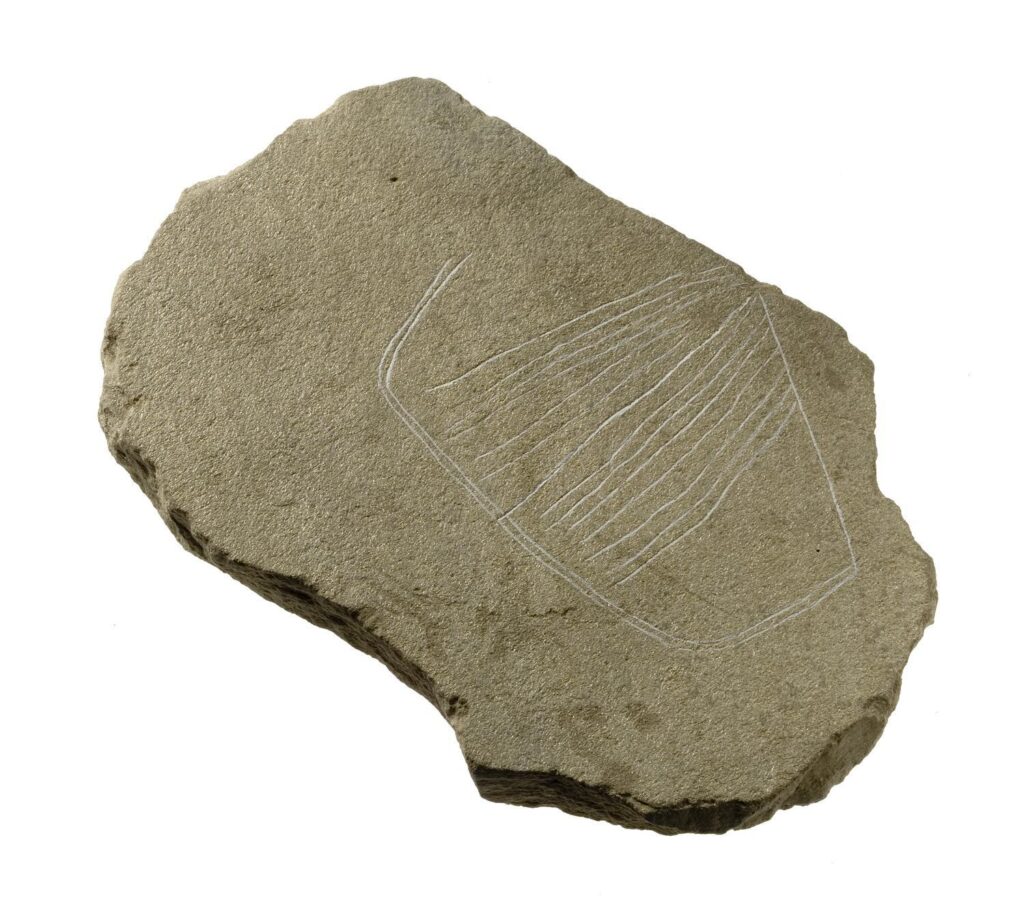
Carving of a Viking ship on a slate from Jarlshof in Shetland which is thought to be over 900 years old (© National Museums Scotland)
Where did the Vikings come from?
It’s true that many Vikings came from Scandinavia (modern Sweden, Denmark and Norway), with Norway providing the strongest connections to Scotland. But it’s likely that folk from other parts of the Baltic Sea (modern Germany, Poland and Estonia) or Low Countries (Belgium, the Netherlands and Luxembourg) – and opportunistic people from the countries that were being raided – would’ve been involved in ‘viking’ activities.
Isotope analysis from Viking graves in Scotland, for example, shows that some individuals who were buried in a pagan Norse fashion during the early Viking Age actually grew up in Britian and Ireland, contrasting with neighbouring graves containing individuals who grew up in Scandinavia.
After all, the 9th and 10th centuries (AD 801 to AD 1000) were a multicultural time, even in Scotland, with a number of different languages being spoken. Language and cultural difference may not have been as big of a barrier as we might imagine when there are opportunities to be had.
As time goes on, these cultures merged and formed new identities which experts have given new names to, such as the “Hiberno-Norse” in Ireland and “Anglo-Danes” in England.
Plus, local raiders were common across these Isles. When talking about Vikings in the raiding sense of the word, there’s a possibility that in a Scottish context, the Vikings could’ve been a long-established group in Britain and Ireland, like the Irish or Picts. When all we have is a short note saying “northmen pillaged a monastery”, who’s to say that the Scandinavian-led warband hadn’t picked up some “local muscle” as well?

“Belt strap-end with organic remains, probably leather, decorated with bronze studs on both faces, from a Viking grave group” from Ùig on Leòdhas (Lewis) in na h-Eileanan Siar (Outer Hebrides) which is thought to be from AD 875 to 925 (© National Museums Scotland)
When did the Vikings first arrive in Scotland?
Traditionally, the start of the Viking Age in Britain and Ireland is thought to kick off in the last decade of the 8th century (around 1,200 years ago) with the well-documented murder of an important royal official in AD 789 and a violent raid on the Northumbrian monastery of Lindisfarne in AD 793 in England.
In Scotland however, the story is likely a bit different. While we do know that the first recorded raid was at Ì Chaluim Chille (the Isle of Iona) off the western coast in AD 795, it’s possible that due to the geographic closeness between the North of Scotland and Norway, raids launched from Scandinavia might have reached Scotland’s shores a decade or two earlier than the recorded events in England (so still in the 8th century).
Wondering why we can’t pin down an exact date? Fewer written historical sources survive from this period of Scottish history, likely due to the raids on powerful and wealthy monasteries like Portmohomack in Easter Ross around the year AD 800 (who would’ve been the ones writing things down), and general turbulence of the era and later wars or disasters.
Both Scotland and Scandinavia changed hugely over the duration of the Viking Age, and change was remarkably gradual and less sudden than we commonly imagined, so scholars tend to break this period into bite-sized chunks. Each modern country impacted by the Viking Age (England, Ireland, France, etc) uses different ways of defining these changes which reflect their historical events and processes.
Scotland’s very early Viking Age (also referred to as the “Norse Period”), for example, is sometimes called the “Picto-Norse interface”, and represents the murky first period of contact between people living in Scandinavia and Scotland. The “Viking Age” proper refers to the period of settlement and colonisation of Scotland, following on from the earliest raids. The late Viking Age in Scotland – called the “Late Norse Period” – actually extends into the mid-15th century (around AD 1450), and refers to the period in which parts of Scotland were at least nominally (in name only) under the rulership of the medieval Scandinavian kingdoms.
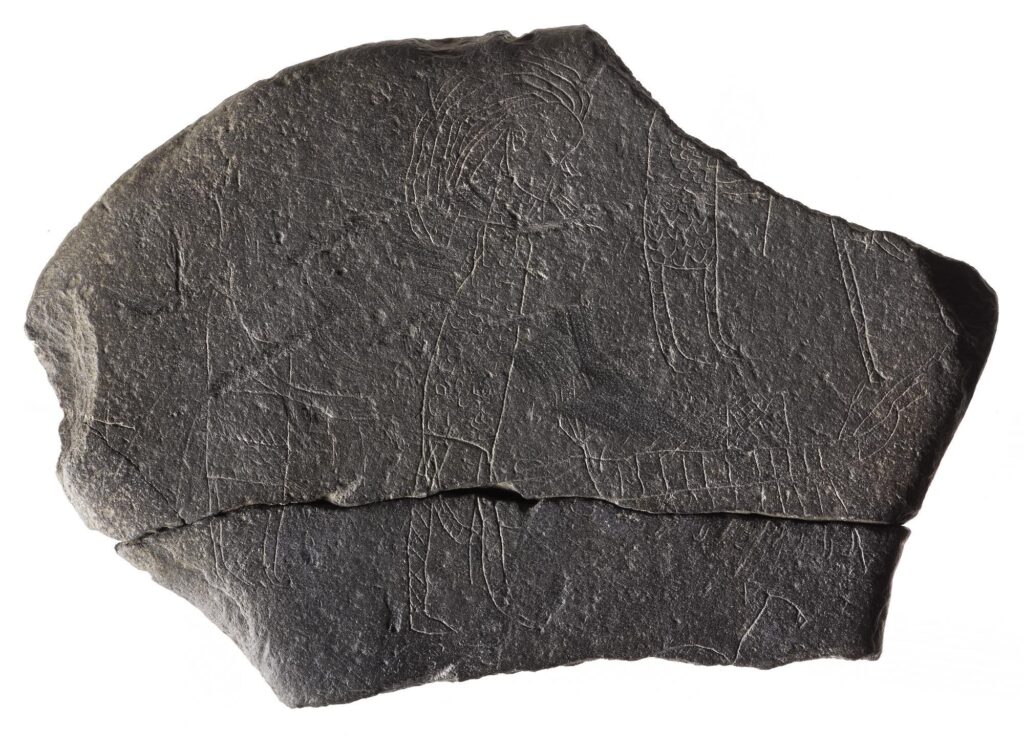
‘The Hostage stone’ which depicts a scene, either witnessed or imagined, that shows “wild-haired raiders” dressed in long coats of mail dragging a hunched figure by a rope, towards a ship (© National Museums Scotland)
Why did Vikings come to Scotland?
While we don’t know much about their arrival, it’s likely that the earliest Vikings were traders from modern-day Norway and Denmark. According to Crucible of Nations: Scotland from Viking Age to Medieval Kingdom by National Museums Scotland’s Dr Adrián Maldonado, they would’ve been seeking opportunities to exchange prestige items (such as fine furs, honey and metalwork) for grain and livestock products (such as fine leather, wool, butter and cheese) (page 31).
Craftspeople working in Scotland produced their fair share of fine metalwork as well, including elite goods which symbolised power both here on earth and in a Christian afterlife. These were valuable objects for trading or gift exchange back in Scandinavia.
Additionally, the kingdoms in Scotland were tapped into a vibrant European trade network that linked all the way to the wealth of the Byzantine Empire in the Mediterranean. This made it a good place to access this rare material according to Dr Maldonado’s Crucible of Nations (page 37).
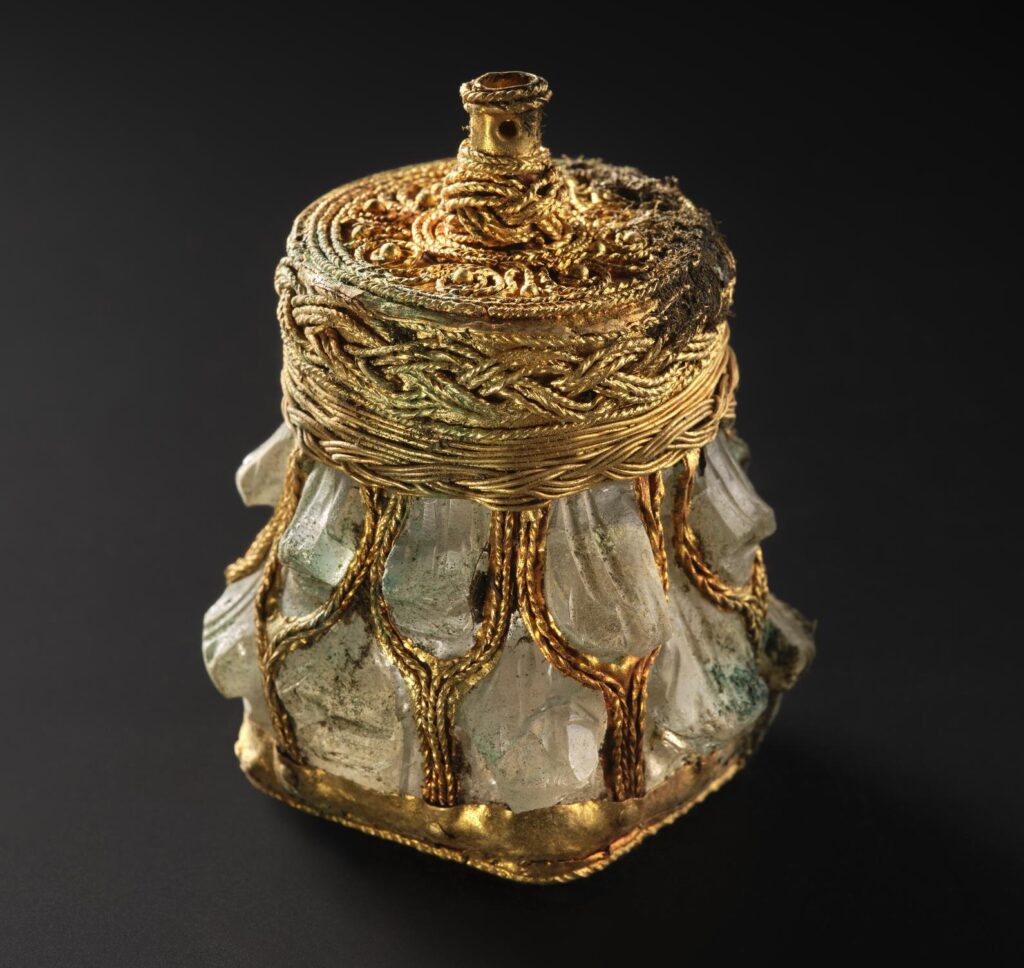
A rock crystal jar from the Galloway Hoard, which “brings together a stunning variety of materials and treasures from Ireland, the Anglo-Saxon kingdoms and as far away as Asia”(© National Museums Scotland)
Where in Scotland did the Vikings live?
Viking colonisation primarily took place in Shetland, Orkney, Caithness in the Highlands, and Innse Gall (the Hebrides). We most strongly associate Vikings with these regions because they remained under Scandinavian control well into the medieval period.
But it’s likely that individuals from Viking Age Scandinavia and their descendants could’ve ended up living anywhere in what is modern day Scotland. Just as today, people frequently moved and lived amongst different cultures, following opportunities and bringing new traditions, language and skills with them.
Objects that have strong Scandinavian cultural connections have been found all across Scotland including in the Firth of Clyde, Galloway, the Lothians, the Borders, Fife, the Moray coast and the Highlands. However, it’s important to remember that objects are not people; these also could’ve been traded or looted by people who moved them to areas where Vikings didn’t reside.
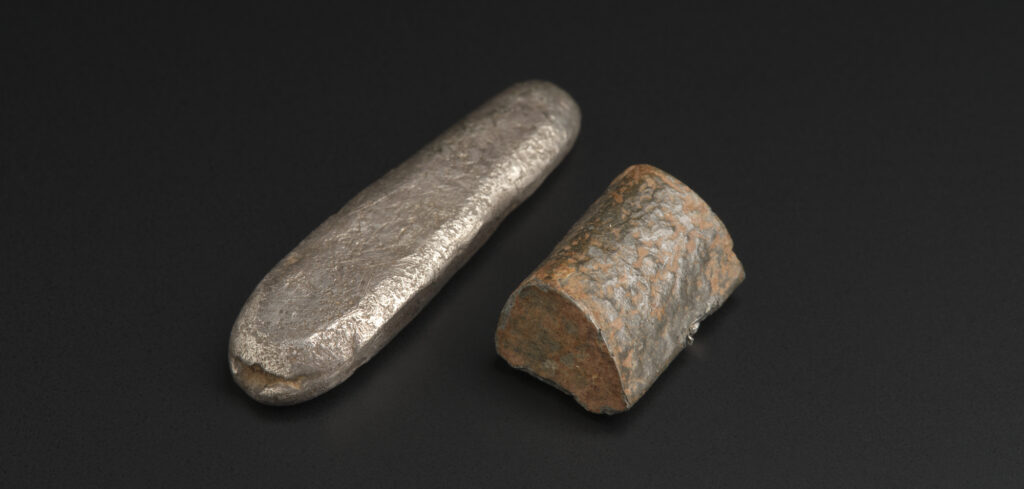
A characteristically “viking cast silver ingot comprising an irregular tapered rod with rounded ends, from Whitmuirhaugh, Kelso, Roxburghshire” (© National Museums Scotland)
What was the Viking lifestyle in Scotland?
Day-to-day life for these men, women and children was similar to that of other medieval people in Scotland, following the pattern set by the seasons. Farming, fishing and craftworking would’ve been the basis of society, with some people taking up trading and raiding at different stages of their lives or when opportunity or necessity presented itself.
Social and economic status was a broad and layered spectrum, with wealth based on ownership of land, ships, livestock, enslaved people and precious metal.
Beach markets were important seasonal gatherings for commerce and social activities alike, where trading ships carrying exotic goods drew up onto established beaches with some regularity over the years. Culbin Sands in Moray, for example, was likely a beach market for a very long period of time.
The Vikings in Scotland lived a fairly rural life when compared to their colonies in Ireland and England. No true urban centres arose in this period, although the settlement at Whithorn in Dumfries & Galloway can be described as ‘proto-urban’ (for example, a village in the early stages of having the size and impact of a town). The late Norse period foundation of the town of Kirkwall in Orkney, which was solidly part of the Kingdom of Norway at the time, was also an important development for the Scandinavian Kingdom.
The number of excavated Viking settlement sites in Scotland is still fairly limited. Generally places which were good to settle, farm and fish continued to be good places well into the modern age, so it’s likely that most settlements lie under modern towns, villages and farms – under our very feet!
A few well-known high-status sites have been excavated, like Orkney’s Brough of Birsay and Earl’s Bu, while several more typical-sized farmsteads have been uncovered in the islands off the north coast of mainland Scotland and na h-Eileanan Siar (Outer Hebrides). This includes The Biggings on Papa Stour and the Udal on Uibhist a Tuath (North Uist), as well as Freswick Links in Caithness.
We do know that unlike the heavily forested Scandinavian homelands, wood was harder to come by on Scotland’s islands, and so builders had to make more use of local materials. Stone and turf for walls, driftwood, heather and grasses for roofing all made good substitutes.
Excavation of sites that we’ve identified from the Viking Age also show a great deal of animal bones, indicating the raising of sheep, cattle, pigs, goats, ponies and chickens. Grain, oats, vegetables and cereal crops were also vital; some of the oldest water-driven mills in Scotland have been dated to the Viking Age in Orkney.
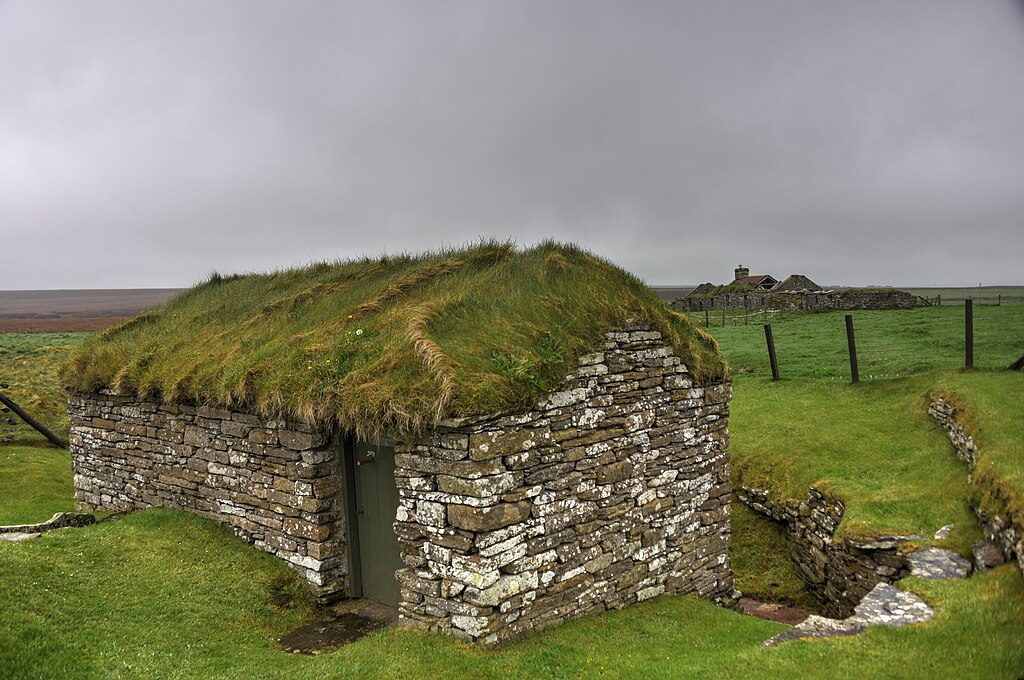
Dounby Click Mill in Orkney. According to Historic Environment Scotland, “the tradition of horizontal water mills in northern and western Scotland dates back to Norse times. The Click Mill at Dounby is one of the best surviving examples of this kind of mill.” (Image credit: August Schwerdfeger, CC BY 4.0 <https://creativecommons.org/licenses/by/4.0>, via Wikimedia Commons)
What evidence did the Vikings leave behind?
What we know about the Vikings in Scotland is based on a wide range of material they left behind.
In addition to artefacts and settlement sites, we can also learn about the Vikings from historical sources such as the Irish Annals, and the legendary stories told in the Norse Sagas such as Orkneyinga Saga. The names of places also provide clues to the past; Norse words and names survive in the landscape all across Scotland, from the Scottish Borders to the isolated archipelago of Hiort (St Kilda) in the North Atlantic Ocean.
Stray objects relating to the Vikings also turn up in all sorts of unusual places with some frequency and are reported to the Scottish Treasure Trove Unit to ensure that they’re preserved in public collections for the nation to learn from and enjoy.
But probably the most famous and recognisable types of evidence left by the Vikings is their burials. Orkney’s Scar Boat Burial, which contained the remains of a man, a woman and a child, is a well-known example. Found in 1991, it included objects which “were unparalleled in Britain both in quality and state of preservation”, including the famous Scar Plaque made of whalebone, a gilded brooch, iron sword, a quiver containing arrows, a bone comb, a set of 22 gaming pieces, a sickle, a weaving sword (used to pack down threads), shears and spindle whorls.
And this list of evidence continues to grow. A richly furnished grave was recently uncovered on Papa Westray in Orkney and you can follow the story with Historic Environment Scotland as analysis on this important discovery continues.
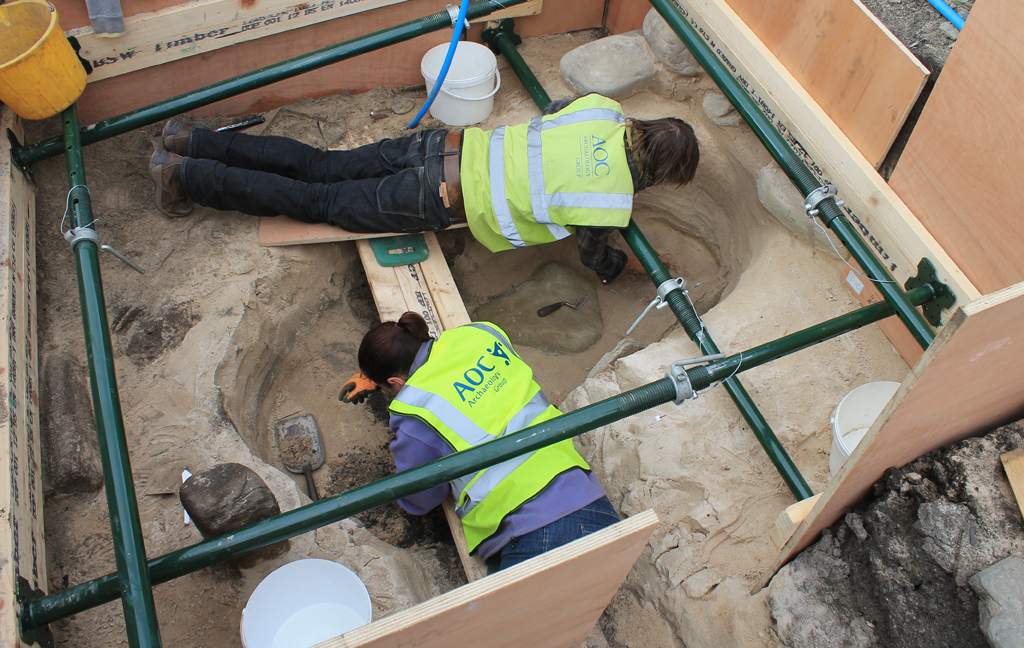
AOC Archaeology carrying out the Papa Westray excavation (© AOC Archaeology)
“Could I be related to a Viking?”
According to Dr Tom Booth, a Senior Research Scientist in the Ancient Genomics Laboratory at the Francis Crick Institute, “it may feel as though [the] new supply of ancient and modern DNA sequences should enable us to make direct biological connections to our ancestors that reveal ‘who we really are’. Indeed, early marketing by some genetic testing companies exploited this, claiming to be able to tell you whether or not you were a ‘Viking’.
However, the idea that the true essence of a person and their sense of identity should boil down to a genetic link with a poorly-defined group of people from the past is highly suspect, and represents a misunderstanding of what genetic ancestry is.”
More information can be found in Dr Booth’s Am I Related to a Viking? The Reliability of Genetic Ancestry Testing article.

Viking sword hilt of bronze inlaid with silver from Eige (Eigg) in na h-Eileanan a-staigh (the Inner Hebrides) from the 9th century (1,100 years ago) (© National Museums Scotland)
What happened to Scotland’s Vikings?
The term “Viking” stops being used in historical sources from around AD 1000 (during the High Medieval Period) because there were no more Viking raids as we know them. The Norse people who settled and stayed in Scotland converted to Christianity after a few generations. They farmed, fished, crafted, traded, commissioned works of art, and enmeshed themselves into the complex political and social networks that criss-crossed these Isles and the North Atlantic.
As areas of heavy Norse colonisation such as Shetland, Orkney, Caithness and Innse Gall transitioned into the Late Norse Period, political ties with Scandinavia grew stronger, and eventually the major lords of these lands swore allegiance to the King of Norway.
Over time, the Kingdom of Scotland (which was then known as the Kingdom of Alba) expanded its influence and territorial extent, gaining control over Innse Gall in AD 1266 and the islands off the north coast of mainland Scotland (like Orkney and Shetland) in AD 1472.
In a gradual and complex process, their cultural practices, customs and languages developed into the modern identities of places such as Orkney and Shetland – therefore becoming strands in the tapestry which makes up modern Scotland. In many ways the Vikings are still here – their contributions to our folklore, place-names, and impact on English, Scots and Gaelic remains visible today.
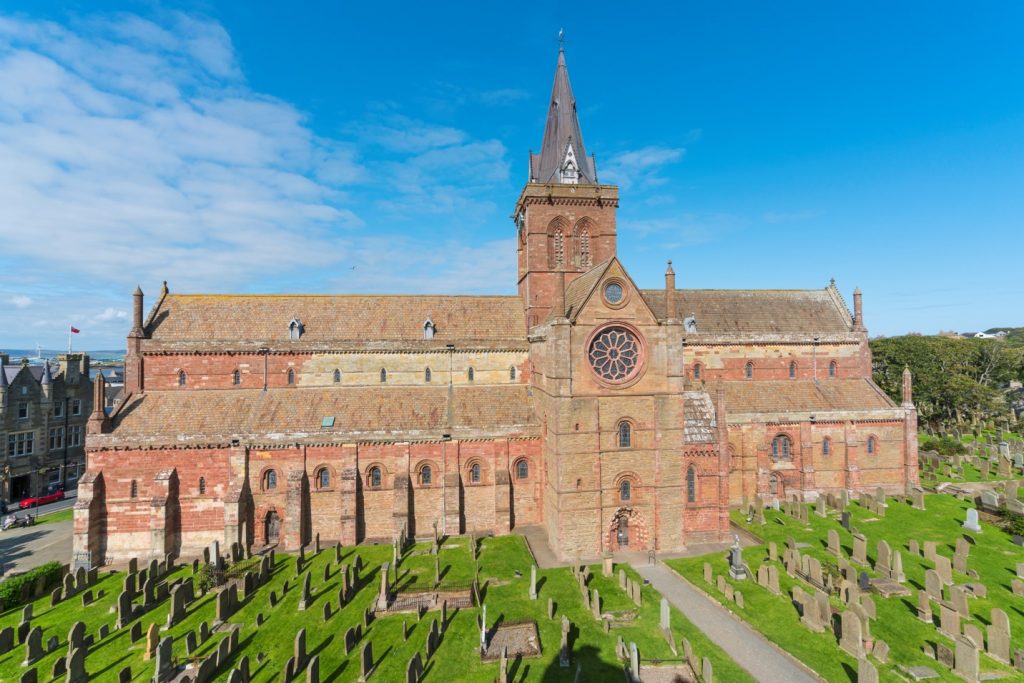
Orkney’s medieval St Magnus Cathedral in Kirkwall, which comes from the Norse name “Kirkjuvágr” (“Church Bay”) (Image Credit: VisitScotland / Kenny Lam)
Want to keep reading? Dig into Queering Archaeology: Vikings in Scotland in English or Gaelic, Boats, Brooches, and Swords: Five Viking Age Scandinavian Burials in Scotland, or Partying like the Viking Earls in Orkney: What Can Archaeology Tell Us?.
By Craig Stanford ACIfA FSAScot, Strategic Heritage Project Officer at Historic Environment Scotland.
Header Image: Carving of a Viking ship on a slate from Jarlshof in Shetland which is thought to be over 900 years old (© National Museums Scotland)
