The Archaeology of Extinct Animals in Scotland
Although extinctions may be natural, many animals have disappeared from Scotland due to hunting and human-related changes as their habitats were destroyed – some thousands of years ago and others much more recently.
AUROCHS
The Wildlife Trusts describe aurochs as an ‘ancient wild cow with huge, curved horns’ who were larger than modern-day cows (their descendants). After the last ice age (over 10,000 years ago), they ‘lived in low densities across Britain and grazed on low-lying, open flat grassland, floodplains, birch woodland and even saltmarsh’.
According to an article in The Glasgow Naturalist, ‘the aurochs is widely recorded in Scotland and the rest of Britain’, including at ‘30 Scottish sites ranging from Orkney to Berwick in the south east and New Galloway in the south west.’[1]
The Scottish Archaeological Research Framework (ScARF) notes that Mesolithic midden (rubbish) remains at the coastal site of Morton in Fife included evidence which suggested that they were using parts of aurochs over 6,100 years ago.[2] They may have been eating the meat, using sinew or tendons in toolmaking, and using the fur for warmth and clothing, for example.
The Links of Noltland, a ‘brilliantly preserved farming settlement’ in Orkney, is also home to the Neolithic cow skull house. Built over 4,500 years ago, ‘28 cattle skulls, some now genetically identified as auroch and auroch-hybrids’, were ‘deliberately placed, inverted, in the foundation of its walls’, making it clear that cattle were significant to these farmers.
Aurochs died out just over 3,500 years ago in the Bronze Age ‘as hunting, farming and an increasing human population pushed them out.’
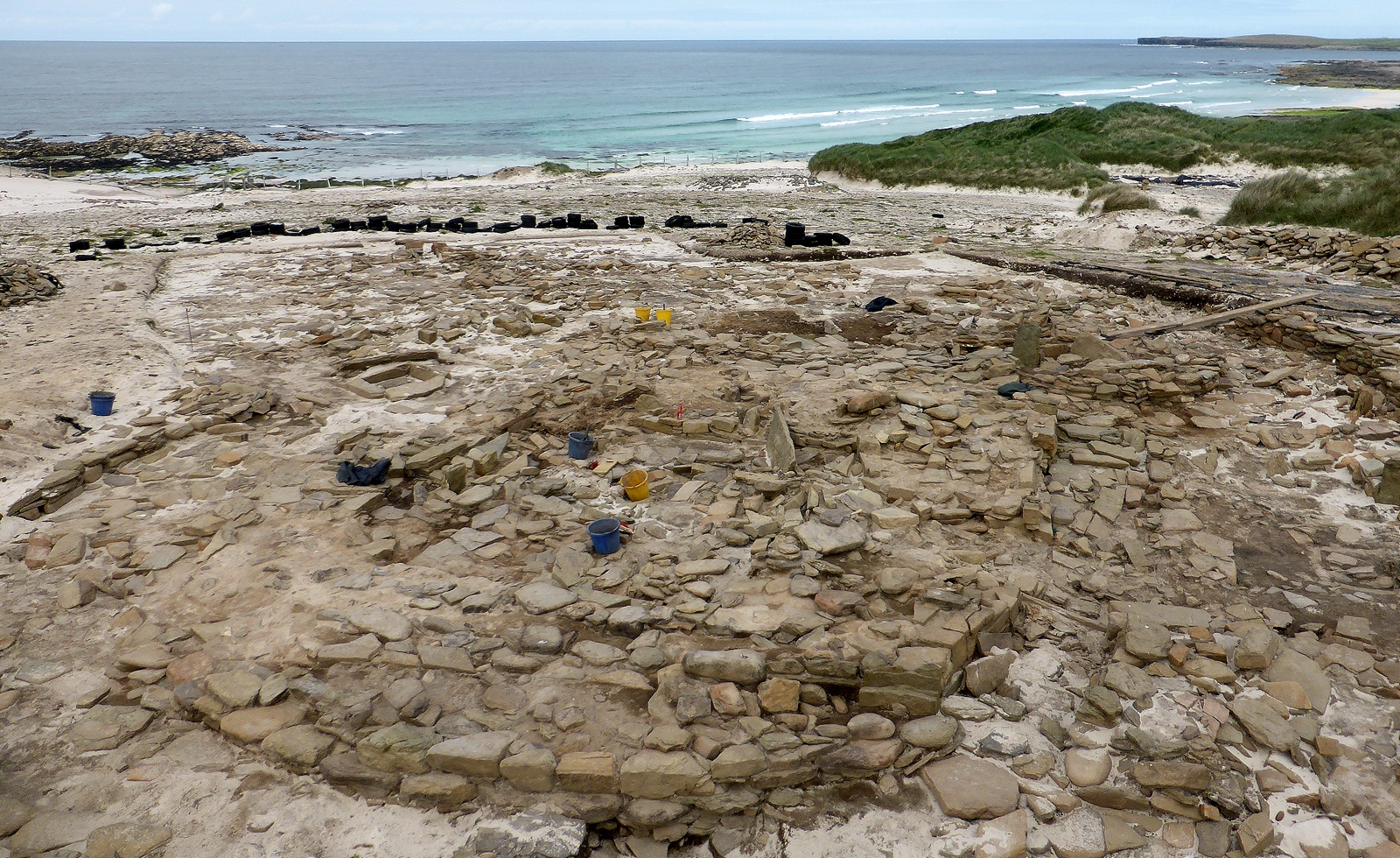
Links Of Noltland Neolithic settlement (Image credit: Sandy Gerrard, CC BY-SA 2.0 <https://creativecommons.org/licenses/by-sa/2.0>, via Wikimedia Commons)
GREY WHALE
According to The Wildlife Trusts, grey whales migrate along the west coast of North America to feed in the northern waters over summer, but they also used to make a similar journey in the Atlantic. It’s speculated that they migrated from breeding grounds between the Bay of Biscay (along the western coast of France) and the Moroccan coast north to the Baltic Sea to feed.
In 2021, the University of the Highlands and Islands Archaeology Institute revealed that analysis of whalebone from Orkney and Shetland had ‘identified the presence of the grey whale at archaeological sites in Scotland for the first time – the first confirmation that seas around Scotland were once part of the species’ range in the eastern North Atlantic.’
One of the Scottish samples came from the excavation at The Cairns in South Ronaldsay in Orkney, where genetic analysis of a large collection of whalebone ‘has provided a window into the complex relationship of Iron Age communities with whales.’ This included a single, large fin whale whose ‘carcase was strategically, and even ceremonially, used and deposited at the closure of the monumental broch’ over 2,000 years ago.
According to an article in the Proceedings of the Society of Antiquaries of Scotland, the data indicates that the grey whale was probably also present in Scottish waters for centuries after the Iron Age.[3]
The Wildlife Trusts note that Devon in southern England ‘claims one of the latest records of this species in the Atlantic, in the year 1610. The Atlantic population quickly plummeted, most likely as a result of hunting, until it was lost completely around 400 years ago.’
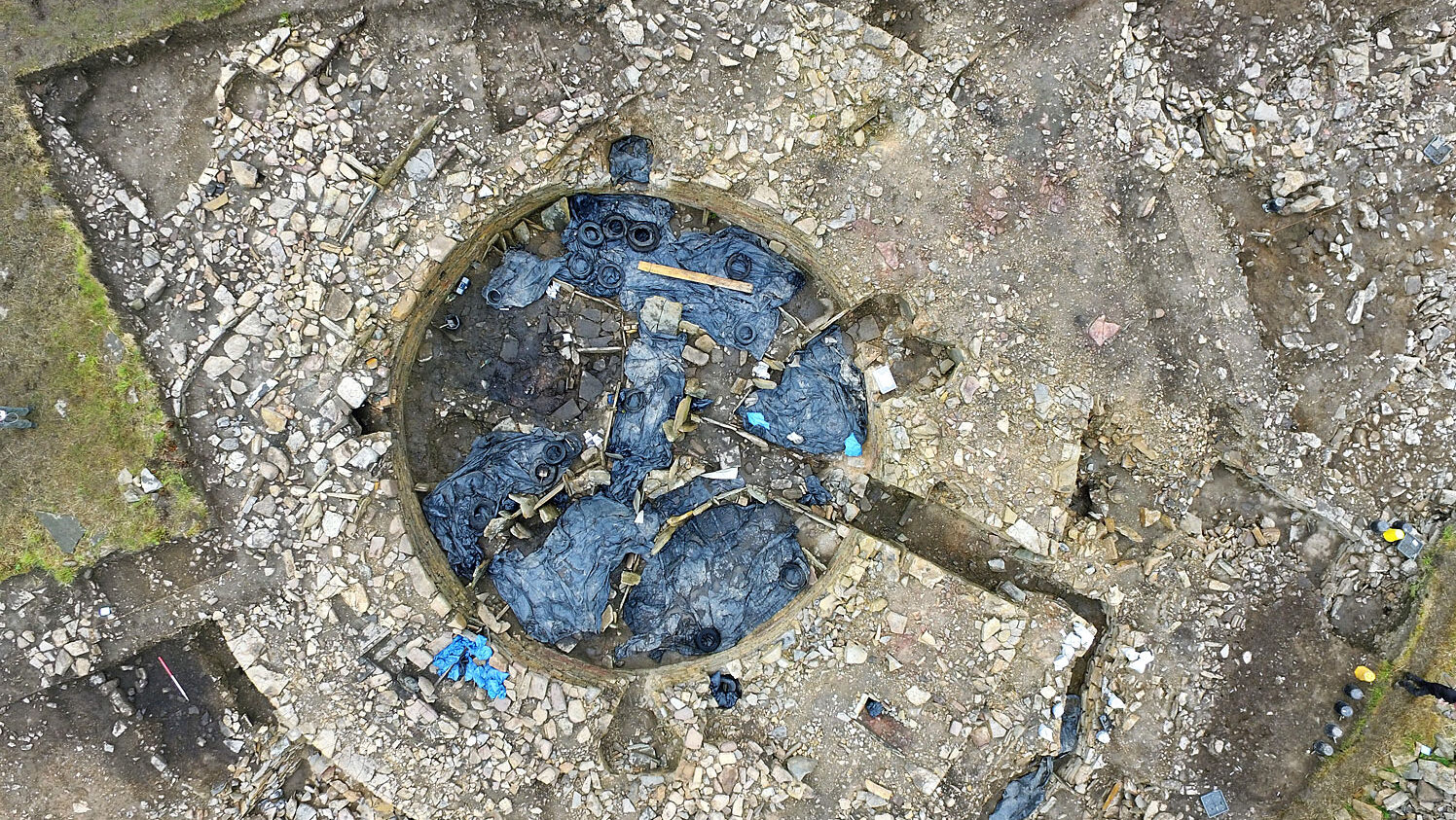
Aerial view of The Cairns (Image © Bobby Friel)
WOLF
According to The Wildlife Trusts, the wolf was a successful predator after the last ice age (over 10,000 years ago). This adaptable carnivore ate ‘deer, aurochs, bison, saiga antelope and other mammals that thrived across the open grassland and woodlands.’
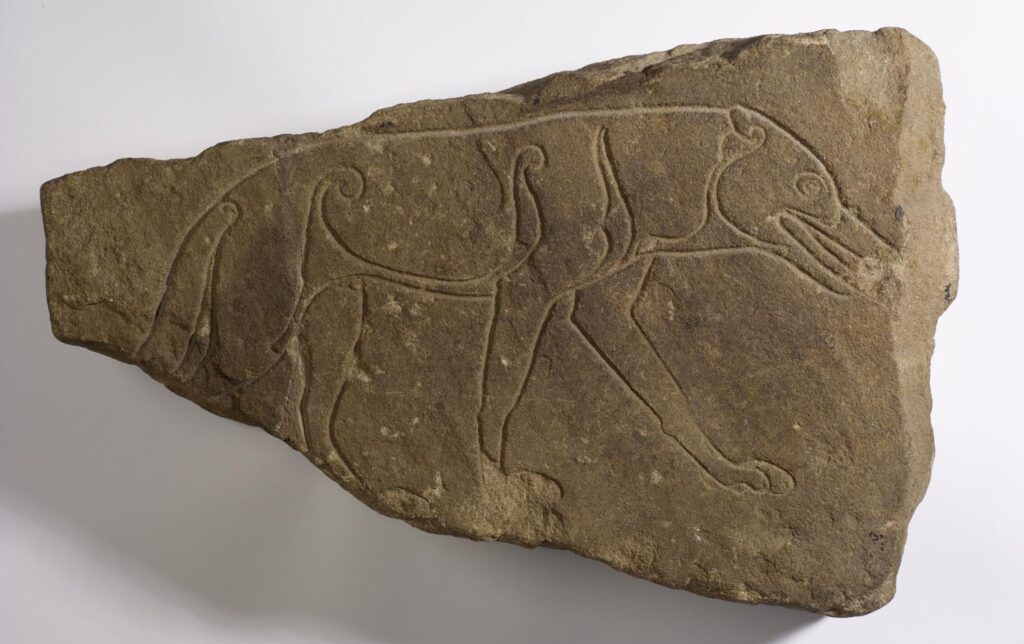
During the medieval period (AD 400 to 1500), it was carved on a handful of Pictish stones. This includes the Ardross Wolf Stone (pictured above), which probably dates from the 6th century (over 1,400 years ago) and can be seen in Inverness Museum and Art Gallery. Palaeontologist Ross Barnett notes the ‘confident lupine stride’, pointed back, lolling tongue, and ‘contrasting underbelly and shoulder stripes’ which led him to believe that ‘whoever carved the Ardross wolf has seen the real thing’.[4]
At Westness in Orkney, a bronze mount decorated with a wolf was found in a grave of a woman and infant dating to AD 850 to AD 900 (over 1,100 years ago), which is now on display in the National Museum of Scotland in Edinburgh.
According to ScARF, evidence of wolves during the medieval period has also been discovered in the Highlands at the monastic site at Portmahomack in Easter Ross[5] and at the famous Eilean Donan Castle.[6]
But despite our close relationship with their canine descendants, ‘wolves were not tolerated’ and they were persecuted to extinction by around 1760 in Britain.
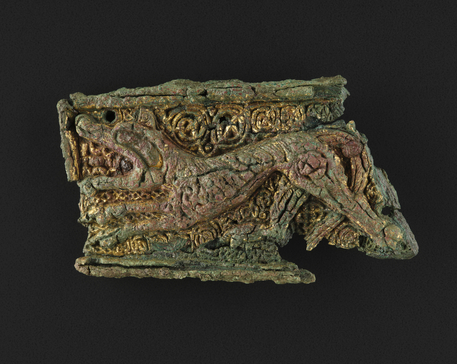
Bronze mount decorated with a wolf (Image © National Museums Scotland)
GREAT AUK
The Wildlife Trusts describe the great auk as a flightless bird which was almost twice the size of the similar-looking razorbill and preferred to live in large colonies at just a few sites.
According to an article in The Glasgow Naturalist[7], excavations in areas such as Orkney and Shetland have recovered numbers of great auk bones. Further south, an upper arm bone from the medieval period (radiocarbon dated to between 1,600 and 1,300 years ago) was uncovered by archaeologists at the Scottish Seabird Centre in East Lothian in 2014.
Interestingly, 30 bones have also been unearthed at the Covesea Caves on the coast of the Moray Firth, where at least three caves appear to have been used for rituals concerning dead bodies at various times between the Early Neolithic (approximately 6,100 years ago) and the Roman Iron Age (approximately 2,000 years ago).
There was a lack of butchery marks, and the birds could have died there due to natural causes, however, the authors of The Glasgow Naturalist article note that it’s possible ‘that the great auk was utilised in ritualistic activity.’
At Broxmouth hillfort in East Lothian, for example, bones from the skull/beak of a great auk were found close to a horse skull, within a pit containing 182 animal bones which appears to have been purposefully placed outside an entrance to the 5,000-year-old hillfort.
A great auk head was also discovered behind the wall of an Iron Age wheelhouse at Cnip on Eilean Leòdhais (the Isle of Lewis), ‘perhaps the most striking ritual deposition of this type’. It’s thought to have been added to the foundation of the building during its construction over 2,000 years ago.
Despite potentially holding some ritual significance, great auk weren’t immune to being hunted for food. According to the article, ‘the inability to fly rendered the Great Auk easy prey, and it was often hunted for its meat and fat’ and ‘as populations dwindled, natural history collectors and museums eagerly hunted these seabirds for display of their eggs and skin’.
The UK’s last great auk was killed in 1840 and the species became globally extinct just four years later.
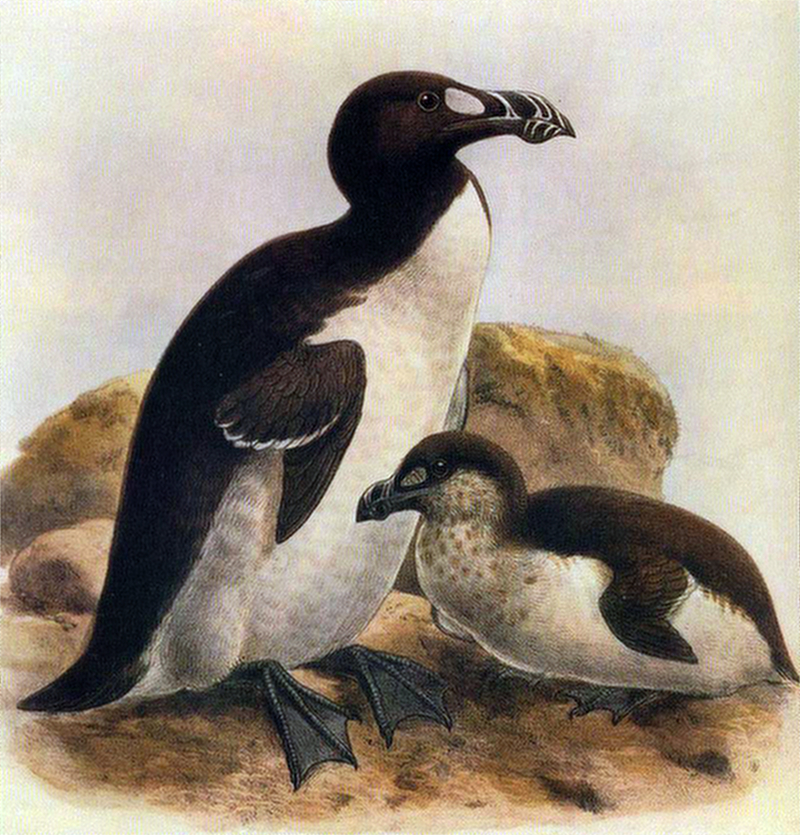
Great auk with juvenile (Image credit: John Gerrard Keulemans, Public domain, via Wikimedia Commons)
Of course, this isn’t an extensive list. First excavated in 1926, the remains of several extinct animals have been found at the cave system of Creag nan Uamh in Sutherland in the Highlands, for example. This includes the lynx, brown bear, wild horse, arctic fox, collared lemming, narrow-skulled vole and the northern vole.
While the situation may feel particularly dire and grim, it should be noted that ‘extinction’ from a particular area doesn’t always have to be permanent. As of this writing, Scotland has seen the reintroduction of beavers[8], with wolves[9] and lynx[10] also being heavily lobbied by rewilding activists for a return.
The debate isn’t clear-cut, with pros and cons to the cultural and ecological impact of reintroducing such large carnivore species into today’s ecosystems.[11] But regardless, the conversations around reintroduction emphasise the impact that humans have on our fellow species, holding the ability not only to push animals to extinction, but also to bring them back.
While the ethical considerations of these abilities continue to be debated, at the very least we should acknowledge the huge responsibility we have to ensure the environment continues to thrive and support the species that currently live alongside our communities.
If you want to keep reading, why not dig into more animals found through archaeology in Scotland?
By Dr Alex Fitzpatrick FSAScot and the Dig It! team. Dr Fitzpatrick is a Zooarchaeologist, Researcher in Heritage, Museums, Diversity & Inclusion, and Science Communicator and Writer. Her PhD was awarded in 2021 from the University of Bradford on analysis of faunal assemblages from the Covesea Caves and she is currently a research associate at the Science Museum’s Dana Research Centre.
Header Image: Ardross Pictish Wolf Stone (Courtesy of Inverness Museum & Art Gallery, High Life Highland)
[1] Kitchener, A.C. & Doune, J. 2012. A record of the aurochs, Bos primigenius, from Morayshire. Glasgow Naturalist (online)
[2] Coles, J, Allo, J, Candow, R, Clegg, T, Cowles, G, Hibbert, F and Wilson, G 1971 ‘The early settlement of Scotland: excavations at Morton, Fife’, Proceedings of the Prehistoric Society 37(2), 284–366. DOI: 10.1017/S0079497X00012688
[3] van den Hurk, Y., & McGrath, K. (2021). Whaling in Iron Age to post-medieval Scotland: a zooarchaeological and biomolecular study of cetacean remains from selected sites in Caithness, the Orkney Islands and the Shetland Islands. Proceedings of the Society of Antiquaries of Scotland, 150, 451–474. https://doi.org/10.9750/PSAS.150.1324
[4] Barnett, Ross 2019 The missing lynx: the past and future of Britain’s lost mammals, Bloomsbury Wildlife: London.
[5] Carver et al 2016 Portmahomack on Tarbat Ness. Changing ideologies in north-east Scotland, sixth to sixteenth century AD, Society of Antiquaries of Scotland: Edinburgh
[6] Clark, J, Garner-Lahire, J I, Spall, C A and Toop N J forthcoming ‘Excavations at Eilean Donan Castle’, Scottish Archaeological Internet Reports
[7] Fitzpatrick, Alex & Bond, Julie & Buster, Lindsey & Armit, Ian. (2020). A brief consideration of the later prehistoric appearance and possible significance of the great auk (Pinguinus impennis) in the Covesea Caves of north-east Scotland. The Glasgow Naturalist. 27. 10.37208/tgn27222.
[8] Campbell-Palmer, R., & Jones, S. (2014). The Scottish Beaver Trial: The story of Britain’s first licensed release into the wild
[9] Nilsen, E. B., Milner-Gulland, E. J., Schofield, L., Mysterud, A., Stenseth, N. C., & Coulson, T. (2007). Wolf reintroduction to Scotland: Public attitudes and consequences for red deer management. Proceedings of the Royal Society B: Biological Sciences, 274, 995–1003. https://doi.org/10.1098/rspb.2006.0369
[10] Bavin, D., MacPherson, J., Crowley, S. L., & McDonald, R. A. (2023). Stakeholder perspectives on the prospect of lynx Lynx lynx reintroduction in Scotland. People and Nature, 5(3), 950–967. https://doi.org/10.1002/pan3.10465
[11] Whitehead, T., & Hare, D. (2025). A shifting baseline theory of debates over potential lynx and wolf reintroductions to Scotland. AMBIO. https://doi.org/10.1007/s13280-025-02186-w
