Four of the Best Archaeological Sites and Discoveries from Medieval Scotland

The medieval period covers a lot of ground, including the appearance of Pictish “kingdoms”, Romans leaving Britain, the first Viking raids, Christianity becoming fully established in most of Scotland, the development of “towns”, increased trade with what is now mainland Europe and more.
So which discoveries and sites from AD 400 to 1500 (1,600 years ago to 500 years ago) help tell this story?
The “Magnificent” Nigg Stone
This Pictish cross-slab in Easter Ross in the Highlands has been described as “the supreme masterpiece of Pictish art” and one of the most elaborate carved stones surviving from early medieval Europe. The carvings and the skill “provide a fascinating glimpse into the world of the Picts”.
It’s believed to have been carved over 1,200 years ago and features a decorated cross on the front and an “extremely complicated” scene on the back which may be an illustration of the Biblical story of how David killed a lion to save a lamb. An eagle above a Pictish Beast, the oldest evidence of a European triangular harp, hunting scenes, serpents, palm trees, a raven, a chalice and “the bowed figures of St Paul and St Anthony” holding books can also be found on the stone.
The design has been compared to famous works from the same period, including free-standing crosses on Ì Chaluim Chille (the Isle of Iona) in Na h-Eileanan a-staigh (the Inner Hebrides) and the Book of Kells illuminated manuscript.
According to Canmore, the stone was “first recorded visually…in the late 18th century but known to have stood in the kirkyard until 1727”. Unfortunately, it was shattered around that time and a small piece was discarded when the upper and lower parts were joined together. Luckily, the missing part (which shows most of the Pictish Beast symbol) was found in 1998 by Niall M Robertson in a nearby stream.
The various pieces are now on display together inside Nigg Old Church in Tain which is part of the Highland Pictish Trail.
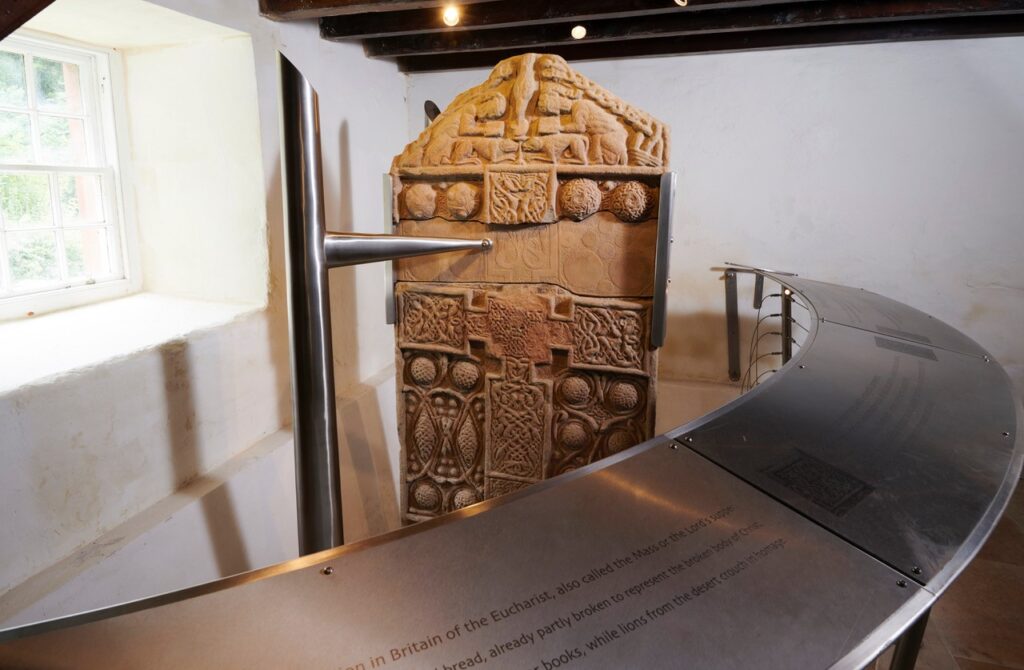
Nigg Stone inside Nigg Old Church (Photo Credit: Ewen Wotherspoon for the Highland Pictish Trail)
The “Heavyweight” Skaill Hoard
Weighing in at over 8 kilograms, the largest Viking Age silver hoard found in Scotland was reportedly discovered in a sandhill at Skaill in Orkney. According to Dr David Griffiths FSAScot, it may have been placed below a structure before it was built as part of a ritual foundation deposit when people were preparing to establish a settlement at the site.
It includes large brooches (such as “iconic” thistle brooches), neck rings, arm rings and bars of silver known as “ingots” which were used to store metal for craftspeople or in economic transactions. It also contains several coins, including Arabic dirhams which were struck at modern-day Baghdad in Iraq in AD 945/6 (over 1,000 years ago).
The Skaill Hoard is also notable for being the earliest hoard which can be dated from coins to contain ‘ring-money’. These plain bracelets could be worn to display wealth, but also used as payment when necessary (which could include cutting them up and weighing them on a balance). Doesn’t sound like a trustworthy system to you? Rest assured. Many of these artefacts have small cuts which were made to test silver purity when it exchanged hands.
If you want a closer look, the hoard is on display in the National Museum of Scotland in Edinburgh.
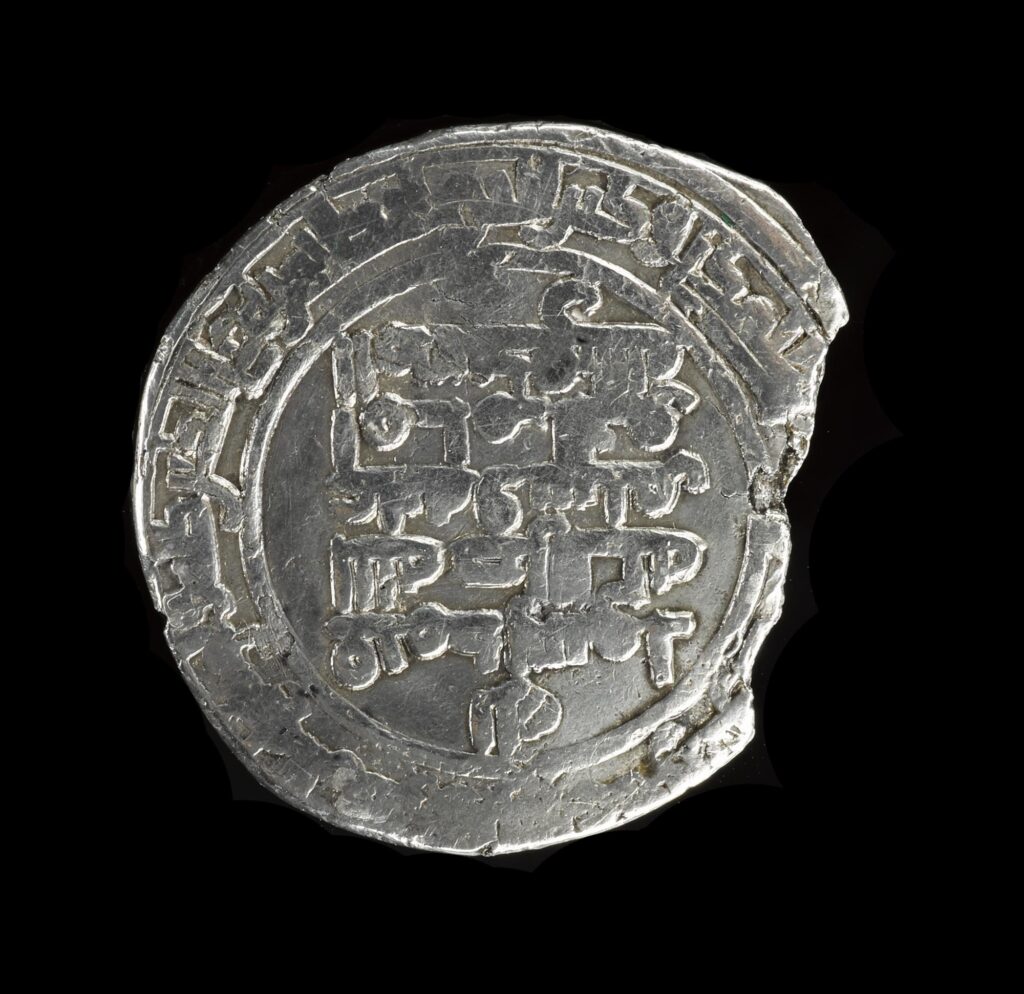
Silver dirham of the time of Al-Mustakfi as Imam al-Haqq, with Abu Hasan Muhammad; Arab (Abbasid), minted at Baghdad, 945 – 946 (334 AH) (© National Museums Scotland)
Three-In-One: Dundonald Castle
This well-preserved late medieval castle was built on top of a prominent hill in South Ayrshire around 1371 and was initially used as a royal residence. In addition to being a high status site, it includes evidence of two other medieval castles.
The first castle was likely to be an earthwork and timber “motte and bailey”-type structure which was developed in the mid-1100s from an earlier hillfort. It was destroyed by fire around 1,000 years ago (AD 1000) which caused the rampart to become vitrified in the intense heat.
A stone castle was then constructed around 1260 but suffered badly during the Wars of Independence with England, including being destroyed by Robert Bruce so it couldn’t be used by his enemies. Some of this castle is still visible, including an area of the west gatehouse and a well.
Third time’s a charm? The huge tower house you can visit today was built around 1371 and includes two feasting halls and a pit prison. The layout is “very much as it was in the later 14th and 15th centuries. There are few royal castles of which this can be said.”
Several archaeological investigations conducted by organisations with the community and volunteers have taken place at the site (including excavations and geophysical survey) to find out more about the castle’s development and occupation over the centuries and more.
Their work unearthed prehistoric artefacts, early medieval pottery (including imported items which indicates that the occupants were part of a trade network that extended from Europe, along the west seaboard) and late medieval coins. To find out more and hear about the latest volunteering opportunities, please visit the Dundonald Castle website.
Dundonald Castle and Visitor Centre is open to the public with visitor access managed by the Friends of Dundonald Castle in partnership with Historic Environment Scotland.
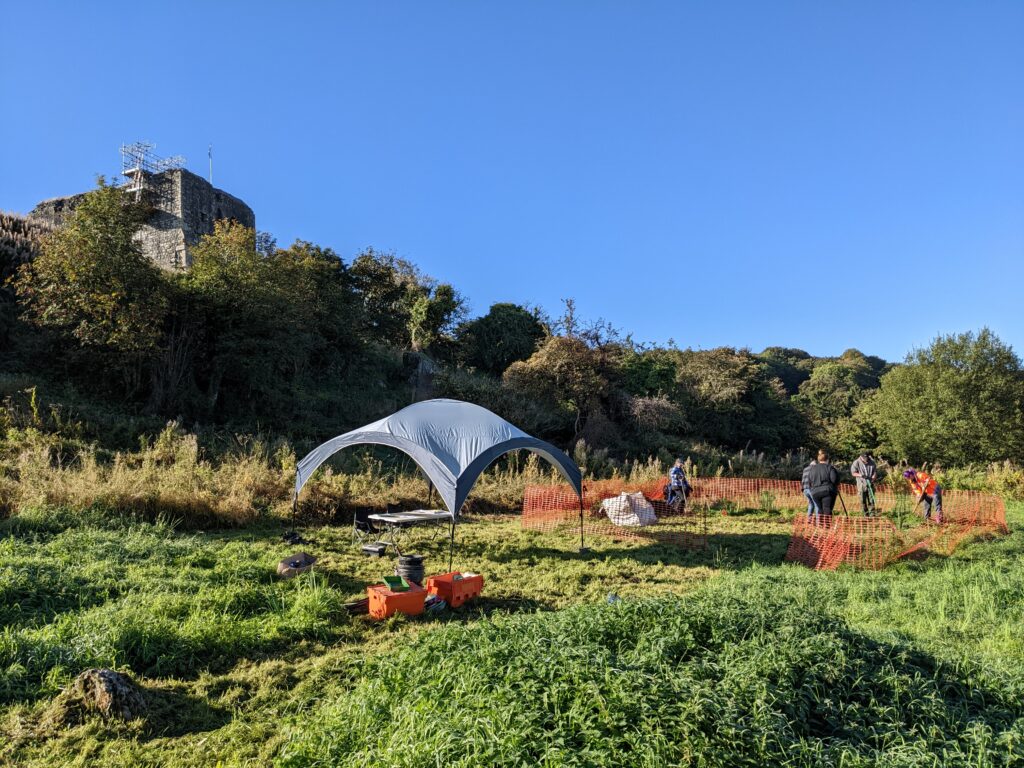
Archaeology at Dundonald Castle (Image Credit: Friends of Dundonald Castle)
Timber and Textiles from Perth High Street
In the 1970s and early 1980s, some of the largest urban medieval excavations ever carried out in Scotland took place in Perth, particularly on the Perth High Street Site in 1975-77. It’s been described as “unparalleled in terms of the depth, quality and quantity of the archaeological deposits revealed”.
Today, archaeology undertaken to offset the impact of construction projects on our historic environment is known as developer-led archaeology. However, this process didn’t exist in the 1970s and pre-development excavation was dependent on the developer (in this case, Marks & Spencer).
They were very generous with the time they allowed which was lucky because it turned out that the site stretched from the 11th to 14th century and included an early town ditch and traces of industrial activity associated with tanning, metalworking and leather and bone-working crafts. Archaeologists also found houses made of wattle and daub (interwoven sticks filled in with a ceramic-straw mixture), the remains of up to 27 timber buildings and a more elaborate hall-house made of stone and timber.
They also uncovered “the most significant collections of wool and silk textiles and leather to have been excavated from a Scottish burgh” (towns/cities given royal approval through a charter). It was a remarkable discovery, as these materials break down quickly and rarely survive on archaeological sites.
These excavations are particularly important as archaeologists uncovered evidence left behind by people who weren’t privileged by status or wealth. In other words, “the debris of daily life”. Many of the finds, such as barrels and window glass, show how Scotland’s earliest towns developed.
A large selection of the objects from the High Street and other city centre sites will be on display when the new Perth Museum opens in Spring 2024.
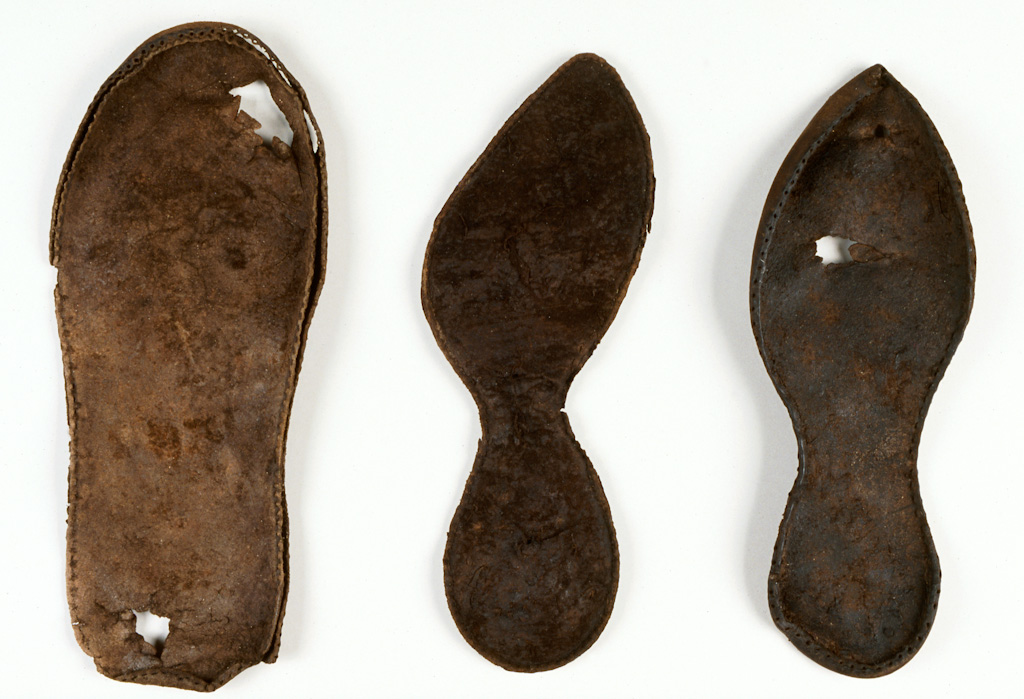
Selection of shoe types from Perth High Street (Image Credit: Perth Museum, Culture Perth & Kinross)
Want to keep exploring Scotland’s medieval period? Other notable sites and artefacts include the Lewis chesspieces, Govan Stones, Sueno’s Stone, Galloway Hoard and the artisan workshops found at Portmahomack.
Header Image Credit: Friends of Dundonald Castle
