Homicide, Fantasy and Historical Fiction: Seven Times Scottish Archaeology Was Written into Books
Some of Scotland’s most famous sites and finds have inspired or made cameos in best-selling novels – although the body count is a bit disturbing.
Mousa Broch
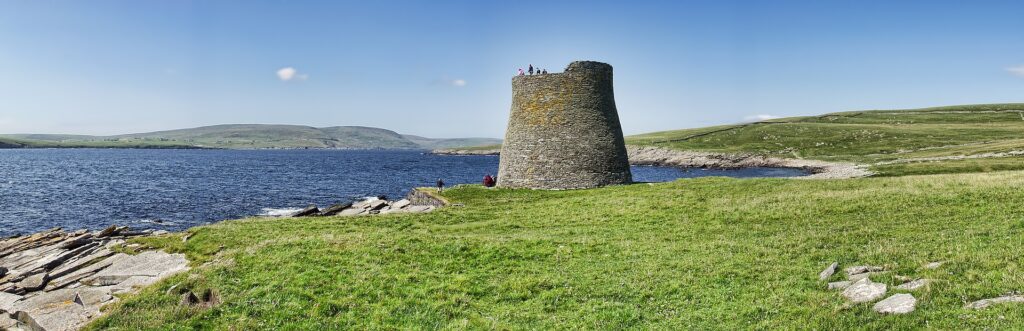
In Black and Blue, the eighth instalment of the Inspector Rebus novels series by Ian Rankin, the protagonist heads to Shetland while chasing clues and ends up visiting Mousa Broch (pictured above).
This 2,300-year-old, 13m tall tower is Scotland’s best-preserved broch (a kind of Iron Age roundhouse) which Rebus describes as looking like “some gigantic sandcastle or upturned flower-pot” before calling it “an extraordinary place”.
Rankin wrote it from a guidebook, but later visited the site and said he “was fascinated by the civilisation and the stuff they were building away back in the Iron Age.”
Wemyss Caves
In a small, former coal-mining village in Fife, you’ll find a group of coastal caves with abstract symbols and animals on the walls which were inscribed around 1,500 years ago. These carvings are widely thought to represent the highest concentration of Pictish cave carvings in Britain.
Wemyss Caves have captivated the imagination of visitors for decades – the carvings were first recorded in the 1860s – and they seem to have done the same to McDermid, who has said that she used to play there as a child.
In her psychological thriller, A Darker Domain, the protagonist (a detective) is called in when archaeology students on a field trip find a body in the caves. Her photograph of the entrance to Well Cave even featured on the original cover. In 2019, she also included them in My Scotland, which “takes readers to the landscapes she has known all her life, and the places where her stories and characters reside.”

The Wemyss Caves, Dovecot Cave cc-by-sa/2.0 – © Kevin Rae – geograph.org.uk/p/125507
Lewis chess pieces
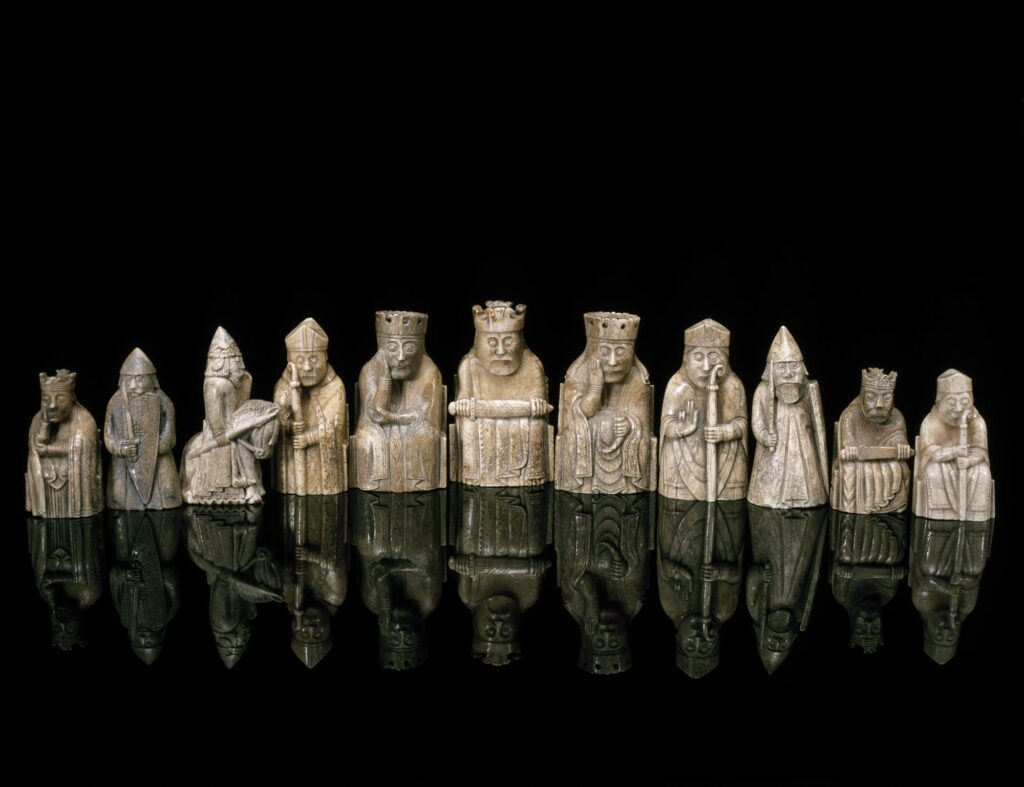
The Lewis chess pieces are possibly the most well-known archaeological find from Scotland, so it’s no surprise that they’ve featured in a few novels.
The elaborate gaming sets are made from walrus ivory and whales’ teeth and were probably produced around 700 years ago in Norway. It’s possible that they belonged to a merchant who buried them for safe keeping while travelling to Ireland but never returned to collect them. They were eventually found on a beach on Eilean Leòdhais (the Isle of Lewis) in 1831.
These curious figures are central to the storyline of Peter May’s The Chessmen, the final chapter in the Lewis trilogy. While investigating illegal game-hunting, the protagonist meets someone who has sculpted “minutely-accurate” replicas, which end up playing a pivotal role in solving a murder.
Want to take a look at the real ones? They’re on display in Lews Castle in Eilean Leòdhais and the National Museum of Scotland in Edinburgh.
By National Museums Scotland – National Museums Scotland, CC BY-SA 4.0, https://commons.wikimedia.org/w/index.php?curid=83115741
Gunnister Man
In Raven Black, the first crime novel in Ann Cleeves’ Shetland series, a young murder victim’s body is discovered preserved in peat years after she was killed and “a veil of suspicion and fear is thrown over the entire community” as the police try to find the culprit.
It’s possible that she was inspired by Shetland’s Gunnister Man, who was found by two men who were cutting peats in the north mainland of Shetland in 1951. The style of his clothing and coins found in his purse – which were incredibly well-preserved – dates his death to around 1700. How did he die? According to Shetland Museum & Archives, “murder cannot be ruled out”.
You can learn more about the Gunnister man in Shetland at Tangwick Haa Museum and Shetland Museum & Archives or the National Museum of Scotland.
Clava Cairns
This list wouldn’t be complete with a reference to the series which has made such an impact in Scotland that there’s a name for it: the “Outlander Effect”.
In Outlander by Diana Gabaldon, the protagonist touches one of the standing stones on the hill of Craigh na Dun on Samhain, a Gaelic festival marking the end of the harvest season, and travels through time to 18th-century Scotland. She soon she meets a “dashing Highland warrior” and gets caught up in the Jacobite Rising.
Craig na Dun might not be real, but many believe that the standing stones at Clava Cairns near Inverness in the Highlands provided the inspiration.
They’re part of a large complex which include 4,000 year-old-structures (cairns) built to house the dead surrounded by a ring of standing stones. According to Historic Environment Scotland, the landscape was an important place for ritual and burial activities in the Bronze Age.
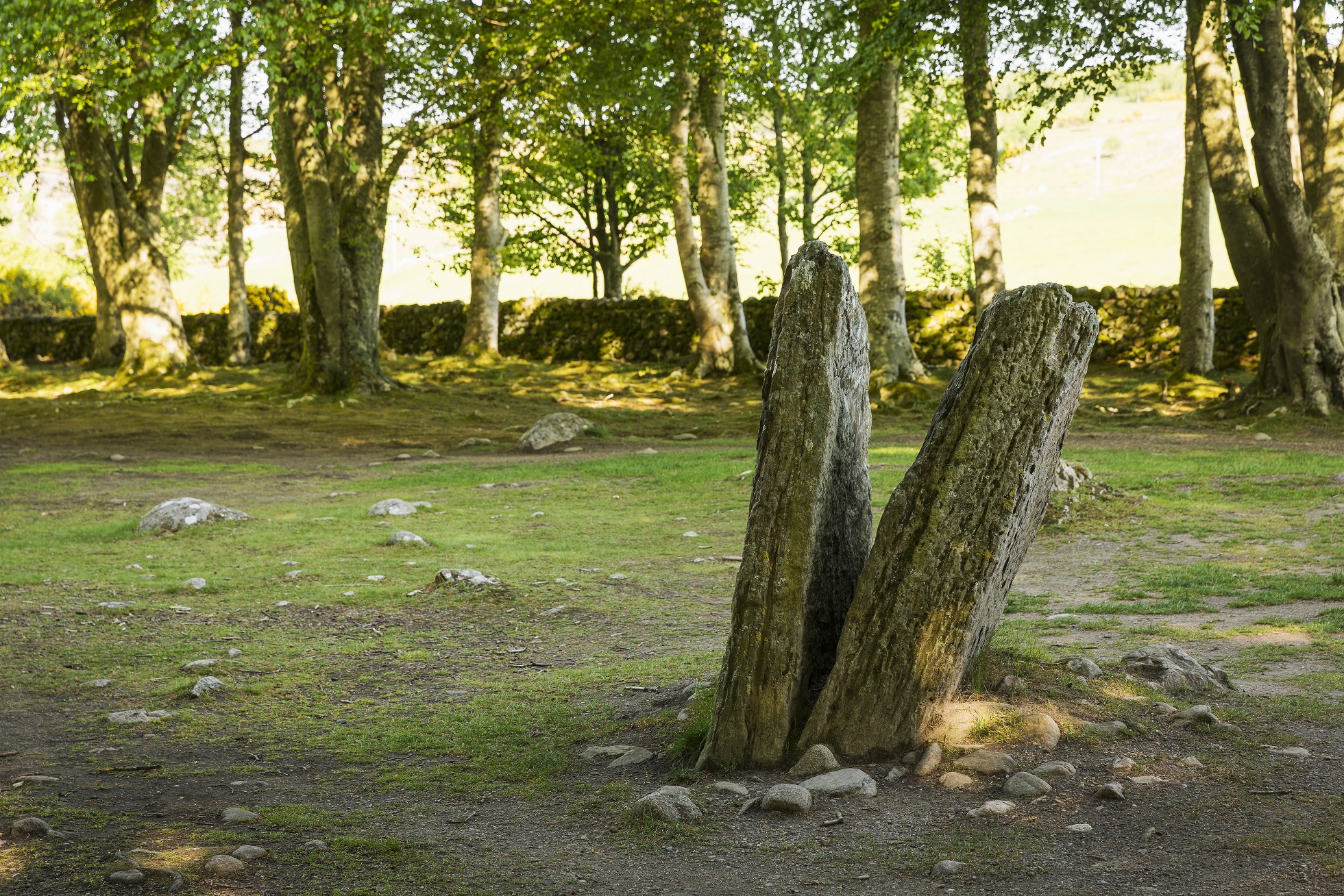
Clava Cairns or the Prehistoric Burial Cairns of Bulnuaran of Clava are a group of three Bronze Age cairns located near Inverness on Culloden Moor (Credit: VisitScotland / Kenny Lam)
Ballachulish Figure
In Iain Malone’s historical thriller, Silma Hill, a “pagan icon” is pulled from the peat beneath Silma Hill, which is crowned with a circle of ancient standing stones.
The figure is then handed over to an unpopular minister who lives nearby with his young daughter, Fiona. The minister plans to write a paper on it for the Historical Antiquities Society (possibly inspired by the Society of Antiquaries of Scotland – who coordinate Dig It!) until the person who discovered the figure is found dead and Fiona is accused of witchcraft.
Although it wasn’t found near standing stones, Maloney maybe have been inspired by the mysterious Ballachulish figure (on display in the National Museum of Scotland).
The 2,500-year-old wooden sculpture of a female was found lying face down under deep peat in 1880 near Loch Leven. Its quartzite pebble eyes would have overlooked the dangerous straits linking the loch with the sea and it’s been suggested that it might have “represented the goddess of the straits, to whom prehistoric travellers would need to make an offering if they wanted to be sure of a safe crossing.”
Antonine Wall
In A Song of Ice and Fire, George RR Martin’s epic fantasy series, a 700-foot wall of ice separates the realm from “savage” Wildings and terrifying ice creatures while people squabble over the Iron Throne (the monarchy) further south.
Hadrian’s Wall in England may have inspired Martin, but some have argued that it sounds more like the Antonine Wall, the more extreme frontier built across Scotland’s Central Belt. Constructed by the Romans over 1,800 years ago, this turf fortification marked the north-west frontier of their empire.
According to David C. Weinczok, author of The History Behind Game of Thrones, the Antonine Wall even mirrors the ice wall’s course, with both fortifications running straight as an arrow from their centre to the east but twisting and turning around natural obstacles to the west.
Weinczok’s also pointed out that the peoples beyond the Antonine Wall, the Caledonians, were described by Tacitus (a historian of the Roman Empire) as having “massive limbs and red-gold hair” – which describes one of the most famous Wildlings, Tormund Giantsbane.

Looking West along the remains of the The Antonine Wall built by the Romans in AD 140. A mile walk from the Falkirk Wheel at Rough Castle, Bonnybridge in Falkirk (Image Copyright: VisitScotland / Kenny Lam)
Bonus: Bloody Scotland
If that’s not enough, Historic Environment Scotland teamed up with the Bloody Scotland festival to publish its first ever fiction book in 2017. The series of short stories were written by some of Scotland’s best crime writers which feature real sites including an 18th-century mill, abandoned modernist ruin and more.
If you think we’ve missed anything from this list, let us know on Twitter or Facebook.
