Six Women in Scottish Archaeology You Need to Know

Women have played a key role in Scottish archaeology for centuries, but many of their achievements and contributions to the discipline remain underappreciated, obscured, or lost in the archive.
From the first female professional archaeologist in the country to a 21st-century activist, these are just some of Scotland’s most pioneering women.
MARGARET TUSHINGHAM: A GLOBETROTTING DIGGER
A Fellow of the Society of Antiquaries of Scotland, Margaret was born in Dysart, Fife. At a young age her family relocated to Canada where she was later hired by the Royal Ontario Museum (ROM), for whom she worked on several excavations in North America.
Through the American School and then the British School of Archaeology, she and her husband Doug excavated many sites throughout the Middle East including Dhiban in Trans-Jordan, Jerusalem in Jordan, and Jericho (where she sported an enviable brogues, checked socks and trousers combo). During the 1950s and 1960s, she worked alongside her husband (who would later become Chief Archaeologist at the Royal Ontario Museum) as an on-site Registrar and Cataloguer of finds.
For the next few decades they travelled the world for the ROM, covering many of their excavations, and working on their exhibitions, including the presentation of a unique plastered skull (from the Jericho excavations) dating from 8000 BC. They were invited to catalogue the Crown Jewels of Iran by the last Shah prior to the Iranian revolution, for which they were awarded gold medals. Margaret died in Ontario in 2016.
It seems that for her whole life Margaret was completely immersed in archaeology. Her own mother was an archaeologist, she married an archaeologist, and Margaret herself passed this interest onto her own daughter, Margot.

Margaret (left) with Dorothy Marshall recording in Jericho (Image Credit: Reproduced with permission from Margot Tushingham)
CAROLINE WICKHAM-JONES: 45 YEARS IN THE FIELD
Caroline Wickham-Jones HonFSAScot began her long, accomplished career in archaeology by studying at the University of Edinburgh. She then managed the daily running of the Artefact Research Unit at the National Museum of Antiquities of Scotland (now the National Museums Scotland Collections Department) from 1977 to 1988.
Throughout this time, Caroline participated in various pieces of groundbreaking research. She was particularly fascinated with the relationship between people and the land throughout her life and even joined an experimental archaeology team living according to the prehistoric hunter/fisher/gatherer lifestyle in Lapland in Finland.
In 1984, she directed her first major project: the excavation of a Mesolithic site at Kinloch, Rùm (Isle of Rhum) in na h-Eileanan a-staigh (the Inner Hebrides). Caroline’s work produced the earliest radiocarbon dates for Mesolithic settlement at the time, which reinvigorated interest in Scotland’s Mesolithic past in the 1990s. She then published her findings in her book Rhum: Mesolithic and Later Sites at Kinloch, Excavations 1984-86 (1990) which is now available online as a free open access e-book.
After completing a master’s degree in Heritage Management at the University of Birmingham, Caroline became the Executive Secretary of the Society of Antiquaries of Scotland, where she later became an Honorary Fellow.
In 2002, Caroline moved to Orkney where she was intimately involved in developing the detailed research agenda for the Neolithic Orkney World Heritage Site.
Caroline was committed to sharing and communicating her ever-increasing knowledge of archaeology, by lecturing at the University of Edinburgh and then the University of Aberdeen, where she helped organise legendary field trips to Orkney.
Before she passed away in 2022, Caroline had built up an impressive publication record with 11 books, 28 book chapters and 53 journal articles. Her accomplished career of 45 years in the field was driven by her passionate belief that archaeology mattered. As she wrote in her blog: ‘Archaeology will enrich your life. Whatever you do…’
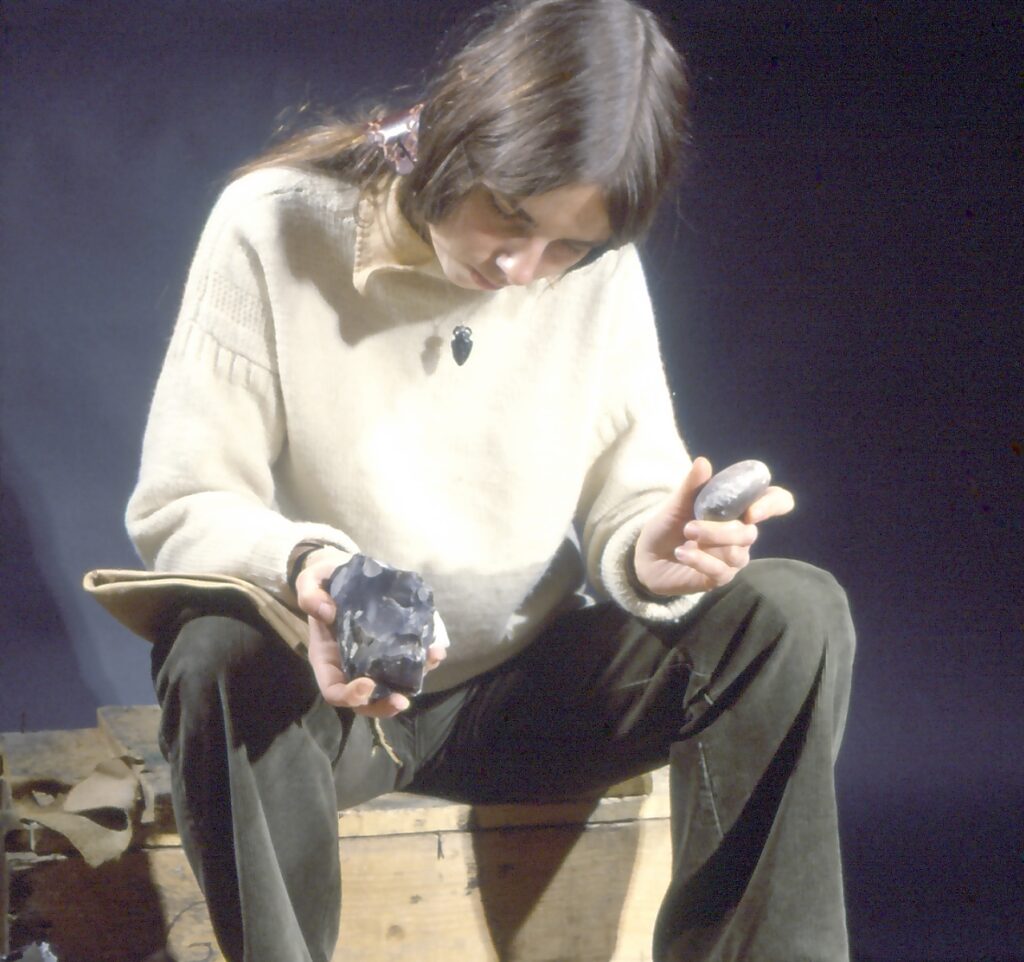
Caroline in the 1970’s (Credit: Caroline Wickham Jones, 1978)
ABEER ELADANY: ARCHAEOLOGIST AND ACTIVIST
Dr Abeer Eladany FSAScot is an archaeologist whose research interests include human remains, the History of Egyptology, and Museology, particularly Ethics and Repatriation. A graduate of Cairo University and Helwan University in Egypt, she worked at the Egyptian Museum in the capital for more than 10 years before travelling to Italy to study conservation of ceramics in Florence.
She then joined the KNH Centre, University of Manchester, to study Biomedical and Forensic Studies in Egyptology where she achieved an MSc and PhD. In 2015, she gained an MLitt in Museum Studies from the University of Aberdeen. In her current role as a curatorial assistant at the University of Aberdeen’s Museums and Special Collections, she promotes wider access to the museum collections.
Abeer is a Fellow of the Society of Antiquaries of Scotland, and an active volunteer and trustee with a wide range of charities ranging from community projects, locality planning, and heritage groups in the UK. She is also a member of the Slavery, Empire and Scotland’s Museums Steering Group which has published its recommendations following a large public consultation regarding how Scotland’s existing and future museum collections and spaces can better recognise and represent a more accurate portrayal of the country’s colonial and slavery history.
Abeer has joined many archaeological excavations in Egypt and in Scotland, particularly in Aberdeenshire where she’s helped uncover (note: some links contain images of human remains): a medieval parish church at the East Kirk of St Nicholas; masonry potentially relating an earlier Franciscan Friary or early College structures at Marischal College Quad; human remains dating back to the 13th century at Robert Gordon College; a Neolithic site in Aden Country Park; the site of a lost 1,500-year-old monastery at Deer Abbey; and the old grammar school at King’s College (see Discovery and Excavation in Scotland 2017, pp 9-10). In 2018, she also took part in excavations at the world-famous Neolithic complex at the Ness of Brodgar in Orkney.
Abeer is also a supporter of Mesolithic Deeside, a group of archaeologists, students and local volunteers investigating the history of the river Dee area 10,000 years ago. She joins them on their fieldwalking events, supports their public engagement activities and curates their temporary exhibitions.
She’s one of Scotland’s most exciting archaeologists and museum professionals, whose work is valued across the sector. As an activist, Abeer advocates for the importance of diverse representation in museums and highlights ongoing efforts to address systemic inequalities in UK heritage and beyond. She continues to contribute to the broader discussions about representation, equity, and inclusion within museums, archaeological and cultural institutions.

Abeer at work in Aberdeenshire (© Ali Cameron)
MARGARET SIMPSON: THE FIRST FEMALE PROFESSIONAL ARCHAEOLOGIST IN SCOTLAND
Born in 1906, Margaret studied archaeology at the University of Edinburgh under Professor Gordon Childe FSAScot. In 1929, she worked on the excavation of a chambered cairn (tomb) at Kindrochat in Perthshire, by examining a megalithic (large stone) chamber. According to Childe, Margaret produced ‘an excellent plan with elevations,’ which you can see in Vol 64 (1930) of the Proceedings of the Society of Antiquaries of Scotland.[1]
After graduating in 1930, Margaret’s career progressed rapidly. From 1929-30, she was the first secretary of the Edinburgh League of Prehistorians. She was also elected a Fellow of the Society of Antiquaries of Scotland in 1930, following in her great-great-uncle, Sir James Young Simpson’s footsteps.
Following a social media appeal in March 2019, Margaret was identified in photographs of Childe’s 1927-1930 excavation of Skara Brae in Orkney. Previously dismissed as a visitor or tourist (despite their dusty shoes and the trowel in Margaret’s hand), she is now recognised as having participated in the dig, alongside Margaret Mitchell, Mary Kennedy, and Margaret Cole, showing women were active in archaeological investigation in the early 20th century.
In 1930, Margaret became the Assistant Inspector of Ancient Monuments, which involved preserving and protecting monuments throughout Scotland. In doing so, Margaret appears to have been the first of Childe’s students to obtain permanent employment in archaeology, making her the first female professional archaeologist in Scotland.
Margaret also used her communication skills to work on some of the first guidebooks for Scottish archaeological sites, in collaboration with James Richardson. These include Stirling and Balvenie Castles (1936) and Inchmahome Priory (1936) with Richardson, and Dunkeld Cathedral (1935), as a sole author. Margaret passed away in 1994, leaving behind a pioneering legacy for other women in Scottish archaeology.
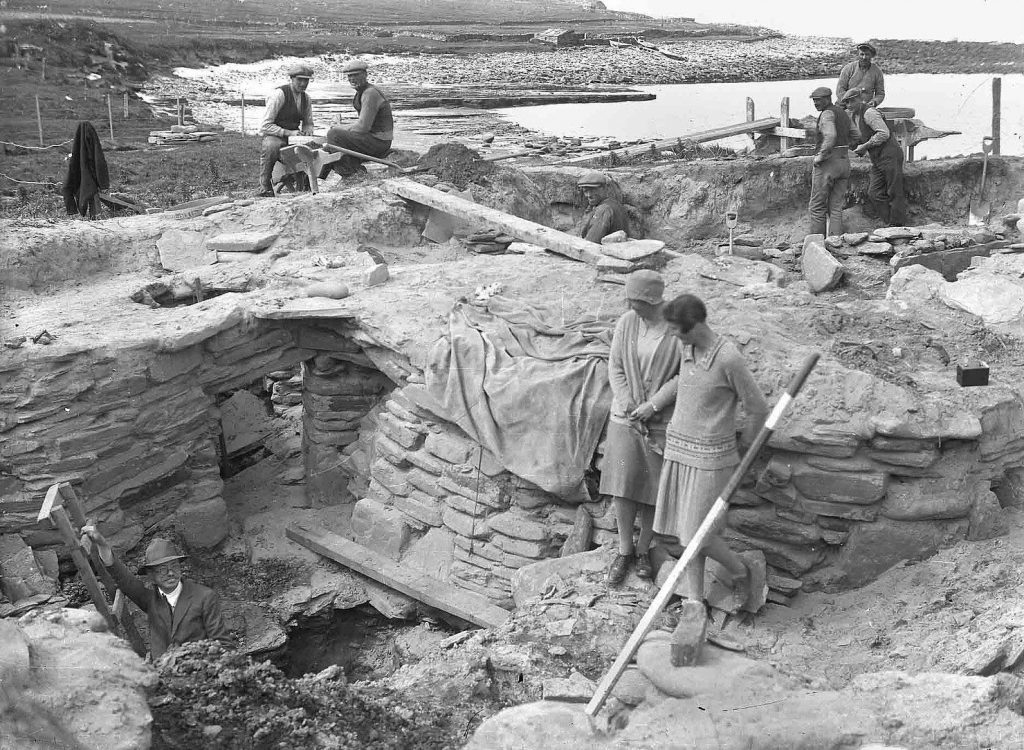
Margaret Simpson and Kathleen Kennedy with Prof Gordon Childe at Skara Brae (Image Credit: Reproduced with permission from Orkney Library and Archive)
MAYA HOOLE: MAKING INTERNATIONAL HEADLINES
Maya Hoole FSAScot is an archaeological researcher with an interest in prehistory, specifically on the Scottish Neolithic, Chalcolithic (or Copper Age) and Early Bronze Age. She graduated from the University of Edinburgh in 2011 with an undergraduate degree in Archaeology and completed her MSc by Research there in 2013.
While early into her career, Maya employed her archaeological skills to manage The Achavanich Beaker Burial project. Launched in 2014, the project re-examined, investigated, and published the finds of a Bronze Age cist burial in Caithness in the Highlands, which had been excavated in 1987.
A range of exciting scientific techniques were used to understand the skeleton (nicknamed ‘Ava’), including ancient DNA and isotope analyses, as well as radiocarbon dating, which helped forensic artist Hew Morrison create a digital facial reconstruction of ‘Ava.’
The project’s ground-breaking research went viral in 2018, making headlines across the world, which spread Maya’s incredible research to new audiences in Scotland and beyond.
Maya also contributed her skills as a Research Assistant to Scotland’s Rock Art project from 2018-2019 and has recorded over 300 rock art panels across Scotland, from the Highlands to Dumfries and Galloway.
Maya now works for Historic Environment Scotland as a Heritage Data Project Manager and is especially keen to continue working with and engaging community groups in archaeology and exploring Scotland’s past.
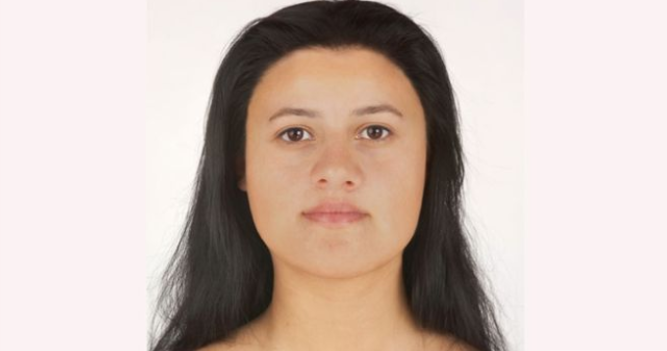
DNA analysis showed that Ava would have had black hair, brown eyes and tanned skin (Credit: Ava Beaker Burial)
MARION CAMPBELL: ARCHAEOLOGIST AND AUTHOR
Born in 1919, Marion Campbell HonFSAScot lived most of her life in Argyll and Bute. Her desire to understand how former generations lived in her homeland led her to undertake research of national importance.
Between 1954 and 1963, Marion and her childhood friend Mary Sandeman worked tirelessly together to complete a field survey of Mid Argyll. The survey noted the location of objects and sites which warranted further research, ranging from standing stones to forts. This survey featured in Vol 95 (1964) of Proceedings of the Society of Antiquaries of Scotland and paved the way for later archaeological studies of Mid Argyll.
In 1955, Marion founded the Natural History of Antiquarian Society of Mid Argyll, dedicated to celebrating and sharing the local history of the region. In 1971, she became the founding editor of the Society’s magazine, The Kist, and made more than 40 contributions. Marion also became an Honorary Fellow of the Society of Antiquaries of Scotland in 1988.
Marion was an enthusiastic advocate for museums in Argyll. She promoted the conversion of Auchindrain Township into an open-air museum, which opened in 1968. In the 1990’s, she donated her personal collection of artefacts to form the founding collection of Kilmartin House, a museum which showcases the archaeological and natural history of Kilmartin Glen, where Marion focused her work.
Marion also expressed her love for Argyll and archaeology through her writing. Expanding upon her field survey report, she published a popular booklet, Mid Argyll: A Handbook of History. In 1977, she published Argyll: The Enduring Heartland, which details Argyll’s history and her connection to the region through poetry, and personal essays. She was also a novelist and set her debut fictional work, The Dark Twin in Bronze Age Scotland.
Marion passed away in 2000 but her legacy lives on. In 2014, Marion’s formidable work ethic and interesting life even became subject of a modern play, The Air that Carries Weight by Rebecca Sharp.
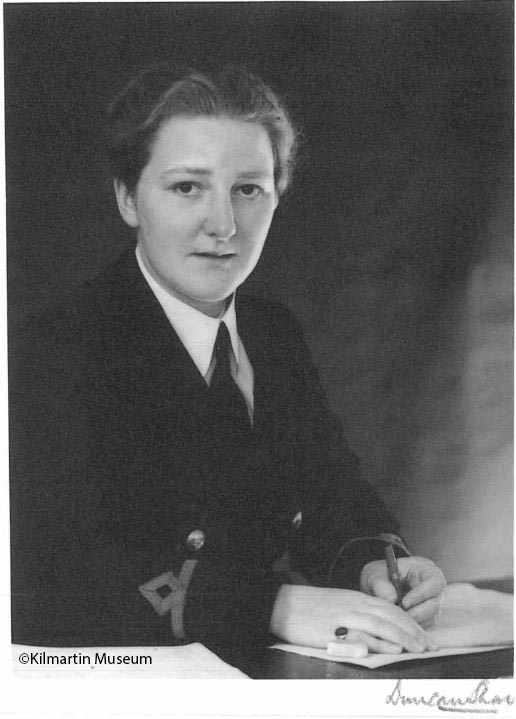
Marion in the Wrens in 1942 (Image Credit: © Kilmartin Museum)
If you would like to keep reading, check out these Dig It! articles written by Caroline, Abeer, and Maya.
BY SALLY PENTECOST FSAScot, DIG IT! COMMUNICATIONS AND EVENTS OFFICER AND AMY JO KEARTON, UNDERGRADUATE HISTORY STUDENT AT THE UNIVERSITY OF GLASGOW.
Featured Image Credit: Caroline Wickham-Jones
Tweet
[1] David J. Breeze, Rosalind K. Marshall, and Ian Ralston, ‘Marguerite Wood and Margaret Simpson, Two Pioneering Scottish Women,’ Scottish Archaeological Journal, 41st Series, 1 2019, p.112.
