Top Six Archaeological Sites and Discoveries in Ayrshire

Perhaps best known as the birthplace of Scottish poet Robert Burns, the histories of people living in North, East and South Ayrshire go back thousands of years.
Ballochmyle cup and ring marks
While cup and ring marks are found on natural outcrops and boulders all over Scotland, these spectacular patterns near Mauchline in East Ayrshire are particularly remarkable because they were carved over three vertical panels on a cliff face, forming one of the most extensive areas of rock art ever found in Britain.
They were first recorded in 1986, when they were uncovered by Kingencleugh Estate workers who were clearing vegetation in the area. According to J. B Stevenson FSAScot, the carvings are made up of several hundred cup and ring motifs in a range of styles, from simple shallow cups through to deeper cups with multiple rings, as well unusual ‘square cups’ and ‘ringed stars’.
Cup and ring marks typically date to the Bronze Age (2500 BC to 800 BC or 4,500 to 2,800 years ago) but three deer-like carvings and some other inscriptions also carved into the rockface are thought to be medieval in date, a period which began much later (around 1,600 years ago).
In their free online resource A Song in Stone, Forestry and Land Scotland consider how the rock art may have been experienced by the people who made and used it:
“One suggestion is that the rock art might have formed part of a communal performance that involved sound, light, and activity. The experiences and activities associated with producing the rock art may have been as important to people as the symbols themselves. We can perhaps think about rock art as a focus for social gatherings that may have taken place at certain times of year or in response to certain events.”
Archaeologist Lizzie Robertson explored how Ballochmyle may have looked at one of these events through an illustration which captures the site in the firelight. Here the rock art appears not just as static carvings, but animated symbols.
The site can still be visited today, but if you can’t get there, AOC Archaeology Group carried out a survey of laser scanning and photogrammetry on the marks in 2015 (funded by Forestry and Land Scotland), resulting in a 3D model which you can view online.
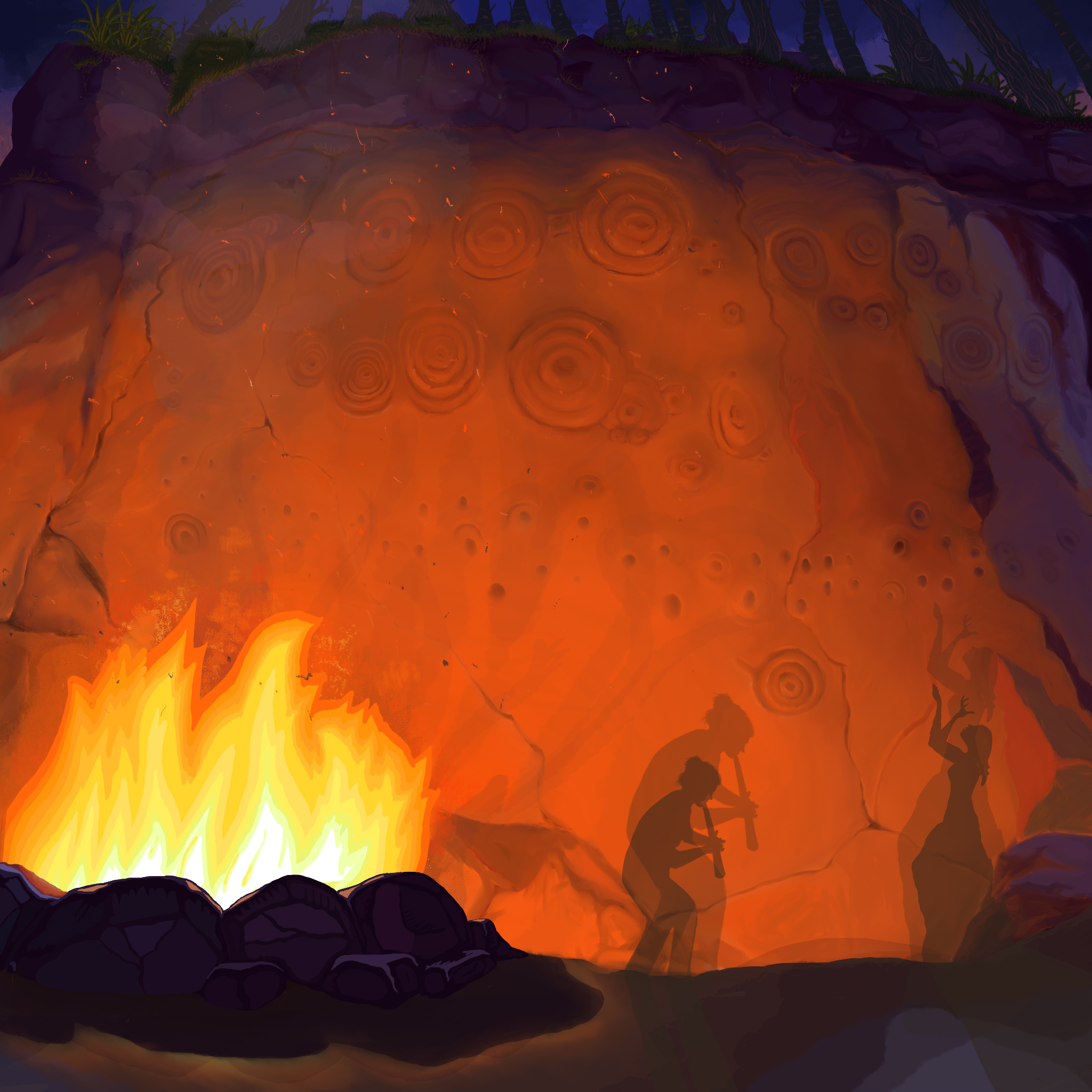
An interpretation of how people may have interacted with the Ballochmyle rock art in the Bronze Age (© Lizzie Robertson)
Lochlea Crannog
A wealth of artefacts have been discovered at the site of this water dwelling, including a unique horse bridle bit which can tell us more about horsemanship in the Iron Age.
The crannog is found on a small loch near Tarbolton in South Ayrshire and was excavated in 1878 as part of a project led by Dr. Robert Munro, a medical doctor and Fellow of the Society of Antiquaries of Scotland (who coordinate Dig It!).
The crannog would’ve been around 40ft in diameter and four hearths (fireplaces) were found inside – one on top of the other – showing that people used the site over multiple periods of time. This theory is supported by the many unique artefacts found at the crannog, with objects dating from the Bronze Age, Iron Age (800 BC to AD 400 or 2,800 years ago to 1,600 years ago), and even later.
Perhaps the most curious of these is an “utterly unique” horse bridle bit which, according to Dr Rena Maguire FSAScot’s article in the Proceedings of the Society of Antiquaries of Scotland, “appears to show a fusion of traditional local Iron Age technology with Continental early medieval styling, specifically the influence of Frankish horsemanship and equipment.”
The Franks were a Germanic-speaking people who invaded the Western Roman Empire in the 5th century AD and dominated present-day northern France, Belgium, and western Germany. According to Dr Maguire, this artefact can tell us more about Scotland’s connections to early medieval Francia (the kingdom of the Franks which gave its name to modern-day France).
Dr Maguire explains, “the Franks had very specific styles of how they made things, like all cultures, and the bits they made had that strange figure of eight link for the reins. This probably gave them extra leverage in controlling a horse.”
“The Lochlea bit could well have been created locally…[as] an interpretation of a Frankish bit traded from southern Britain.” She goes on to suggest that “the bit may represent a desire to ride out in something resembling the equipment of the charismatic Frankish ruling class, in the hope that the rider or driver may be imbued with status or fortune”.
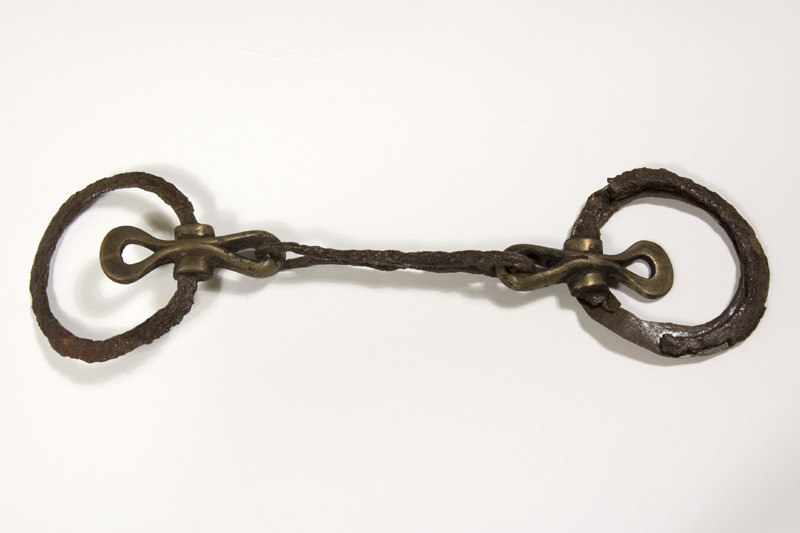
Lochlea crannog bit (© East Ayrshire Council)
Girvan’s Roman Brooch
In 2020, GUARD Archaeology Ltd. unearthed an “unusual” and “visually striking” Roman enamelled plate brooch during excavations in advance of development at Girvan Distillery in South Ayrshire.
The brooch is a rare type for Scotland and is thought to have come from Continental Europe during the later 2nd century AD (around 1,800 to 1,900 years ago), most likely with the Roman army.
While the brooch itself is fascinating, where it was found makes it even more intriguing. It was buried at the base of a timber palisade (stakes used as a fence or wall) which enclosed an Iron Age roundhouse. But there were no Roman forts nearby at the time the dwelling was built.
Archaeologists from GUARD believe the brooch could shine a light on the way people in Iron Age Scotland interacted with Roman soldiers around the time the Empire was losing its grip on the south of the country.
Jordan Barbour FSAScot of GUARD Archaeology has suggested that the brooch may have fallen into the hands of the roundhouse’s residents, not through a trading network, but “through ad hoc exchange with Roman troops operating north of Hadrian’s Wall, perhaps even taken in battle as a trophy”.
He continues, “if the inhabitants had established regular trade with Roman Britain, we might expect to find a greater variety of Roman objects, but this was the only Roman artefact found at this site, and it was recovered from a solidly native context.”
Dr Fraser Hunter FSAScot, Principal Curator of Prehistoric and Roman Archaeology at National Museums Scotland, believes that items like this brooch were often used in forging political links and building relations between the Roman occupying forces and the local population.
The excavation report states how the brooch may have been a prized possession of the wealthy local farming family who likely occupied the roundhouse. Dr Hunter has also noted how such brooches could’ve easily fitted into local traditions of displaying status or other identities through jewellery.
He also suggests that the brooch may have then been placed in the foundations of the fortified roundhouse as a sacrifice during its construction to grant protection to the household (see p.43).
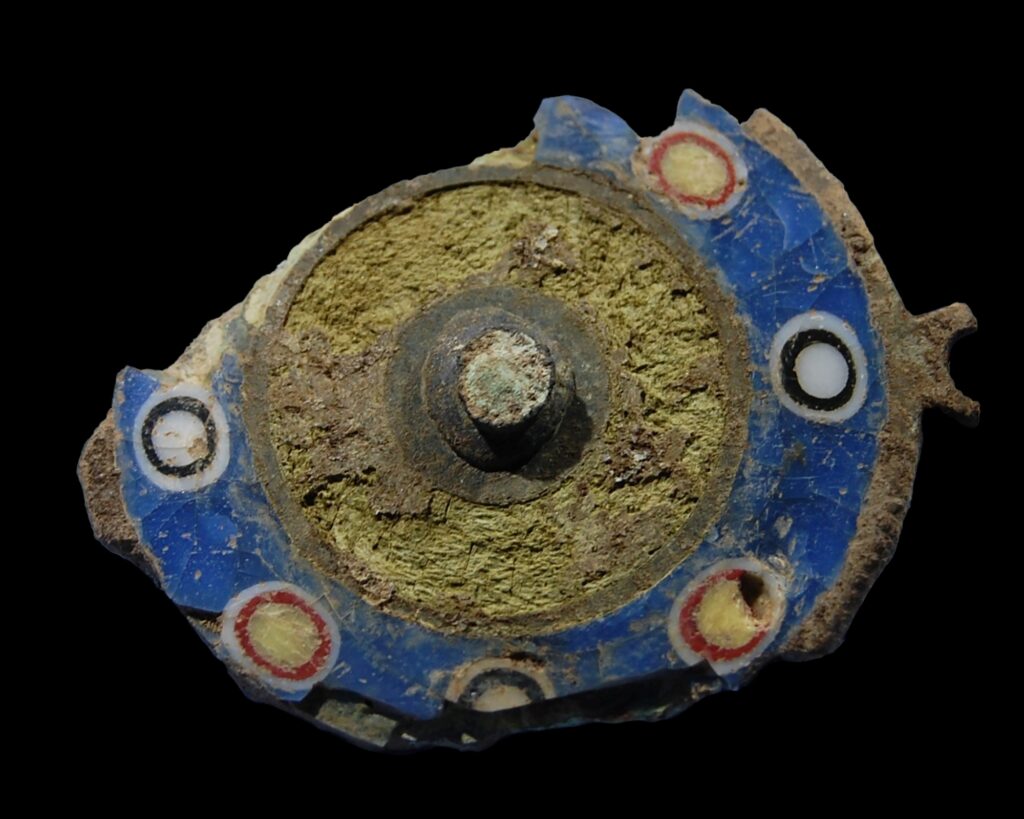
Girvan Brooch (© GUARD Archaeology Ltd.)
Inscribed Slates from Kilwinning Abbey
The ruins that you can visit at Kilwinning Abbey in North Ayrshire today date from the late 1100s, but it’s thought that there has been a church on the site since the AD 700s.
From 2010 to 2012, the Kilwinning Community Archaeology Project led by Dr Tom Rees FSAScot of Rathmell Archaeology uncovered a large quantity of artefacts during their excavation in the grounds of the abbey. This included 12 slate fragments – one found by an 8-year-old volunteer – which had been incised (marked or decorated with cuts).
Two of these slates bear gothic lettering, perhaps made by medieval abbey monks in training. Two other slates are incised with unfinished sketches of “beasts”, possibly intended to be lions. Mark Hall FSAScot, Collections Officer at Perth Museum & Art Gallery, believes these may have been copied from manuscript art, again perhaps by someone undergoing religious training at the abbey.
But the majority of the slates were inscribed with gaming boards. Three games appear to be represented among 10 of the slates: alquerque, daldos and merels. According to Mark, the boards were likely “temporary objects used for entertainment; the use of spare building material suggests that they may have been produced by masons and other workers.”
“Merelles boards are the most common type found in Scotland and are thought to date from between the 11th and 16th century. They were used for a counter-based game, typically played with nine counters (or men) per player giving it the more common name of ‘Nine Men’s Morris’”.
This collection of slates show that this material was used by different groups of people connected to the abbey in the late medieval period, both for the purpose of education, and for entertainment – just like how we might play games today.
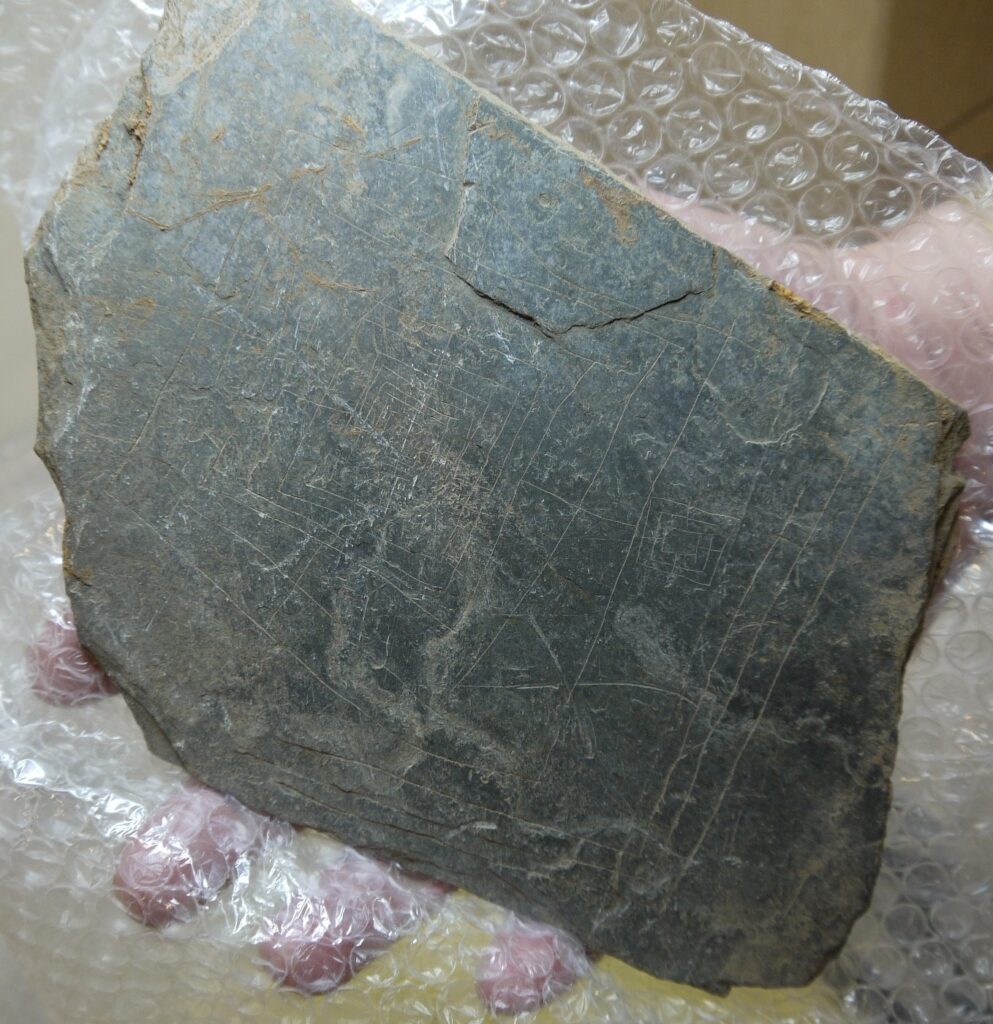
One of the medieval gaming boards from Kilwinning Abbey (Credit: Mark Hall, Curator at Perth Museum)
Medieval Ring from Dundonald Castle
In 2019, a late medieval gold ring was found in a very unusual manner within the grounds of Dundonald Castle in South Ayrshire. Picked up by chance from the top of a molehill, it’s thought that the artefact was brought to the surface through the mole’s digging activities – making it a keen excavator!
The ring was reported to Treasure Trove Unit, the system for ensuring that artefacts of archaeological and historical significance are preserved in public collections for the nation to learn from and enjoy. After being processed, it was added to Scotland’s national collection which is cared for by National Museums Scotland.
The ring contains a purple amethyst-like stone inset and features an engraved floral decoration on the shoulders of the hoop. Experts at Treasure Trove Unit say that “the style of the bezel and decoration on the shoulders indicates that the likely date for this finger ring is c.16th century”, around 500 years ago.
Dr Georgia Vullinghs, National Museums Scotland’s Curator of Renaissance and Early Modern History, said: “the stone may have been believed to hold protective qualities for the wearer” and “this is certainly an elite object. The ring likely belonged to one of the residents of the castle, or a visitor, during the 16th century.”
If you’ve been inspired by the mole, the Friends of Dundonald Castle host community excavations to uncover more about the hill’s fascinating and long-stretching history.
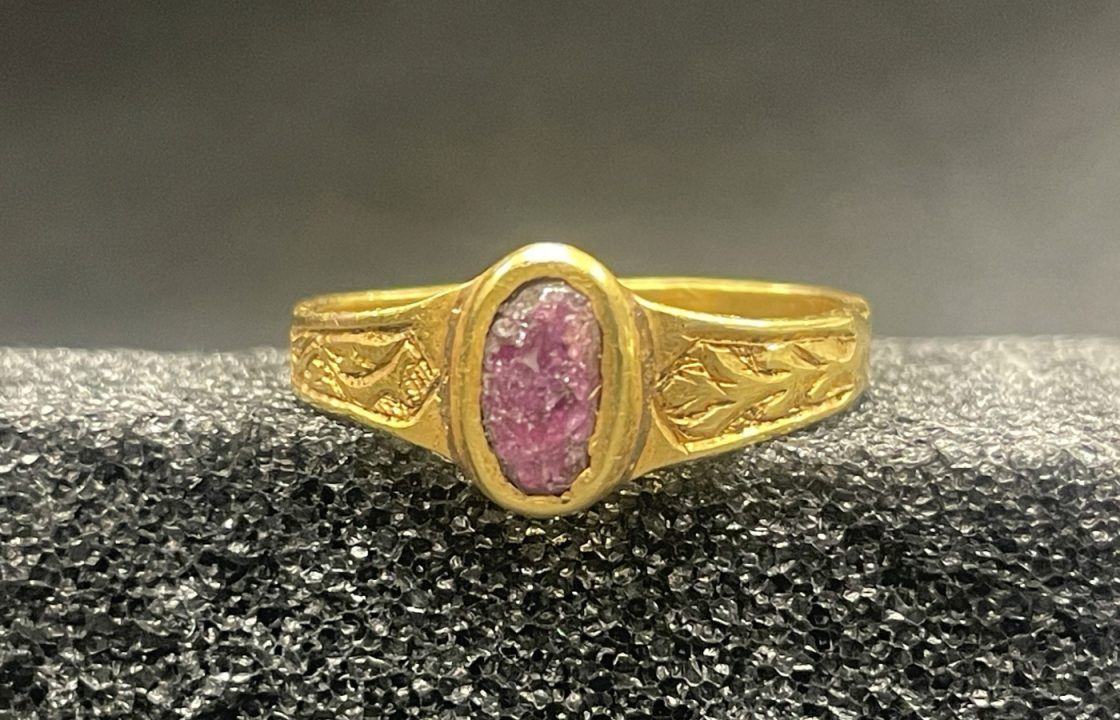
Dundonald Ring (© National Museum Scotland)
Culzean Castle Caves
You may be familiar with the grand 18th-century house on the South Ayrshire coast known as Culzean Castle, which is cared for by the National Trust for Scotland (NTS), but did you know that there are caves lying beneath the castle which have been used for millennia?
Culzean Coves are made up of the remains of two cave systems, the Main Cavern System located below the castle and the Stables Caves System located beneath the stable block. Each consists of three main caverns.
These caves have been awarded scheduled monument status as they represent the earliest surviving visible components of Castle Coif, which dates back to the 12th century AD (over 800 years ago) and was the predecessor of Culzean Castle. Though in Stable Cave, archaeologists have also uncovered radiocarbon-dated evidence of human activity from even earlier, in the Iron Age (over 1,600 years ago).
What’s more, Derek Alexander FSAScot, Head of Archaeology at NTS, has said: “There are many tales associated with the caves, which include ghosts, smugglers and hiding fugitives.”
According to NTS: “Smuggling was big business in Ayrshire in the 17th and 18th centuries… A stairway probably linked the caves to the original castle kitchen above, and they were probably used as storage cellars well before the smuggling boom, [but] for several decades in the 1700s, these caves were a smugglers’ lair, a discreet hiding place for illicitly imported wine, port, rum, brandy, tea, silks and other goods.”
In 2018, archaeologists and volunteers uncovered the remains of a medieval doorway leading into Stable Cave and an iron strip which may have been part of the door hinge or fittings. The team also found modern pottery, glass and some 18th-century wine bottles, all of which speak to the caves’ connections with Culzean’s smuggling past.
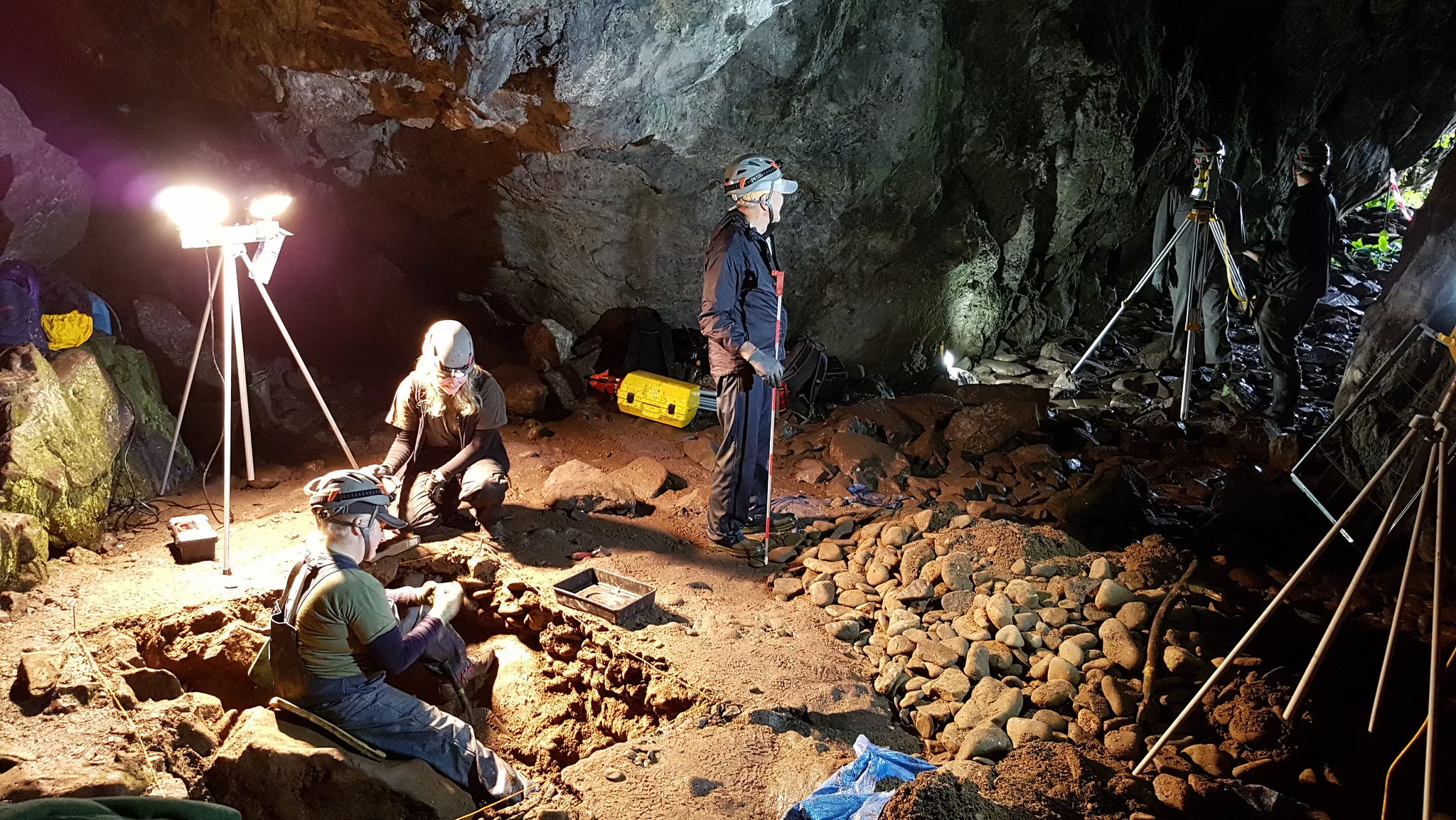
Excavations at Culzean Caves (© National Trust for Scotland)
Want to uncover more regional archaeology? Check out our Discover articles on nearby South Lanarkshire and Inverclyde.
Header Image: Ballochmyle Panel 1 (© Forestry and Land Scotland by AOC Archaeology Group)
